Oosto
Oosto (formerly AnyVision) is a leading Vision AI platform specializing in real-time facial recognition and video analytics for …
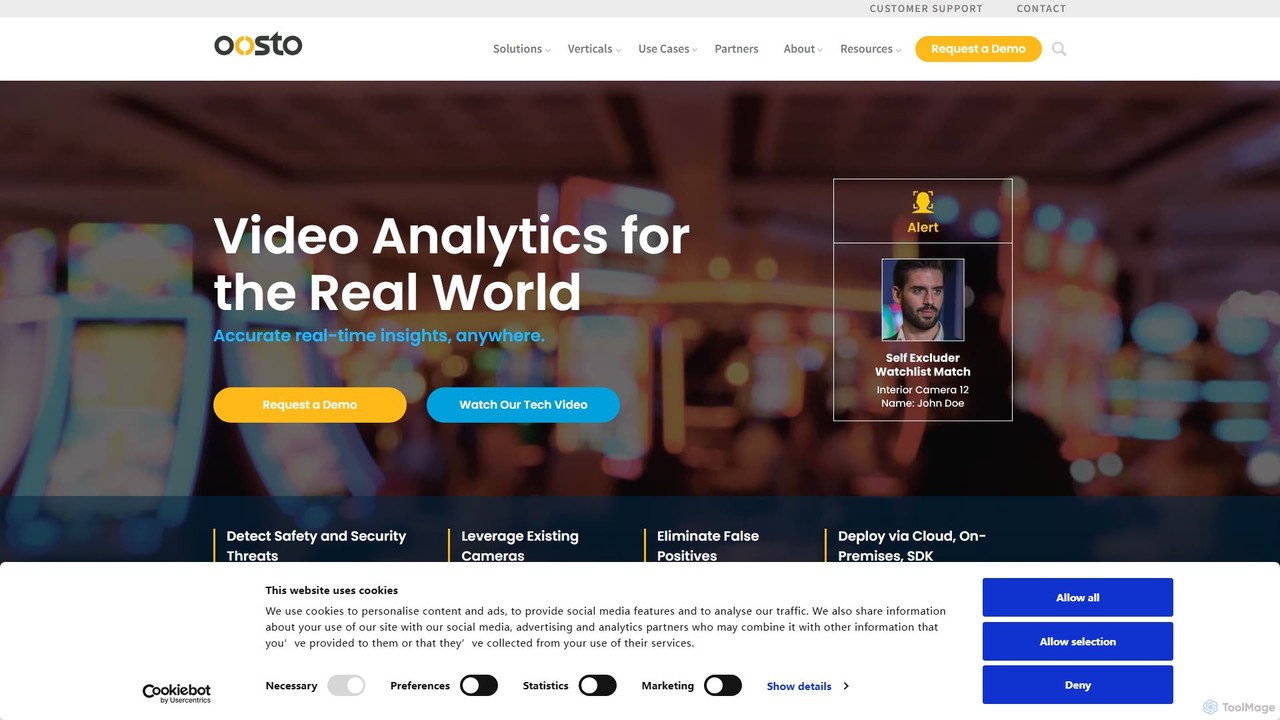
Oosto (formerly AnyVision) is a leading Vision AI platform specializing in real-time facial recognition and video analytics for enterprise security. It enhances physical security by identifying persons of interest, automating access control, and providing actionable operational intelligence from existing video streams.
About Vision Ai
Vision AI tools are a specialized category of AI that enables machines to interpret and understand visual information from images and videos. These tools leverage deep learning models, such as Convolutional Neural Networks (CNNs), to analyze visual data at a granular level. They empower applications to recognize objects, identify people, read text, and comprehend complex scenes, transforming raw pixels into actionable insights. As a core component of the AI Infrastructure, Vision AI provides the essential building blocks for developing intelligent systems that can see and interact with the physical world.
Core Features
- Object Detection: Identifies and locates multiple objects within an image or video frame.
- Image Classification: Assigns a specific category or label to an entire image based on its content.
- Optical Character Recognition (OCR): Extracts printed or handwritten text from images and documents.
- Facial Recognition: Detects, analyzes, and verifies human faces for identification or attribute analysis.
- Image Segmentation: Partitions an image into pixel-level segments to isolate specific objects or areas.
Use Cases
Vision AI is widely adopted across various industries. In manufacturing, it automates quality control by detecting product defects on assembly lines. Retailers use it for automated inventory management and in-store analytics. In healthcare, it assists in analyzing medical images like X-rays and MRIs to identify anomalies. It is also the foundational technology for autonomous vehicles and advanced surveillance systems.
How to Choose
When selecting a Vision AI tool, consider the specific task requirements, such as the required accuracy and processing speed (latency). Evaluate the range of pre-trained models available and the ease of fine-tuning them with your own data. Assess the integration options, including API availability and SDK support. Finally, analyze the pricing model—whether it's based on API calls, processing time, or a subscription—to ensure it aligns with your budget and usage scale.

Vision AiUse Cases
Automated Quality Control in Manufacturing
A quality assurance manager on a manufacturing line uses a Vision AI system to automate defect detection. Cameras positioned along the assembly line capture high-resolution images of each product. The Vision AI model, trained to identify imperfections like scratches, cracks, or misalignments, analyzes these images in real-time. When a defect is detected, the system automatically flags the item and diverts it for review or removal. This process significantly increases inspection speed and accuracy compared to manual checks, reducing waste and ensuring higher product quality.
Automated Data Extraction from Documents
An accounts payable clerk uses a Vision AI tool with Optical Character Recognition (OCR) to streamline invoice processing. Instead of manually entering data, the clerk uploads scanned invoices or PDFs to the system. The AI automatically identifies and extracts key information such as invoice number, vendor name, date, and line-item details. The extracted data is then validated and populated directly into the accounting software. This automation eliminates tedious data entry, reduces human error, and accelerates the entire payment cycle, allowing the team to focus on more strategic tasks.
Retail Shelf Monitoring and Inventory Analysis
A retail store manager implements a Vision AI system to monitor shelf availability in real-time. Cameras installed in the aisles continuously capture images of the shelves. The AI analyzes these images to detect out-of-stock items, misplaced products, and incorrect price tags. When an issue is identified, an alert is sent to a store associate's mobile device with the exact location and problem description. This allows for rapid restocking and correction, improving the customer shopping experience and preventing lost sales due to empty shelves.
Assisting Medical Diagnosis with Image Analysis
A radiologist uses a Vision AI-powered software to assist in the analysis of medical scans like MRIs or CT scans. The AI model, trained on a vast dataset of annotated medical images, can quickly highlight potential anomalies, such as tumors or fractures, that may be subtle or difficult for the human eye to detect. The software provides a 'second opinion' by flagging regions of interest for the radiologist's review. This doesn't replace the expert's judgment but acts as a powerful tool to enhance diagnostic accuracy, reduce review time, and prioritize critical cases.
Enhancing Security with Smart Surveillance
A security operations center for a large corporate campus uses a Vision AI-powered surveillance system. Instead of security personnel manually monitoring hundreds of camera feeds, the AI system analyzes the video streams in real-time. It can automatically detect unauthorized access in restricted areas, identify specific individuals on a watchlist, recognize abandoned objects, and flag unusual crowd behavior. When a potential threat is detected, the system sends an immediate alert to security staff with relevant video clips, enabling a faster and more effective response.
Powering Autonomous Vehicle Perception
An automotive engineer working on an Advanced Driver-Assistance System (ADAS) integrates Vision AI APIs to process real-time data from the vehicle's cameras. The system uses object detection to identify and track pedestrians, cyclists, other vehicles, and traffic signs. Lane detection algorithms help keep the vehicle centered in its lane. By fusing this visual data with information from other sensors like radar and LiDAR, the system can make critical decisions for features like adaptive cruise control, automatic emergency braking, and lane-keeping assist, forming the foundation for autonomous driving.