CometAPI
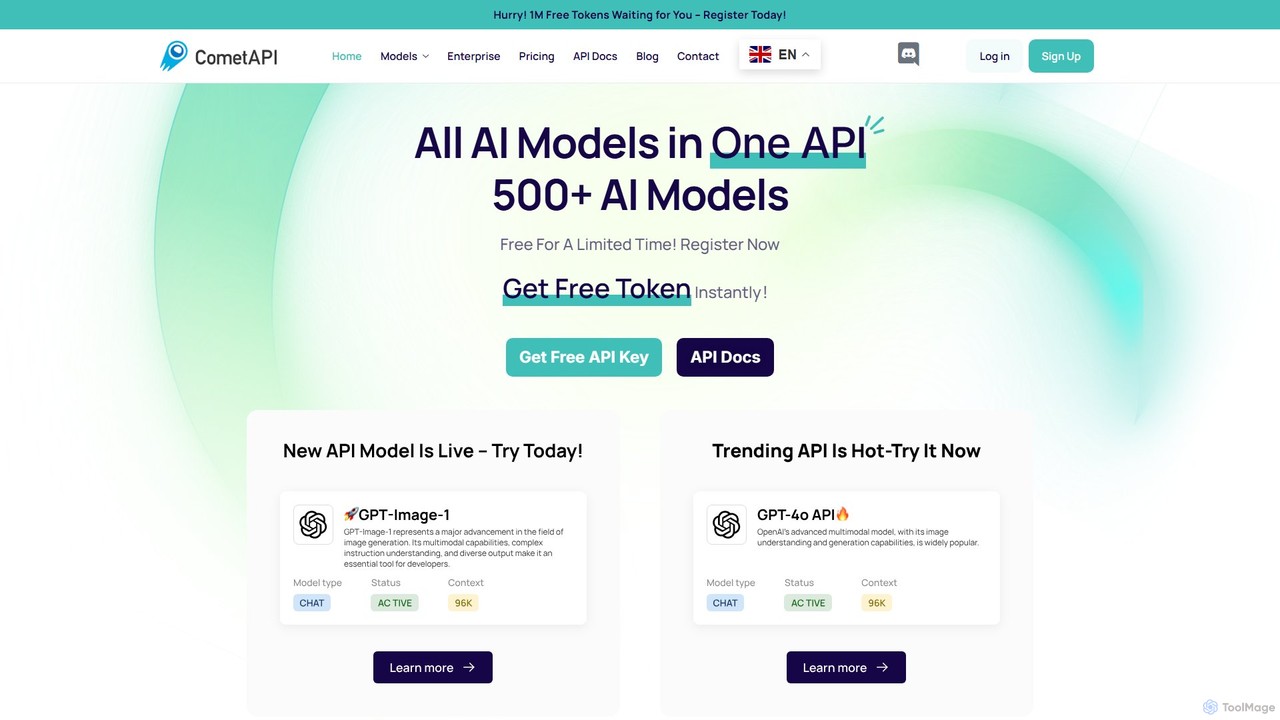
CometAPI is a unified API platform that provides developers with a single API key to access over 500 …
CometAPI is a unified API platform that provides developers with a single API key to access over 500 of the latest AI models. It simplifies integration for text, code, music, and video generation, including models like GLM, Qwen, Suno, and Midjourney Video.
About Ai Model Aggregators
AI Model Aggregators are sophisticated platforms that unify access to multiple artificial intelligence models from various providers through a single, streamlined API. These tools act as an intelligent routing layer, enabling developers and businesses to dynamically select, manage, and optimize the use of different AI models for specific tasks. By abstracting away the complexities of integrating diverse model APIs, aggregators enhance flexibility, reduce development overhead, and ensure robust, cost-effective AI application deployment.
Core Features
- Unified API Access: Provides a single interface to interact with numerous AI models from different vendors.
- Dynamic Model Routing: Intelligently directs requests to the most suitable or cost-effective model based on predefined criteria.
- Cost Optimization: Helps reduce inference costs by leveraging pricing differences and usage patterns across models.
- Performance Monitoring & Fallback: Tracks model performance and automatically switches to alternative models in case of failures or degraded service.
- Experimentation & A/B Testing: Facilitates easy comparison and testing of different models to find the best fit for specific tasks.
Use Cases
Developers and enterprises leverage AI Model Aggregators to build more resilient and adaptable AI-powered applications. They are crucial for scenarios requiring access to specialized models for different sub-tasks, or for ensuring continuous service availability by diversifying model dependencies. Aggregators simplify the management of AI infrastructure, allowing teams to focus on application logic rather than API integration challenges.
How to Choose
When selecting an AI Model Aggregator, consider the breadth of supported AI models and providers, the flexibility of its routing logic, and its cost management features. Evaluate the ease of integration with existing systems, the latency introduced by the aggregation layer, and the robustness of its monitoring and fallback capabilities. Security features, data privacy policies, and community support are also vital considerations for long-term deployment.

Ai Model AggregatorsUse Cases
Optimizing AI Inference Costs
For businesses with high AI usage, an AI Model Aggregator can significantly reduce operational expenses. By dynamically routing requests to the most cost-effective model available across different providers (e.g., choosing a cheaper model for non-critical tasks or during off-peak hours), companies can achieve substantial savings without compromising performance. This is particularly valuable for large-scale deployments in customer service or content generation.
Ensuring AI Application Reliability
Developers can enhance the resilience of their AI-powered applications by using aggregators. If a primary AI model provider experiences downtime or performance degradation, the aggregator can automatically switch to a backup model from another provider. This failover capability ensures continuous service availability, minimizing disruptions for end-users and maintaining business continuity, critical for real-time applications like chatbots or recommendation engines.
Rapid Experimentation with Diverse Models
Data scientists and AI researchers often need to compare the performance of various AI models for a specific task. An aggregator provides a unified interface to quickly swap between models from different vendors (e.g., OpenAI, Anthropic, Google). This accelerates the experimentation phase, allowing teams to efficiently A/B test models, evaluate outputs, and identify the optimal solution for their unique requirements without extensive code changes.
Building Multi-Modal AI Applications
For complex applications that require different types of AI capabilities (e.g., text generation, image analysis, speech recognition), aggregators simplify the integration of specialized models. Instead of managing multiple distinct APIs, developers can orchestrate calls to various models through a single aggregator. This streamlines the development of sophisticated multi-modal experiences, such as an AI assistant that can understand voice commands, generate text responses, and analyze images.
Scalable AI Model Management
Enterprises deploying AI at scale face challenges in managing numerous models, versions, and providers. An AI Model Aggregator centralizes this management, offering a single control plane for monitoring usage, setting rate limits, and updating model configurations. This simplifies governance, ensures consistent policy enforcement, and allows for efficient scaling of AI resources as demand grows, reducing operational complexity for large teams.
Dynamic Content Generation & Personalization
Content creators and marketing teams can leverage aggregators to dynamically generate diverse content or personalize user experiences. By routing requests to different generative AI models based on content type, tone, or audience, they can produce varied outputs (e.g., short social media posts from one model, long-form articles from another). This enables highly customized and engaging interactions, adapting to real-time user preferences and context.