ToolMage
Sign in

Best 1 Training Data AI tools for Ai Model Development

Popular Training Data AI tools in Ai Model Development include Label Studio, helping you work more efficiently.

Freemium

Label Studio

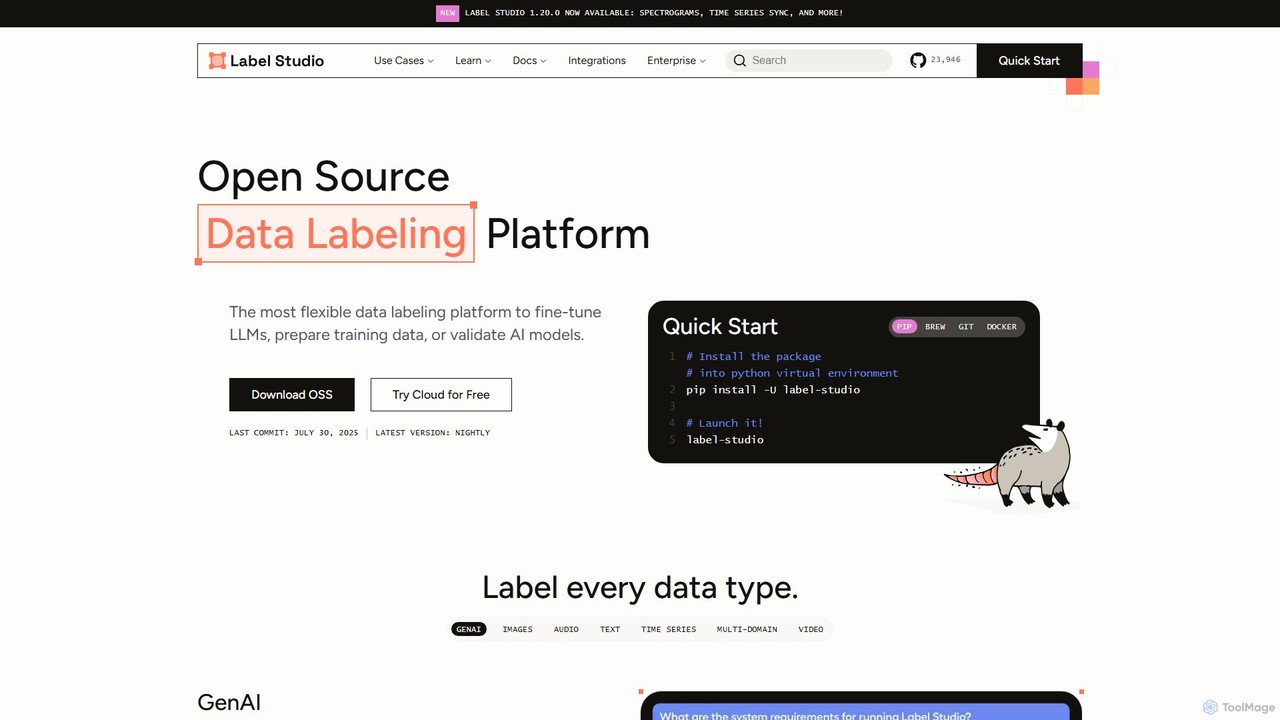
Label Studio is a versatile open-source data labeling platform designed for a wide range of data types. It enables users to annotate images, text, audio, video, and time-series data to fine-tune LLMs, prepare training data for machine learning, and validate AI models with human-in-the-loop feedback.

Training Data
Visits 265KFavorites 137Likes 143

About Training Data

Training Data tools are specialized AI-powered platforms designed to collect, annotate, and prepare high-quality datasets essential for developing and refining machine learning models. These tools streamline the crucial initial phase of AI model development by ensuring data is accurately labeled and formatted. They enable AI practitioners to build robust models that perform reliably across various applications, from computer vision to natural language processing.

Core Features

  • Data Collection & Sourcing: Facilitates gathering diverse and relevant raw data from various sources.
  • Data Annotation & Labeling: Provides interfaces and AI-assisted features for accurately tagging, categorizing, and segmenting data.
  • Data Augmentation: Generates synthetic data or modifies existing data to increase dataset size and diversity.
  • Quality Assurance & Validation: Implements mechanisms to verify annotation accuracy and data consistency.
  • Data Versioning & Management: Tracks changes to datasets, ensuring reproducibility and collaborative workflows.

Use Cases

These tools are indispensable for AI researchers, data scientists, and machine learning engineers. They are used to prepare datasets for training computer vision models for object detection, annotating text for natural language understanding, or labeling sensor data for autonomous driving systems. The goal is to transform raw information into structured, usable formats for model ingestion.

How to Choose

When selecting a training data platform, consider the types of data you need to process (images, text, audio, video), the complexity of annotation tasks, and the scalability requirements for large datasets. Evaluate its integration capabilities with existing ML pipelines, the level of automation offered for annotation, and the robustness of its quality control features. Pricing models and support for collaborative workflows are also important factors.

Featured tool rankings

Training Data use cases

1

Annotating Images for Computer Vision Models

A machine learning engineer needs to train an object detection model for autonomous vehicles. They use a training data platform to precisely label thousands of images with bounding boxes around pedestrians, vehicles, and traffic signs. This detailed annotation ensures the model accurately identifies and localizes objects in real-world driving scenarios, crucial for safety and performance.

2

Preparing Text Data for Natural Language Processing

A data scientist is building an NLP model for sentiment analysis of customer reviews. They utilize training data tools to annotate text data, categorizing sentences or phrases as positive, negative, or neutral. This process involves identifying key entities and relationships within the text, enabling the model to accurately understand and classify the emotional tone of customer feedback.

3

Generating Synthetic Data for Rare Scenarios

In industries like healthcare or finance, real-world data for rare but critical events (e.g., specific disease outbreaks, fraud patterns) is scarce. Data engineers use training data tools with augmentation capabilities to generate synthetic data that mimics these rare scenarios. This expands the dataset, allowing AI models to be trained on a more comprehensive range of situations, improving their ability to detect and respond to anomalies.

4

Transcribing and Annotating Audio for Speech Recognition

A company developing a voice assistant needs high-quality audio data for training. They employ training data tools to transcribe spoken language into text and annotate specific elements like speaker turns, background noise, or emotional tone. This meticulous process ensures the speech recognition model can accurately convert diverse audio inputs into text, improving the assistant's understanding and responsiveness.

5

Validating and Cleaning Datasets for Model Robustness

Before deploying an AI model, a data quality specialist uses training data tools to validate and clean the prepared datasets. This involves identifying and correcting inconsistencies, removing duplicate entries, and handling missing values. Ensuring the data is clean and accurate prevents the model from learning erroneous patterns, leading to more robust, fair, and reliable AI system performance in production environments.

6

Preparing Geospatial Data for Environmental Monitoring

Environmental scientists use training data tools to process and label geospatial data, such as satellite imagery or drone footage, for AI models that monitor deforestation, urban expansion, or climate change impacts. This involves segmenting land cover types, identifying specific features, and tracking changes over time. High-quality labeled geospatial data is critical for developing accurate predictive models for environmental conservation and resource management.

Training Data FAQ

What is Training Data in AI?

Training data in AI refers to the collection of information, such as images, text, audio, or video, that has been carefully prepared and labeled to teach a machine learning model. It serves as the input for the model during its learning phase, allowing it to identify patterns, make predictions, or perform specific tasks. High-quality training data is fundamental for building effective and accurate AI models, directly impacting their performance and reliability in real-world applications.

How to choose the right Training Data platform?

Choosing the right training data platform involves evaluating several key factors. First, consider the types of data you'll be working with (e.g., images, text, audio, video) and ensure the platform supports them. Second, assess its annotation capabilities, including the variety of annotation tools and the level of AI assistance. Third, look at scalability for handling large volumes of data and its integration with your existing machine learning pipelines. Finally, evaluate its quality control features, pricing structure, and support for collaborative team workflows.

What is the difference between data collection and data annotation?

Data collection involves gathering raw, unprocessed information from various sources, such as web scraping, sensor feeds, or existing databases. Data annotation, on the other hand, is the process of labeling or tagging this collected raw data with meaningful attributes to make it understandable for machine learning models. For example, collecting images is data collection, while drawing bounding boxes around objects in those images and labeling them is data annotation. Both are crucial steps in preparing training data, but annotation adds the necessary context for AI learning.

Why is high-quality training data crucial for AI models?

High-quality training data is crucial because it directly influences the accuracy, fairness, and robustness of AI models. Models learn from the patterns and examples present in the data; if the data is biased, inaccurate, or incomplete, the model will inherit these flaws, leading to poor performance, incorrect predictions, and potentially harmful outcomes. Clean, diverse, and accurately labeled data ensures the model generalizes well to new, unseen data and performs reliably in real-world scenarios, making it trustworthy and effective.

What are the key steps in preparing training data?

Preparing training data typically involves several key steps. First, data collection gathers raw information from relevant sources. Second, data cleaning and preprocessing involves handling missing values, removing duplicates, and transforming data into a consistent format. Third, data annotation and labeling adds meaningful tags or attributes to the data. Fourth, data augmentation expands the dataset by creating variations. Finally, quality assurance and validation ensure the accuracy and consistency of the prepared data before it's used to train AI models.