Label Studio
Label Studio is a versatile open-source data labeling platform designed for a wide range of data types. It …
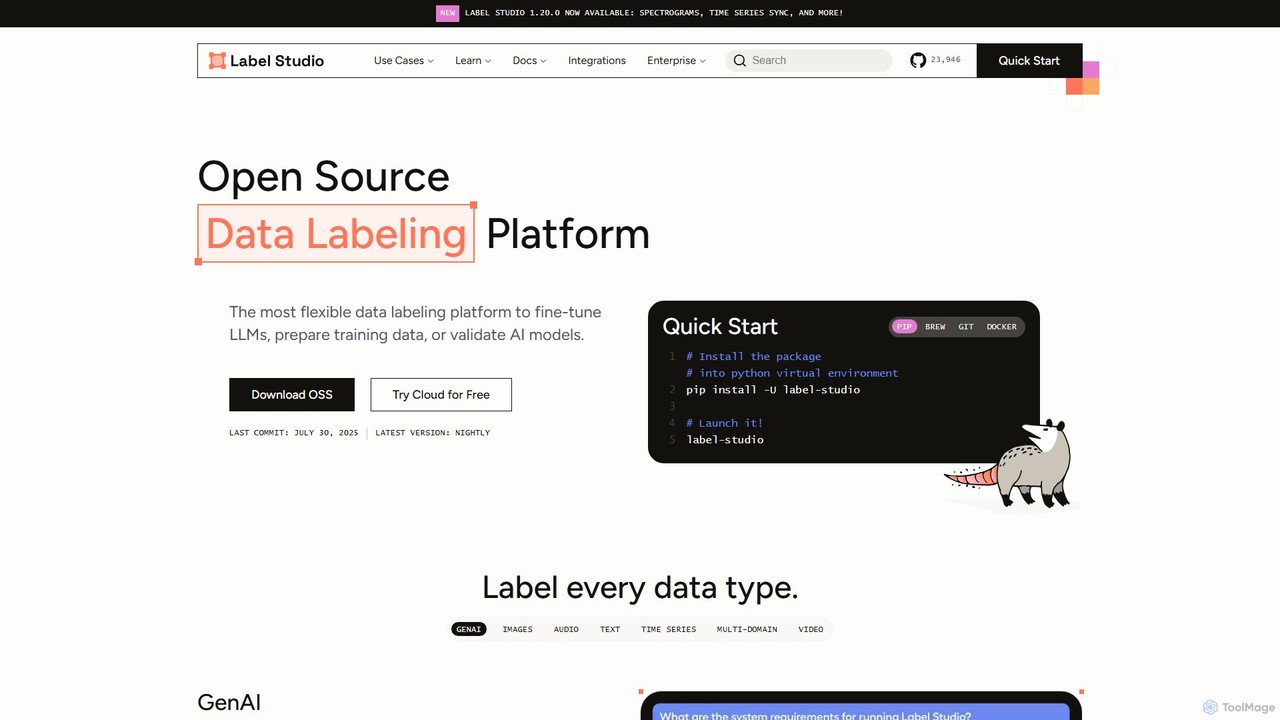
Label Studio is a versatile open-source data labeling platform designed for a wide range of data types. It enables users to annotate images, text, audio, video, and time-series data to fine-tune LLMs, prepare training data for machine learning, and validate AI models with human-in-the-loop feedback.
About Ai Model Development
AI Model Development tools are specialized platforms and frameworks that empower data scientists, machine learning engineers, and developers to build, train, evaluate, and deploy artificial intelligence models efficiently. These tools streamline the entire machine learning lifecycle, from data preparation and feature engineering to hyperparameter tuning and model monitoring. They enable the creation of sophisticated AI solutions for various applications, accelerating innovation and bringing intelligent capabilities to businesses and products.
Core Features
- Data Preprocessing: Tools for cleaning, transforming, and preparing raw data for model training.
- Model Training & Experimentation: Environments to train machine learning and deep learning models, track experiments, and manage versions.
- Hyperparameter Tuning: Automated or guided optimization of model parameters to achieve better performance.
- Model Evaluation & Validation: Metrics and visualizations to assess model accuracy, bias, and robustness.
- Model Deployment & Monitoring: Capabilities to deploy trained models into production and continuously monitor their performance and drift.
Use Cases
AI Model Development tools are crucial for organizations building custom AI solutions, such as developing predictive analytics for financial services, creating recommendation engines for e-commerce, or training computer vision models for autonomous systems. They support data science teams in iterating rapidly on model designs and deploying robust AI applications.
How to Choose
When selecting an AI Model Development platform, consider its support for various ML frameworks (e.g., TensorFlow, PyTorch), scalability for large datasets and complex models, integration with existing data infrastructure, and the level of automation (AutoML) offered. Evaluate its MLOps capabilities for seamless deployment and monitoring, as well as pricing and community support.

Ai Model DevelopmentUse Cases
Accelerating Predictive Model Development with AutoML
Business analysts and domain experts can leverage AI Model Development platforms with AutoML capabilities to quickly build and deploy predictive models without extensive coding knowledge. For instance, a marketing team can use such a tool to predict customer churn based on historical data, automatically selecting the best algorithms and tuning hyperparameters, leading to faster insights and targeted retention strategies.
Training Custom Deep Learning Models for Computer Vision
AI researchers and computer vision engineers utilize AI Model Development tools to train highly specialized deep learning models for tasks like object detection, image segmentation, or facial recognition. They can manage large datasets, experiment with different neural network architectures (e.g., CNNs, Transformers), and fine-tune models on GPUs/TPUs, enabling breakthroughs in areas like medical imaging analysis or autonomous driving.
Establishing End-to-End MLOps Pipelines
Data scientists and MLOps engineers use these platforms to set up automated pipelines for continuous integration, delivery, and deployment of machine learning models. This involves automating data ingestion, model retraining, version control, and A/B testing in production. For example, a financial institution can ensure its fraud detection model is always up-to-date and performing optimally with minimal manual intervention.
Advanced Feature Engineering for Complex Datasets
Data engineers and machine learning practitioners employ AI Model Development tools to perform sophisticated feature engineering on complex, high-dimensional datasets. These tools offer functionalities for feature selection, extraction, and transformation, which are critical for improving model performance. This allows for uncovering hidden patterns in data, such as identifying key indicators for equipment failure in industrial IoT applications.
Optimizing and Deploying Models to Edge Devices
Software developers and embedded systems engineers use AI Model Development platforms to optimize trained models for resource-constrained environments, such as edge devices or mobile applications. This includes model quantization, pruning, and conversion to lightweight formats. They can then deploy these optimized models for real-time inference, enabling smart functionalities directly on devices like smart cameras or industrial sensors.
Managing and Tracking AI Experimentation at Scale
AI research teams and data science leads rely on these tools to manage and track hundreds or thousands of machine learning experiments. The platforms provide centralized dashboards for logging metrics, hyperparameters, code versions, and datasets, facilitating collaboration and reproducibility. This ensures that teams can efficiently compare different model iterations, identify the most promising approaches, and accelerate research cycles.