GPUX
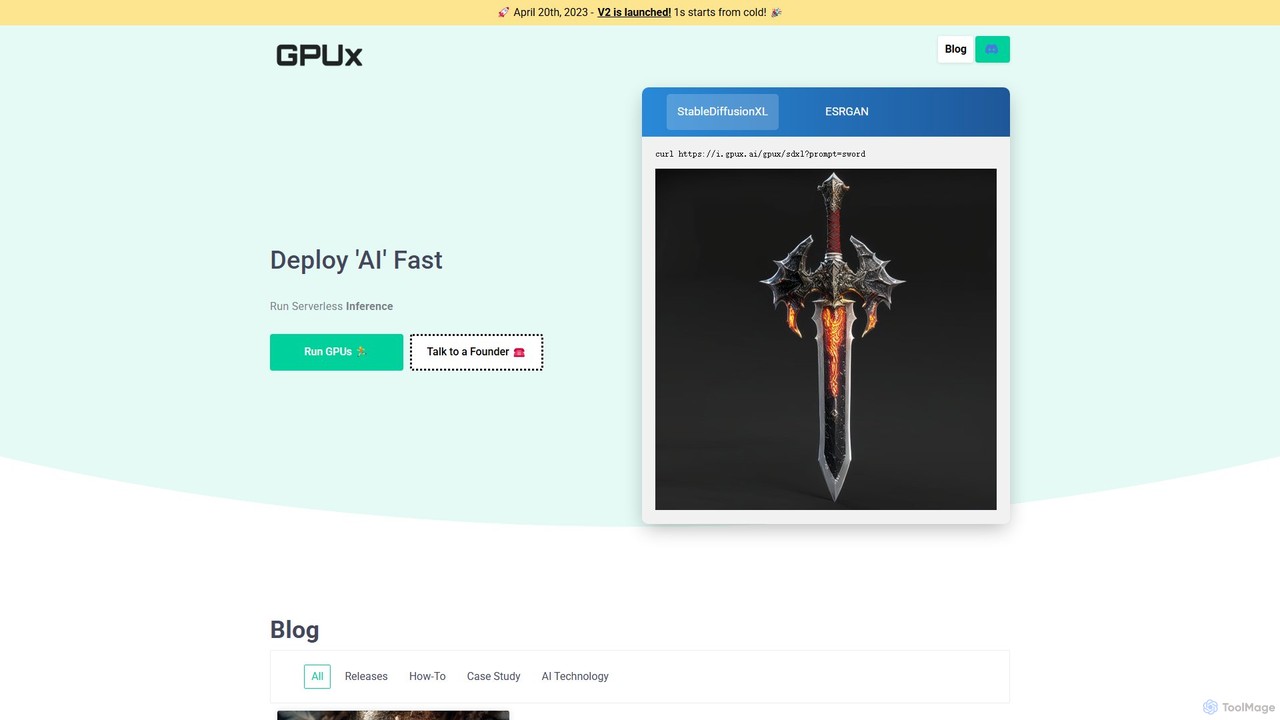
GPUX is a serverless, decentralized GPU cloud platform for fast and affordable AI model inference. It allows developers …
GPUX is a serverless, decentralized GPU cloud platform for fast and affordable AI model inference. It allows developers to run models via API and enables GPU owners to earn money by contributing their hardware to a P2P network.
About Model Deployment
Model Deployment tools are a specialized category of software designed to take a trained machine learning model and make it available for use in a production environment. These platforms bridge the gap between model development and real-world application by providing the necessary infrastructure for serving, scaling, and monitoring. They enable developers and data scientists to efficiently integrate AI capabilities into applications, websites, or business processes through stable API endpoints. This process is a critical step in the MLOps lifecycle, ensuring that the value of a model is realized through practical use.
Core Features
- Scalable Serving: Automatically manages server resources to handle fluctuating traffic, ensuring low latency and high availability.
- Model Versioning: Tracks different versions of a model, allowing for easy rollbacks or A/B testing between versions.
- Performance Monitoring: Provides dashboards and alerts for tracking model accuracy, prediction latency, and resource usage in real-time.
- API Endpoint Generation: Creates secure and stable REST APIs for models, simplifying integration with other applications.
- Environment Management: Handles software dependencies and hardware configurations, ensuring the model runs consistently across different environments.
Use Cases
These tools are essential for technology companies, data science teams, and enterprises looking to operationalize their AI investments. Common scenarios include deploying a fraud detection model for a financial app, serving a recommendation engine on an e-commerce site, or integrating a natural language processing model into a customer support chatbot. They are crucial for any organization moving from experimental AI to production-grade systems.
How to Choose
When selecting a Model Deployment tool, consider the scale of your application, from small projects to enterprise-level traffic. Evaluate its compatibility with your existing machine learning frameworks (like TensorFlow or PyTorch) and cloud infrastructure (AWS, GCP, Azure). Also, assess the tool's MLOps capabilities, such as integration with CI/CD pipelines and automated monitoring features. Finally, consider the balance between ease of use (fully managed platforms) and flexibility (more configurable libraries).

Model DeploymentUse Cases
Deploying a Real-Time Fraud Detection API
A fintech company's data science team has developed a highly accurate fraud detection model. To protect their users, they need to integrate this model into their transaction processing system. Using a model deployment platform, they package the model, define its dependencies, and create a secure API endpoint. The platform automatically scales the infrastructure to handle thousands of transactions per second with minimal latency. This allows the company to check every transaction for fraud in real-time, significantly reducing financial losses and increasing customer trust without slowing down the user experience.
A/B Testing Recommendation Engine Models
An e-commerce platform wants to improve its product recommendation engine. The MLOps team has two new model versions to test against the current production model. They use a model deployment tool that supports advanced traffic routing. They deploy all three models and configure the tool to route 80% of user traffic to the current model, 10% to version A, and 10% to version B. The platform's integrated monitoring dashboard allows them to compare click-through rates and conversion metrics for each model in real-time. After a week, they can confidently identify the best-performing model and route 100% of traffic to it with zero downtime.
Serving a Generative AI Model via a Public API
A startup has created a novel text-to-image generation model and wants to offer it as a paid service. They use a model deployment platform to host their large model on powerful GPU instances. The platform provides tools to create a public-facing API, manage user authentication with API keys, and set up rate limiting and usage-based billing tiers. This abstracts away the complex infrastructure management, allowing the startup to focus on improving their model and marketing their service, while the deployment tool ensures reliable and scalable access for their customers.
Automating Model Retraining and Deployment Pipelines
A financial services company uses a model to predict credit risk, which needs to be updated monthly with new data. Their MLOps team builds a CI/CD pipeline for machine learning. When new data is available, a training job is automatically triggered. Once the new model is trained and validated, the pipeline uses a model deployment tool's API to push the new version to a staging environment. After passing automated tests, it's promoted to production, replacing the old model seamlessly. This automation reduces manual effort, minimizes the risk of human error, and ensures the credit risk model is always up-to-date.
Deploying Models to Edge Devices for IoT
A manufacturing company wants to use computer vision for quality control on its assembly line. They have a model that can detect defects in real-time. Instead of sending video streams to the cloud, they need to run the model directly on cameras (edge devices) to minimize latency. They use a model deployment tool that specializes in edge computing. The tool helps optimize the model's size and computational requirements, packages it with the necessary runtime, and provides a system for securely deploying and updating the model on hundreds of devices remotely. This enables instant defect detection and reduces network bandwidth costs.
Monitoring Model Performance and Detecting Drift
A retail company uses a demand forecasting model to manage inventory. Over time, consumer behavior changes, and the model's accuracy starts to degrade (a phenomenon known as model drift). The model deployment platform they use continuously monitors the model's predictions against actual sales data. It automatically detects statistical drift in the input data and a drop in predictive accuracy. The system sends an alert to the data science team, notifying them that the model is no longer performing optimally. This proactive monitoring allows the team to retrain the model with fresh data before inaccurate forecasts lead to significant inventory issues.