ToolMage
Sign in

Best 1 Inference AI tools for Ai Model Platforms

Popular Inference AI tools in Ai Model Platforms include DistributeAI, helping you work more efficiently.

DistributeAI
Paid

DistributeAI

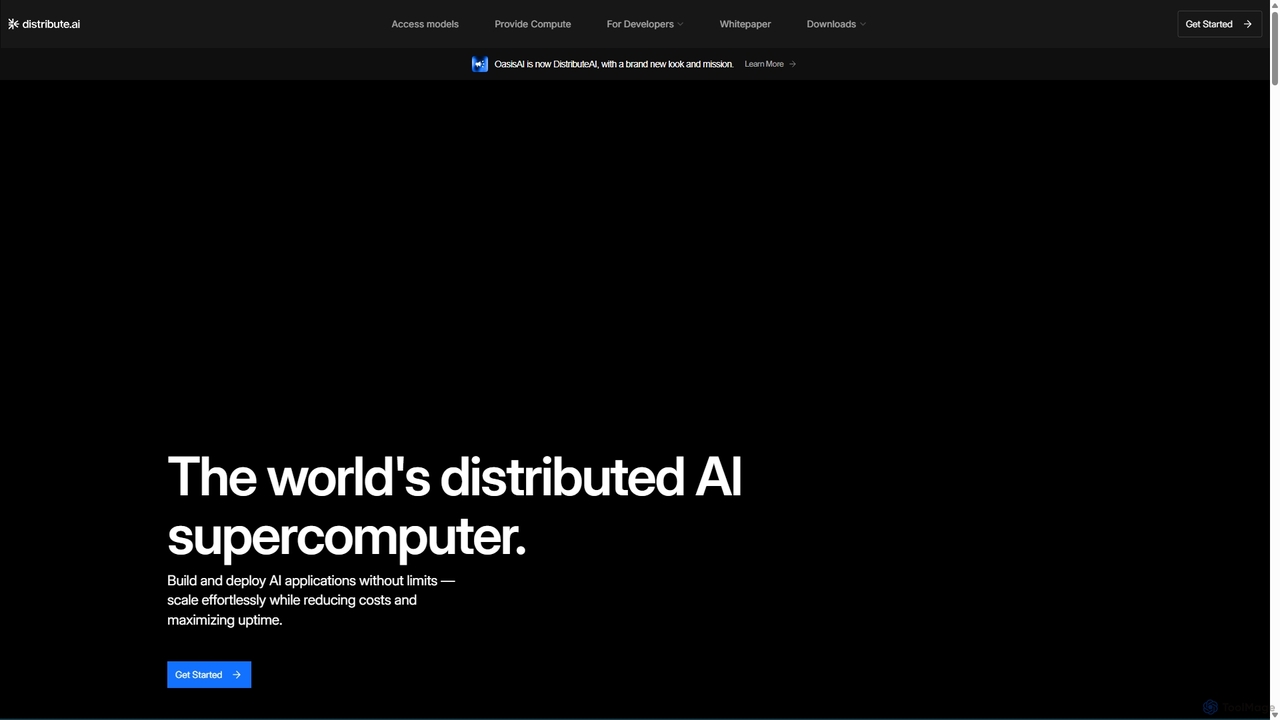
DistributeAI is a decentralized AI supercomputer platform that provides developers with scalable, low-cost access to a vast library of open-source AI models. It enables building and deploying AI applications through a developer-friendly API and SDK, while also allowing users to monetize their idle computing power by contributing to the global network.

Inference
Visits 12.3KFavorites 133Likes 123

About Inference

AI Inference platforms are specialized services for deploying and running trained machine learning models to make predictions on new data. They are optimized for low latency and high throughput, translating a model's theoretical knowledge into practical, operational outputs. These platforms are crucial for integrating AI capabilities into applications, such as powering recommendation engines or analyzing live video streams. They focus on the post-training phase, ensuring models are accessible, scalable, and cost-effective in production environments.

Core Features

  • Optimized Model Serving: Provides high-performance environments, often using GPUs or custom hardware, to serve models with minimal latency.
  • Autoscaling Infrastructure: Automatically adjusts compute resources based on real-time traffic to handle demand spikes and minimize costs.
  • Multi-Framework Support: Natively supports popular machine learning frameworks like TensorFlow, PyTorch, and ONNX for seamless deployment.
  • Performance Monitoring: Offers dashboards to track key metrics such as latency, throughput, error rates, and resource utilization.
  • A/B Testing & Canary Deployments: Enables safe rollout of new model versions by directing a portion of traffic to them before full deployment.

Use Cases

These platforms are essential for MLOps engineers, data scientists, and developers building AI-powered applications. Common applications include real-time fraud detection in financial transactions, content moderation on social media, and powering personalized user experiences in e-commerce.

How to Choose

When selecting an Inference platform, consider factors like supported model frameworks, latency and throughput requirements, cost structure (pay-per-use vs. dedicated instances), scalability features, and ease of integration with your existing MLOps pipeline.

Featured tool rankings

Inference use cases

1

Powering a Real-Time Fraud Detection System

A financial technology company needs to approve or deny millions of credit card transactions daily. Their data science team builds a machine learning model to score each transaction's fraud risk. Using an AI Inference platform, MLOps engineers deploy this model as a highly available API endpoint. The platform's autoscaling feature handles traffic spikes during peak shopping seasons, while its GPU-optimized infrastructure ensures that each prediction is returned in under 50 milliseconds, enabling instant transaction decisions and preventing financial losses without impacting the customer experience.

2

Serving Personalized E-commerce Recommendations

An online retail giant wants to provide a unique shopping experience for each user. They use an AI Inference platform to host a complex recommendation model. This model processes a user's real-time browsing behavior, purchase history, and items in their cart. The platform serves personalized product suggestions on the homepage, product pages, and at checkout. Its ability to handle high concurrency ensures that tens of thousands of simultaneous users receive fresh, relevant recommendations instantly, leading to a measurable increase in user engagement and conversion rates.

3

Automating Content Moderation on Social Media

A rapidly growing social media platform faces the challenge of moderating millions of user-uploaded images and videos daily. To combat harmful content, they deploy several computer vision models on an AI Inference platform. These models automatically detect and flag content related to violence, hate speech, and nudity. The platform's high throughput capabilities allow it to process the massive volume of media in near real-time, significantly reducing the burden on human moderators and enabling faster enforcement of community guidelines to maintain a safe online environment.

4

Deploying a Large Language Model (LLM) for a Chatbot

A SaaS company wants to improve customer support by launching an AI-powered chatbot. They choose a powerful Large Language Model (LLM) but face challenges with its high computational requirements. By using a specialized AI Inference platform, they can deploy the LLM efficiently. The platform manages the complex GPU resource allocation and provides a simple API for their application to call. This setup ensures that the chatbot can handle thousands of concurrent conversations with low response times, providing instant, helpful answers to customer queries 24/7 and reducing the workload on the human support team.

5

Accelerating Medical Image Analysis

A healthcare technology provider develops an AI model to detect early signs of disease in medical scans like X-rays and MRIs. To integrate this into hospital workflows, they deploy the model on a secure, compliant AI Inference platform. When a radiologist uploads a scan, it is sent to the model via an API. The platform processes the high-resolution image in seconds and returns an analysis highlighting potential areas of concern. This assists radiologists by prioritizing cases and providing a second opinion, leading to faster and more accurate diagnoses without replacing the expert's final judgment.

6

Optimizing Logistics with Real-Time Route Planning

A large delivery service company aims to reduce fuel costs and delivery times. They deploy a machine learning model on an AI Inference platform that predicts traffic patterns and calculates the most efficient delivery routes in real-time. The platform ingests live data from thousands of delivery vehicles, weather reports, and traffic sensors. It continuously serves updated route recommendations to drivers' mobile apps. This dynamic optimization, made possible by the platform's low-latency inference, helps the company save millions in operational costs and improve customer satisfaction with more accurate delivery estimates.

Inference FAQ

What is an AI Inference platform?

An AI Inference platform is a specialized cloud or on-premise service designed to run trained machine learning models in a production environment. Its primary purpose is to take a model that has already learned from data and use it to make fast, reliable predictions on new, incoming data. Unlike training platforms that focus on building models, inference platforms are optimized for operational efficiency, focusing on low latency, high throughput, and scalability to serve real-time applications.

What's the difference between AI model training and inference?

Training and inference are two distinct phases in the machine learning lifecycle.

  • Training is the process of teaching a model by feeding it a large dataset. During this phase, the model learns to identify patterns and relationships in the data. It is computationally intensive, time-consuming, and typically done offline.
  • Inference is the process of using the trained model to make predictions on new, unseen data. This is the 'live' or 'production' phase. It needs to be fast, efficient, and scalable to handle real-world requests with low latency.
In short, training creates the model, while inference uses the model to provide value.

How do I choose the right AI Inference platform?

Selecting the right platform depends on your specific needs. Consider these key factors:

  • Model Compatibility: Ensure the platform supports your model's framework (e.g., TensorFlow, PyTorch, ONNX).
  • Performance Requirements: Evaluate your application's needs for latency (response time) and throughput (requests per second).
  • Scalability: Look for features like autoscaling to handle variable traffic loads efficiently.
  • Cost: Compare pricing models, such as pay-per-use versus reserved instances, and factor in data transfer and storage costs.
  • Ease of Use: Assess the platform's tools for deployment, monitoring, and integration with your existing MLOps workflow.

Who typically uses AI Inference platforms?

AI Inference platforms are primarily used by technical roles responsible for operationalizing machine learning models. Key users include:

  • MLOps Engineers: They focus on the entire lifecycle of a model, and use inference platforms for the critical deployment, scaling, and monitoring stages.
  • Application Developers: They integrate model endpoints (APIs) provided by the platform into user-facing applications, such as websites or mobile apps.
  • Data Scientists: While their main focus is on model development, they use these platforms to test model performance in a production-like environment and analyze real-world prediction data.

What are the benefits of using a dedicated Inference platform?

Using a dedicated platform instead of building your own inference infrastructure offers several key advantages. These include reduced operational complexity, as the platform manages servers, scaling, and software updates. They provide lower latency and higher throughput due to specialized hardware and software optimizations. Cost efficiency is another major benefit, achieved through autoscaling and pay-per-use pricing models that eliminate the need for over-provisioning hardware. Finally, they improve model reliability and uptime with built-in monitoring and failover capabilities, allowing teams to focus on model development rather than infrastructure management.