Best of the Year 1 results Ai Model Platforms AI Tools

Popular AI tools in the Ai Model Platforms field include DistributeAI, etc., helping you quickly improve efficiency.

DistributeAI

DistributeAI

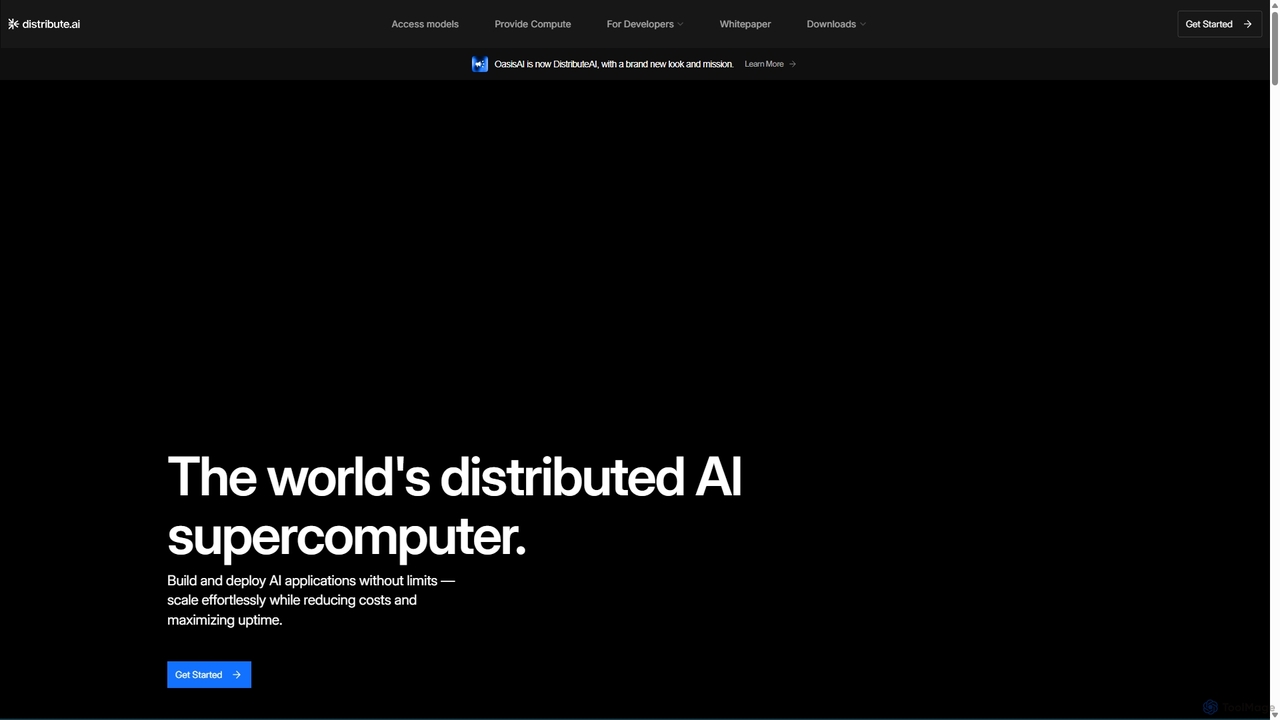
DistributeAI is a decentralized AI supercomputer platform that provides developers with scalable, low-cost access to a vast library …

8.5K

About Ai Model Platforms

AI Model Platforms are centralized services that provide developers and businesses with access to a diverse range of pre-trained artificial intelligence models. These platforms typically offer access via APIs, enabling the integration of advanced capabilities like natural language processing, image generation, and data analysis directly into applications. Their primary value lies in abstracting away the complexity of training and hosting models, significantly accelerating the development of AI-powered features. Many platforms also provide tools for model fine-tuning and manage the scalable infrastructure required for production-level inference.

Core Features

  • Model Catalog: Access a curated library of open-source and proprietary AI models for various tasks.
  • API Access & SDKs: Integrate models into applications using standardized REST APIs and language-specific toolkits.
  • Model Fine-Tuning: Customize pre-trained models with your own data to improve performance on specific tasks.
  • Scalable Inference Endpoints: Deploy models on managed infrastructure that automatically scales to handle fluctuating demand.
  • Experimentation Playground: Test and compare different models and prompts through a user-friendly web interface without writing code.

Use Cases

AI Model Platforms are widely used by software developers to embed AI features into new or existing products, data scientists to rapidly prototype and test different models, and enterprises seeking to leverage advanced AI without building an in-house machine learning team. Common applications include powering intelligent chatbots, automating content moderation, and generating marketing copy.

How to Choose

When selecting an AI Model Platform, consider the availability of specific models you need, the platform's performance metrics like latency and uptime, and the pricing structure (e.g., pay-per-use vs. subscription). Also evaluate the quality of developer documentation, the ease of fine-tuning models, and the platform's integration capabilities with your existing tech stack.

Ai Model PlatformsUse Cases

1

Building an Intelligent Customer Service Chatbot

A startup's development team needs to build a 24/7 customer support chatbot that can handle complex user queries beyond simple keyword matching. Using an AI Model Platform, they integrate a powerful large language model (LLM) like GPT-4 via its API. This allows the chatbot to understand conversational context, answer nuanced questions, and even perform tasks like checking order statuses by calling other internal APIs. The platform manages the model's uptime and scalability, enabling the team to launch a sophisticated chatbot in weeks instead of months.

2

Automating Content Moderation for a Social Platform

A social media company faces the challenge of moderating user-generated content at scale. They use an AI Model Platform to access specialized classification models for text and images. By sending new posts to the platform's API, they can automatically detect and flag content that violates their policies, such as hate speech or graphic imagery. This automates a significant portion of the moderation workload, allowing human moderators to focus on complex edge cases and appeals, improving both efficiency and platform safety.

3

Rapid Prototyping of AI-Powered Features

A product manager wants to test the viability of a new feature that summarizes long articles for their news app. Instead of committing development resources, they use the 'Playground' interface of an AI Model Platform. They can paste text, experiment with different summarization models, and adjust prompts in real-time to see the quality of the output. This allows them to quickly validate the concept and gather example outputs for user testing and stakeholder presentations, all before a single line of code is written, de-risking the development process.

4

Fine-Tuning a Model for Industry-Specific Language

A legal tech company wants to build a tool that can accurately summarize legal documents. General-purpose language models struggle with the specific jargon and structure of legal texts. Using an AI Model Platform's fine-tuning capabilities, they upload a dataset of legal documents and their corresponding summaries. The platform handles the complex process of adapting a base model to this specific domain. The resulting fine-tuned model demonstrates a significantly higher accuracy in understanding and summarizing legal language, forming the core of their new product offering.

5

Generating Marketing Copy Variations at Scale

A marketing team for an e-commerce brand needs to create dozens of unique product descriptions and social media ads for a new product launch. Manually writing each variation is time-consuming. They use an AI Model Platform's text generation API, providing it with key product features and a target audience. In minutes, they generate hundreds of creative and compelling copy variations. This allows them to A/B test different messaging across various channels, optimizing their campaigns for higher engagement and conversion rates without a massive time investment.

6

Analyzing Customer Feedback from Multiple Sources

A large enterprise collects customer feedback from surveys, support tickets, and social media. Manually analyzing this unstructured text data is infeasible. They stream this data to an AI Model Platform that offers sentiment analysis and topic extraction models. The API processes thousands of entries, categorizing feedback as positive, negative, or neutral, and identifying recurring themes like 'shipping delays' or 'user interface'. This provides the product team with actionable, data-driven insights to prioritize improvements and better understand customer needs.

Ai Model PlatformsFrequently Asked Questions