
PloyD
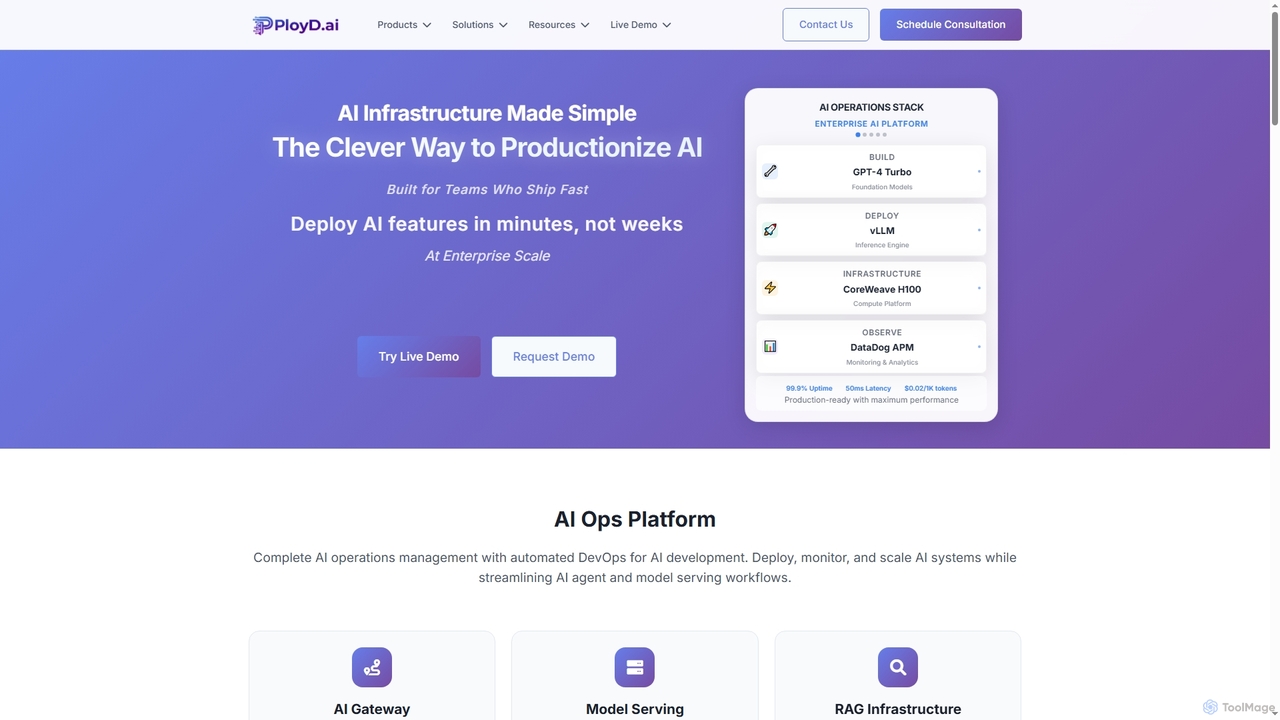
PloyD is an enterprise AI operations platform designed to streamline the productionization of AI models and applications. It …
PloyD is an enterprise AI operations platform designed to streamline the productionization of AI models and applications. It tackles common challenges like developer velocity bottlenecks, infrastructure complexity, team efficiency, and security compliance, enabling organizations to deploy, manage, and scale AI solutions with confidence and speed.
About Model Deployment
Model Deployment tools are AI-powered solutions designed to integrate trained machine learning models into production environments, making them accessible for real-world applications. These platforms streamline the complex process of taking a model from development to operational use, ensuring it can generate predictions or insights reliably and at scale. They are essential for transforming theoretical AI capabilities into tangible business value, enabling continuous delivery of intelligent features.
Core Features
- Automated Deployment: Facilitates one-click or CI/CD-driven release of models to production.
- API Endpoint Creation: Automatically generates scalable RESTful APIs for easy model integration into applications.
- Scalability & Load Balancing: Manages fluctuating inference loads by dynamically scaling resources and distributing requests.
- Model Versioning & Rollback: Tracks different model iterations, allowing for safe updates and quick reversion to stable versions.
- Performance Monitoring: Provides real-time metrics on model latency, throughput, error rates, and resource utilization.
Use Cases
Model Deployment is crucial for organizations aiming to operationalize their AI investments. It enables financial institutions to deploy real-time fraud detection systems, e-commerce platforms to roll out personalized recommendation engines, and manufacturing companies to integrate predictive maintenance models into their IoT infrastructure, ensuring AI models deliver continuous value.
How to Choose
When selecting a Model Deployment solution, consider its integration capabilities with your existing MLOps pipeline and data infrastructure. Evaluate its support for various ML frameworks (e.g., TensorFlow, PyTorch), scalability features, monitoring and alerting systems, and security protocols. Ease of use, cost-effectiveness, and compliance with industry regulations are also vital factors.
Model DeploymentUse Cases
Automated Fraud Detection Model Deployment
Financial institutions leverage Model Deployment tools to integrate sophisticated fraud detection models directly into their transaction processing systems. ML engineers can containerize models, create high-performance API endpoints, and ensure low-latency inference for millions of daily transactions. This automation significantly reduces financial losses and the need for manual review, making AI-driven security proactive and efficient.
E-commerce Product Recommendation Engine Rollout
E-commerce platforms utilize Model Deployment solutions to continuously update and roll out personalized product recommendation engines. Data scientists can perform A/B testing or canary deployments, gradually exposing new model versions to small user segments while monitoring key performance indicators. Successful models are then seamlessly rolled out to the entire user base, enhancing customer experience and boosting conversion rates without service interruption.
Predictive Maintenance Model Integration for Industrial IoT
Industrial IoT solution providers deploy machine learning models for predictive maintenance using these tools. Models trained to anticipate equipment failures are packaged and deployed to edge devices or cloud environments, integrating with sensor data streams. This enables proactive scheduling of maintenance, minimizing costly downtime and optimizing operational efficiency in manufacturing and energy sectors.
Scalable NLP Model API for Customer Support
SaaS companies developing AI-powered customer support solutions use Model Deployment to provide highly available and scalable Natural Language Processing (NLP) models. These models, for tasks like sentiment analysis or intent recognition, are deployed as microservices, capable of handling thousands of concurrent requests from various client applications, with automatic scaling based on demand. This enhances customer service efficiency by automating query routing and improving response times and agent productivity.
Medical Imaging Diagnosis Model Accessibility
Healthcare AI developers deploy trained medical image classification models (e.g., for X-ray or MRI analysis) to make them accessible for clinical use. Deployment platforms ensure secure integration within compliant cloud environments, creating APIs that connect with hospital PACS systems, ensuring data privacy and high inference accuracy for diagnostic support. This assists radiologists with faster, more consistent preliminary diagnoses, ultimately improving patient outcomes.
Real-time Bidding (RTB) Model for AdTech Optimization
AdTech platforms rely on Model Deployment tools for ultra-low-latency deployment of real-time bidding (RTB) models. These models predict ad click-through rates (CTR) within milliseconds, enabling optimal bidding decisions. Specialized deployment solutions ensure models are highly performant and continuously monitored for prediction quality, maximizing ad campaign effectiveness and revenue for advertisers.