Best of the Year 1 results Ai Orchestration AI Tools

Popular AI tools in the Ai Orchestration field include LLM Hub, etc., helping you quickly improve efficiency.

LLM Hub

LLM Hub

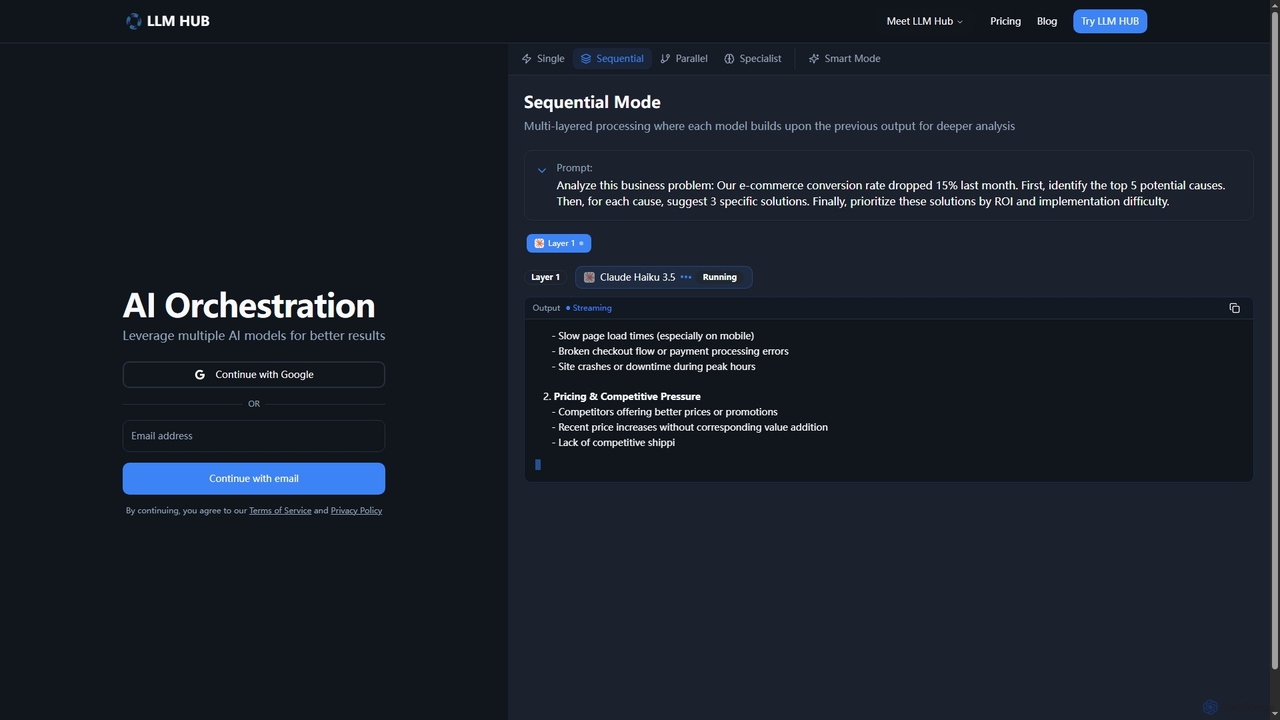
LLM Hub is an advanced multi-model AI orchestration platform designed to leverage the power of 20+ large language …

3.6K

About Ai Orchestration

AI Orchestration refers to AI-powered tools that design, deploy, manage, and monitor complex artificial intelligence workflows and systems. These platforms integrate various AI models, data pipelines, and computational resources, enabling seamless coordination and execution of multi-stage AI tasks. They are crucial for operationalizing sophisticated AI applications, ensuring efficiency, reliability, and scalability across diverse business processes and technical environments.

Core Features

  • Workflow Design & Automation: Visually define and automate sequences of AI models, data transformations, and business logic.
  • Model Deployment & Management: Facilitate the deployment, versioning, and lifecycle management of multiple AI models.
  • Performance Monitoring & Optimization: Track AI model performance, resource utilization, and identify bottlenecks for continuous improvement.
  • Data Pipeline Integration: Connect and manage data flows between various sources, AI models, and target systems.
  • Resource Allocation & Scaling: Dynamically allocate and scale compute resources (CPU/GPU) based on workload demands.

Use Cases

AI Orchestration is widely adopted in MLOps for automating machine learning lifecycles, in enterprise automation for complex decision-making processes, and by developers building multi-agent AI systems. It ensures that disparate AI components work cohesively to deliver intelligent outcomes, from real-time analytics to personalized customer experiences.

How to Choose

When selecting an AI Orchestration platform, prioritize its integration capabilities with your existing AI stack and data infrastructure. Evaluate its scalability to handle future growth, the robustness of its monitoring and logging features, and the ease of use for designing and managing workflows. Consider also the support for various deployment environments and the overall cost-effectiveness.

Ai OrchestrationUse Cases

1

Automating End-to-End MLOps Pipelines

Data scientists and ML engineers leverage AI orchestration tools to automate the entire machine learning lifecycle, from data ingestion and model training to deployment and continuous monitoring. This ensures consistent model performance, reduces manual intervention, and accelerates the delivery of AI-powered applications into production environments, enhancing operational efficiency and model reliability.

2

Coordinating Multiple AI Agents for Complex Tasks

Developers build sophisticated AI applications by orchestrating various specialized AI agents, such as natural language understanding, knowledge retrieval, and response generation agents. The orchestration layer manages their interactions, data flow, and task sequencing to achieve a unified, intelligent outcome, enabling advanced customer service bots, research assistants, or complex decision-making systems.

3

Dynamic Business Process Automation with AI

Business analysts and process owners utilize AI orchestration to automate complex, adaptive business processes that require intelligent decision-making at various stages. For example, an insurance claim process might involve AI for document analysis, fraud detection, and risk assessment, with orchestration ensuring seamless handoffs and conditional logic based on AI outputs, leading to faster and more accurate claim processing.

4

Optimizing AI Resource Allocation and Scheduling

IT operations teams and cloud architects use AI orchestration platforms to efficiently manage and allocate computational resources for diverse AI workloads. These tools dynamically scale resources based on demand, prioritize critical tasks, and optimize cost by ensuring that GPU and CPU resources are utilized effectively across training, inference, and data processing jobs, maximizing infrastructure efficiency.

5

Seamlessly Integrating Diverse AI Services and APIs

Software architects and developers integrate various third-party AI services, such as sentiment analysis, image recognition, or translation APIs, into a cohesive application. AI orchestration tools provide a unified interface and workflow engine to connect these services, manage API calls, handle data transformations, and ensure reliable communication, simplifying the development of composite AI solutions and reducing integration complexities.

6

Building Real-time AI Decision-Making Workflows

Financial institutions or e-commerce platforms deploy AI orchestration to create real-time decisioning systems, such as fraud detection or personalized recommendation engines. These systems rapidly process incoming data, trigger multiple AI models in sequence or parallel, and execute actions based on aggregated AI insights, enabling immediate responses to dynamic events and improving user experience or security measures.

Ai OrchestrationFrequently Asked Questions