ToolMage
Sign in

Best 4 Ai Research AI tools

Popular Ai Research AI tools include Seed, PricePerToken, GenAI List, and AIDiscoveryBoards, helping you work more efficiently.

PricePerToken

PricePerToken

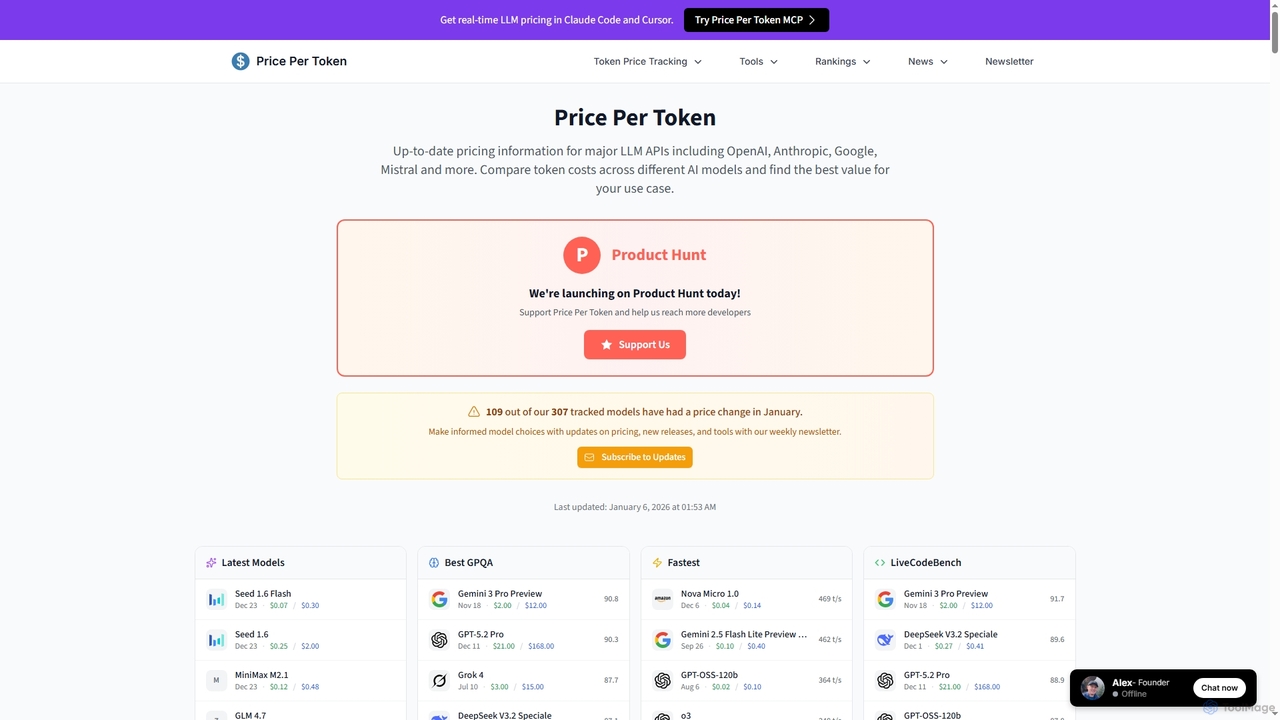
PricePerToken is an essential AI tool offering real-time LLM API pricing comparisons for over 300 models. It helps developers, researchers, and businesses compare token costs, analyze performance benchmarks, and optimize their AI spending across major providers like OpenAI, Anthropic, Google, and Mistral.

Llm Pricing
Visits 185.5KFavorites 52Likes 37
GenAI List

GenAI List

GenAI List is a comprehensive online directory dedicated to tracking, exploring, and comparing generative AI models. It serves as an essential guide to the rapidly evolving AI landscape, featuring thousands of models from various organizations. Users can discover new releases, filter by type, openness, and capabilities, and gain insights into practitioner opinions.

Model Discovery
Visits 5.8KFavorites 44Likes 40
Seed

Seed

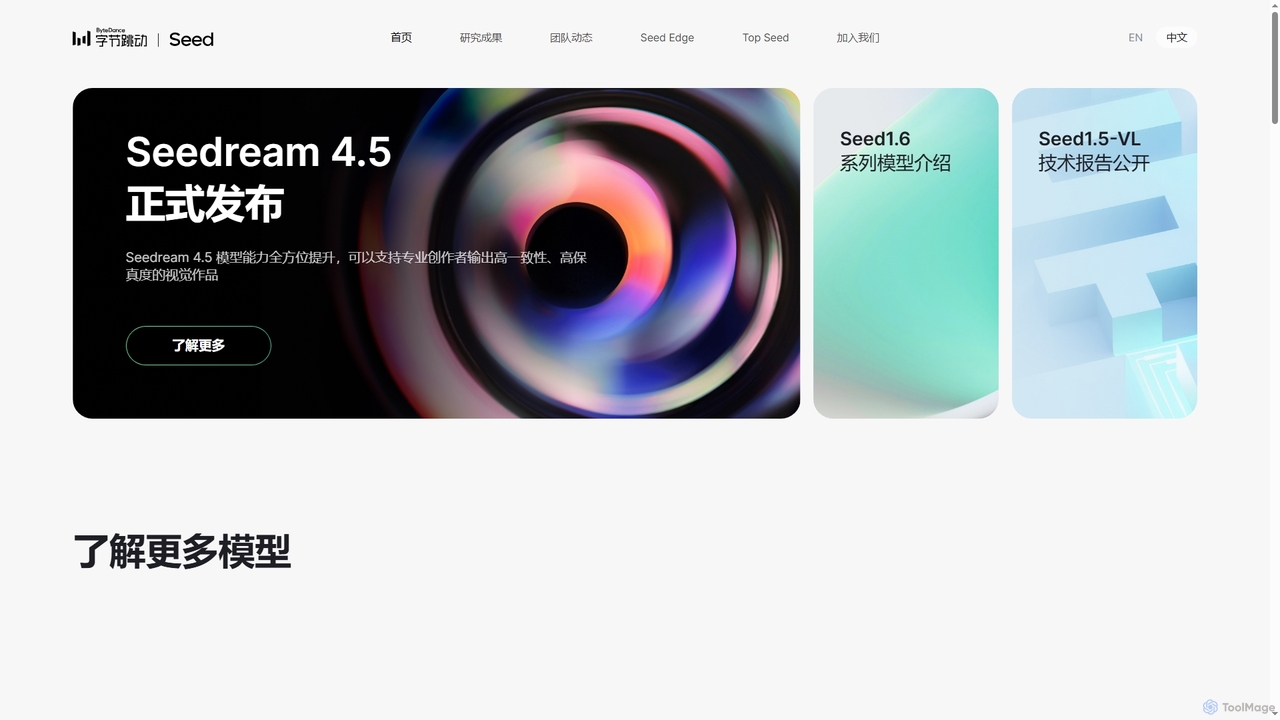
Seed is ByteDance's advanced AI research initiative focused on building general artificial intelligence. They develop foundational models across various domains including multimodal, vision, speech, robotics, and LLMs, driving innovation in both academic research and real-world applications.

Foundational Models
Visits 885.5KFavorites 120Likes 123
AIDiscoveryBoards

AIDiscoveryBoards

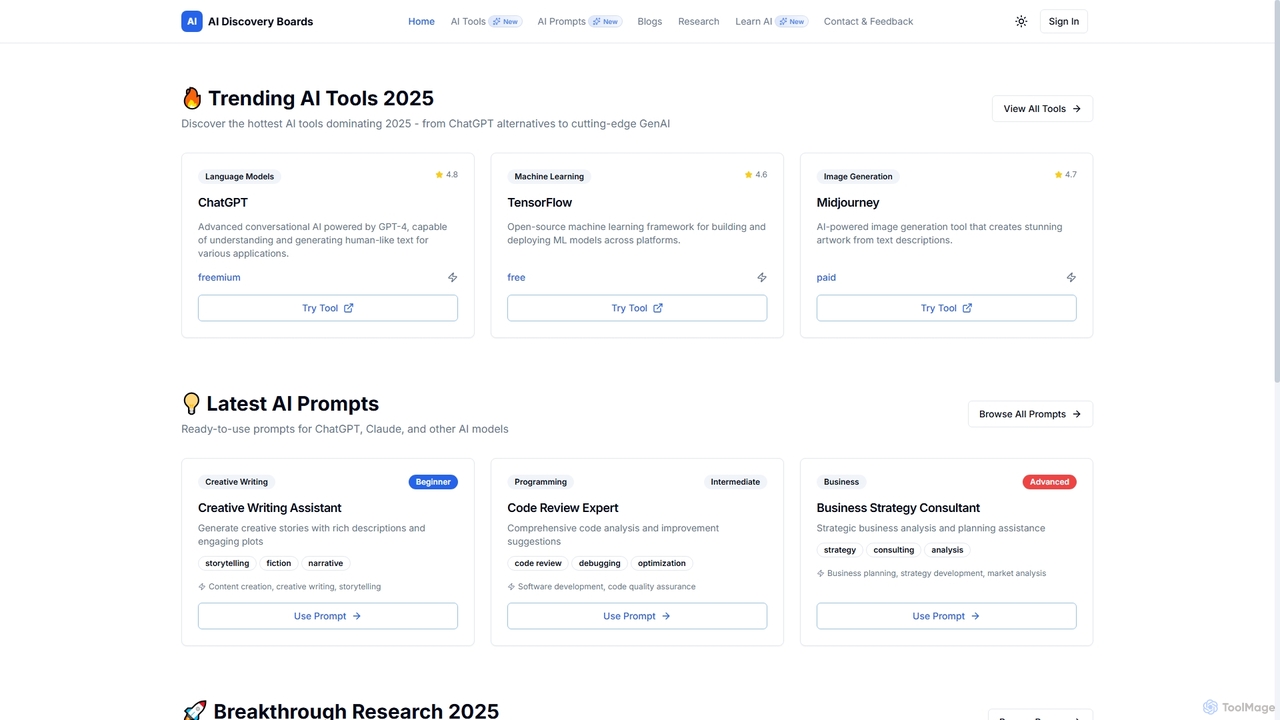
AIDiscoveryBoards is a comprehensive online platform designed to help users discover trending AI tools, explore the latest AI prompts, delve into groundbreaking AI research papers, and access curated AI learning resources. It serves as a central hub for staying updated on the rapidly evolving artificial intelligence landscape.

Tool Directory
Visits 5.6KFavorites 144Likes 141

About Ai Research

AI Research tools are specialized software platforms that facilitate the development, experimentation, and validation of artificial intelligence models. They provide integrated environments for managing datasets, tracking experiments, and analyzing model performance, often supporting popular frameworks like TensorFlow and PyTorch. These tools are crucial for researchers and data scientists to systematically explore new algorithms, reproduce results, and accelerate the innovation cycle in machine learning. By centralizing the research workflow, they enhance collaboration and ensure the integrity of experimental findings.

Core Features

  • Experiment Tracking: Logs and compares metrics, parameters, and artifacts for every model training run.
  • Model Versioning & Registry: Manages different versions of models, their lineage, and deployment stages.
  • Hyperparameter Optimization: Automates the process of finding the optimal set of hyperparameters for a model.
  • Data Management & Versioning: Tracks changes in datasets to ensure reproducibility and consistency in experiments.
  • Collaborative Workspaces: Provides shared environments for teams to work on projects, share insights, and manage resources.

Use Cases

These tools are primarily used in academic institutions, corporate R&D labs, and AI-focused startups. For instance, a university research group might use a platform to develop a novel neural network architecture, while a tech company's data science team could use it to build and refine a proprietary fraud detection model. They are essential in fields requiring rigorous experimentation, such as natural language processing, computer vision, and reinforcement learning.

How to Choose

When selecting an AI Research tool, consider its integration with your existing tech stack, including ML frameworks and cloud providers. Evaluate its scalability to handle large datasets and complex computations. Assess the collaboration features to ensure they fit your team's workflow. Finally, analyze the pricing model, whether it's open-source, usage-based, or a subscription, to align with your budget and project scale.

Ai Research use cases

1

Academic Research on Novel Algorithms

A university research team is developing a new type of neural network for climate modeling. They use an AI research platform to manage vast climate datasets, track hundreds of experimental runs with different architectures and hyperparameters, and visualize the results. The platform's collaboration features allow professors and PhD students to share findings in real-time, comment on specific runs, and collectively build upon each other's work, significantly accelerating the path to publication.

2

Corporate R&D for NLP Model Development

A data science team at a large tech company is tasked with building a next-generation sentiment analysis model. Using an AI research tool, they can version control their large text datasets, ensuring every team member uses the same data. The tool's experiment tracking automatically logs the performance of different model architectures (like BERT vs. GPT variants). This systematic approach allows them to compare results objectively and select the best-performing model for integration into their customer feedback analysis product.

3

Reproducible Research and Benchmarking

An independent organization aims to create a public benchmark for computer vision models on a new, challenging dataset. They use an AI research platform to host the dataset and provide a standardized environment. Researchers from around the world can submit their models. The platform automatically runs the models against the dataset, tracks performance metrics like accuracy and inference speed, and updates a public leaderboard. This ensures fair, transparent, and reproducible benchmarking for the entire AI community.

4

Hyperparameter Tuning for Optimization

An AI engineer is trying to maximize the accuracy of an image classification model. Manually testing different learning rates, batch sizes, and optimizer types is time-consuming. They use the hyperparameter optimization feature of an AI research tool. They define the range of values for each parameter, and the tool automatically runs dozens of experiments in parallel on a cloud cluster. It presents a dashboard showing which combination of parameters yielded the best results, saving days of manual work and leading to a more performant model.

5

Developing Reinforcement Learning Agents

A startup is building a reinforcement learning (RL) agent to optimize logistics routing. The research process involves numerous simulations in a virtual environment. An AI research platform is used to manage these simulations as experiments. It logs key metrics for each run, such as total distance traveled and delivery times. The platform allows the team to visualize the agent's learning progress over thousands of episodes and compare the effectiveness of different reward functions, which is critical for developing a commercially viable RL model.

6

Managing Model Lineage and Governance

In a regulated industry like finance, a team needs to build an AI model for credit scoring. It's crucial to maintain a clear audit trail. They use an AI research platform with a model registry. This feature tracks which version of the code, data, and parameters were used to train each specific model version. When regulators ask for an explanation of a model's decision, the team can quickly retrieve the exact artifacts used to build it, ensuring compliance and transparency in their AI development process.

Ai Research FAQ

What are AI Research tools?

AI Research tools are comprehensive software platforms designed to streamline the entire machine learning lifecycle, from data preparation to model deployment. They provide a structured environment for researchers and data scientists to conduct experiments, track results, manage models, and collaborate effectively. Key features often include experiment tracking, data versioning, hyperparameter optimization, and model registries, which collectively accelerate innovation and ensure research reproducibility.

How do I choose the right AI Research tool?

Choosing the right tool depends on your specific needs. Consider the following factors:

  • Framework Support: Ensure it supports your preferred machine learning frameworks (e.g., TensorFlow, PyTorch, Scikit-learn).
  • Scalability: Assess its ability to handle your data volume and computational demands, including support for distributed training.
  • Collaboration: Evaluate its features for team-based projects, such as shared workspaces, user roles, and reporting.
  • Integration: Check for compatibility with your existing infrastructure, like cloud storage (S3, GCS) and code repositories (GitHub, GitLab).
  • Cost and Deployment: Compare pricing models (open-source, SaaS, on-premise) and choose one that fits your budget and security requirements.
What's the difference between an AI Research tool and a standard IDE?

A standard Integrated Development Environment (IDE) like VS Code or PyCharm is primarily a code editor with debugging and version control integrations. An AI Research tool is a much more specialized platform built on top of that. It focuses on the entire MLOps lifecycle, providing features specifically for machine learning, such as tracking experiment metrics, visualizing model performance, managing large datasets, and automating hyperparameter searches. While you write code in an IDE, you manage and analyze the entire research process in an AI Research tool.

Who are the primary users of AI Research tools?

The primary users are individuals and teams actively involved in building and training AI models. This includes:

  • Academic Researchers: PhD students and professors in universities who are pushing the boundaries of AI theory and application.
  • Data Scientists: Professionals in corporate settings who build predictive models for business applications like fraud detection, recommendation systems, or customer churn analysis.
  • Machine Learning Engineers: Engineers who focus on the practical application and scaling of models, ensuring they are robust and efficient for production environments.
  • AI Startups: Teams in startups that are developing novel AI-powered products and need to iterate on model development quickly.
Why is experiment tracking important in AI research?

Experiment tracking is crucial for several reasons. First, it ensures reproducibility; you can always go back to a previous experiment and know exactly which code, data, and hyperparameters were used. Second, it facilitates comparison; you can systematically compare the performance of dozens or hundreds of model runs to identify what works best. Third, it supports collaboration by creating a centralized, shared record of all research activities, preventing duplicated effort and enabling teams to build on each other's findings. Without systematic tracking, AI research can become chaotic and difficult to manage, especially in complex projects.