AIWorldNext
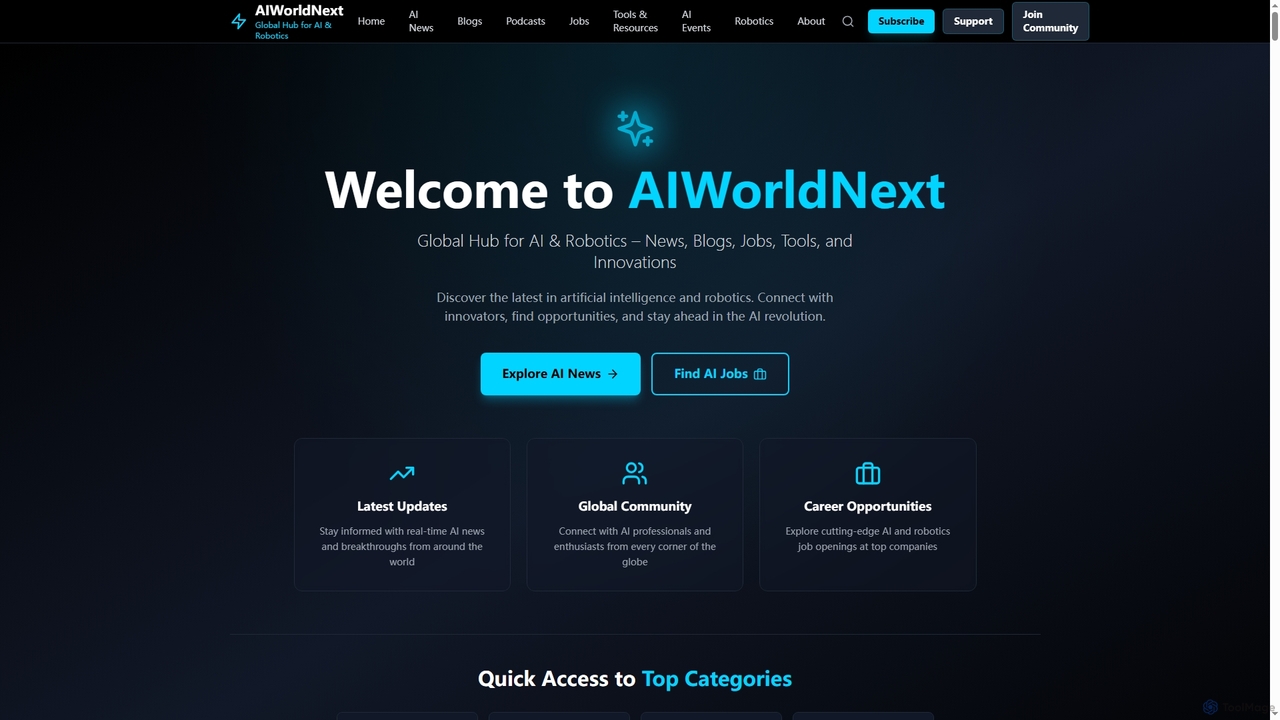
AIWorldNext is a premier global hub for artificial intelligence and robotics, offering a comprehensive platform for news, expert …
AIWorldNext is a premier global hub for artificial intelligence and robotics, offering a comprehensive platform for news, expert blogs, job opportunities, AI tool directories, and community engagement. It serves as a vital resource for professionals, researchers, and enthusiasts to stay informed and connected in the rapidly evolving AI landscape.
About Ai Resource
AI Resources are foundational elements and platforms that empower the development, deployment, and understanding of artificial intelligence. These resources encompass a wide array of tools, datasets, models, and knowledge bases, providing essential building blocks for innovators and users alike. They enable everything from training sophisticated AI models to accessing pre-built solutions and staying informed about the latest advancements in the AI landscape.
Core Features
- Pre-trained Models: Access to ready-to-use AI models for various tasks like natural language processing, computer vision, and speech recognition.
- Comprehensive Datasets: Curated collections of data essential for training, validating, and testing AI algorithms across diverse domains.
- API Access: Programmatic interfaces allowing developers to integrate AI functionalities into their applications without building models from scratch.
- Development Platforms: Integrated environments offering tools for AI model creation, training, deployment, and management.
- Learning & Documentation: Educational materials, tutorials, and extensive documentation to guide users in understanding and utilizing AI technologies.
Use Cases
AI Resources are indispensable across various sectors. Developers leverage them to accelerate model training and integrate advanced AI capabilities into software. Researchers utilize vast datasets and pre-trained models for experimentation and innovation. Businesses access AI APIs to enhance existing products or build new AI-powered services, while individuals use learning resources to upskill in AI. They serve as the backbone for creating intelligent applications and fostering AI literacy.
How to Choose
Selecting the right AI Resources involves evaluating several factors. Consider the specific AI task (e.g., NLP, vision), the quality and relevance of available datasets, the performance and flexibility of pre-trained models or APIs, and the ease of integration with existing systems. Also, assess the cost, community support, and the comprehensiveness of documentation and learning materials provided by the resource.

Ai ResourceUse Cases
Accelerating AI Model Development with Pre-trained Models
AI developers and data scientists can significantly reduce development time by leveraging pre-trained AI models. Instead of training a model from scratch, they can fine-tune an existing model (e.g., a large language model or an image recognition model) with their specific dataset. This approach saves computational resources, accelerates prototyping, and allows for faster deployment of AI-powered features in applications, from intelligent chatbots to advanced image analysis tools.
Enhancing Product Features via AI APIs
Product managers and software engineers can integrate sophisticated AI capabilities into their applications without deep AI expertise by using AI APIs. For instance, an e-commerce platform can use a sentiment analysis API to gauge customer feedback from reviews, or a content management system can utilize a text summarization API to generate concise article previews. This allows for rapid feature deployment, enriching user experience and adding competitive value to products.
Training Custom AI Models with Specialized Datasets
Researchers and enterprise AI teams often require highly specific datasets to train custom AI models for niche applications. AI resource platforms provide access to vast, diverse, and often domain-specific datasets (e.g., medical imaging, financial transactions, autonomous driving data). These curated datasets are crucial for developing accurate and robust AI solutions tailored to unique business challenges, ensuring models perform optimally in their intended environments.
Learning and Upskilling in Artificial Intelligence
Individuals and teams looking to build expertise in AI can utilize comprehensive AI learning resources. These include online courses, tutorials, documentation, and community forums provided by AI resource platforms. Aspiring AI engineers can learn about machine learning algorithms, deep learning frameworks, and practical application development. This fosters a skilled workforce capable of understanding, implementing, and managing AI technologies effectively.
Benchmarking and Evaluating AI System Performance
AI researchers and engineers use standardized AI resources, such as benchmark datasets and evaluation metrics, to assess and compare the performance of different AI models and algorithms. By running their models against established benchmarks, they can objectively measure accuracy, efficiency, and robustness. This process is vital for identifying superior models, understanding their limitations, and driving continuous improvement in AI research and development.
Accessing Open-Source AI Frameworks and Libraries
Developers and academic institutions frequently rely on open-source AI frameworks and libraries (e.g., TensorFlow, PyTorch) available as AI resources. These frameworks provide the fundamental tools and infrastructure for building, training, and deploying machine learning models. Their open nature fosters collaboration, allows for customization, and significantly lowers the barrier to entry for AI development, enabling a wide range of innovative projects and research initiatives.