Transluce
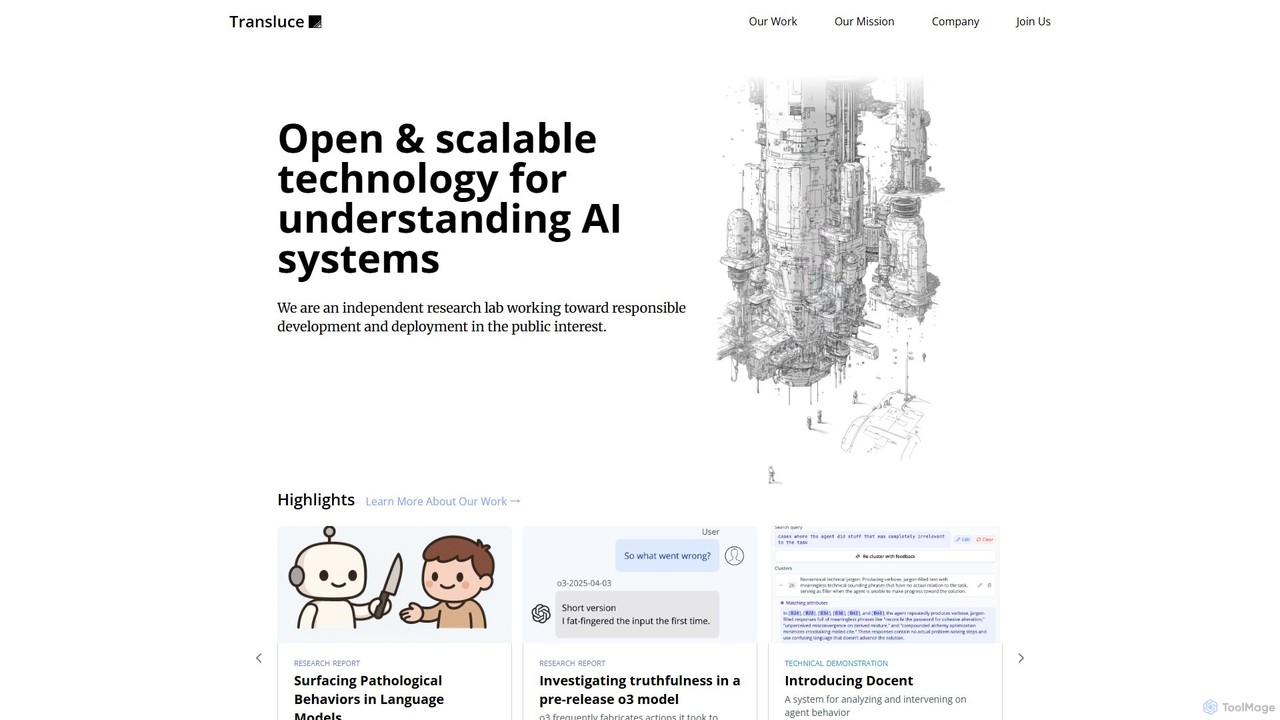
Transluce is an independent research lab developing open, scalable technology to understand AI systems. They build tools like …
Transluce is an independent research lab developing open, scalable technology to understand AI systems. They build tools like Docent and Monitor to analyze, evaluate, and intervene in AI agent behavior, promoting responsible AI development through enhanced interpretability and safety.
About Model Evaluation
Model Evaluation tools are a class of software used to systematically assess the performance, fairness, and robustness of artificial intelligence models. They employ quantitative metrics and qualitative analysis to measure a model's accuracy, identify hidden biases, and test its resilience against unexpected or adversarial inputs. This evaluation is critical for ensuring model reliability, maintaining user trust, and mitigating risks before and after deployment. As a key component of AI Security and MLOps, these tools provide the necessary insights to build safe, effective, and responsible AI systems.
Core Features
- Performance Metrics Analysis: Measures standard metrics like accuracy, precision, recall, F1-score, and AUC for classification, or MSE and R² for regression.
- Bias and Fairness Auditing: Detects and quantifies biases related to demographics, gender, or other sensitive attributes in model predictions.
- Robustness and Stress Testing: Simulates adversarial attacks, noisy data, and edge cases to evaluate a model's stability and security.
- Explainability (XAI) Analysis: Provides insights into a model's decision-making process using techniques like SHAP or LIME to enhance transparency.
- Drift Detection: Monitors for changes in data distributions or model performance over time to signal when retraining is needed.
Use Cases
Model Evaluation tools are essential in high-stakes industries like finance for validating credit scoring models, in healthcare for verifying diagnostic AI, and in autonomous systems for ensuring the safety of perception models. They are also used in HR to audit recruitment algorithms for fairness and in e-commerce to maintain the relevance of recommendation engines.
How to Choose
When selecting a Model Evaluation tool, consider the frameworks and model types it supports (e.g., TensorFlow, PyTorch, Scikit-learn). Evaluate its integration capabilities with your existing MLOps pipeline and data sources. Assess the depth of its analysis features, including the range of fairness and robustness tests. Finally, examine its reporting and visualization capabilities for sharing insights with stakeholders.

Model EvaluationUse Cases
Pre-Deployment Validation of a Credit Scoring Model
A data science team at a financial institution is developing a new AI model to assess credit risk. Before deploying it, they use a model evaluation tool to perform a comprehensive audit. The tool analyzes the model's accuracy, precision, and recall on a holdout dataset. Critically, it runs fairness checks to ensure the model does not discriminate against applicants based on protected attributes like race or gender. It also conducts robustness tests by simulating scenarios with missing data or unusual inputs, ensuring the model's predictions remain stable and reliable under various conditions, thereby mitigating regulatory and reputational risk.
Auditing an LLM for Safety and Hallucinations
A company integrating a Large Language Model (LLM) into its customer service chatbot uses a model evaluation platform to ensure its safety and reliability. The platform runs a suite of tests specifically designed for LLMs. This includes evaluating the model for toxic or biased language generation, testing its propensity to 'hallucinate' or generate factually incorrect information, and assessing its vulnerability to prompt injection attacks. The evaluation report provides clear metrics and examples, allowing developers to fine-tune the model or implement stronger guardrails before public release, protecting the brand and its users.
Stress Testing an Autonomous Vehicle's Perception Model
An automotive engineering team uses a model evaluation tool to stress-test the object detection model for an autonomous vehicle. The tool generates and applies a wide range of adversarial examples, such as traffic signs with subtle graffiti or images captured in adverse weather conditions like heavy rain or fog. By measuring the model's performance drop under these challenging scenarios, engineers can identify specific weaknesses. This iterative process of testing and retraining is crucial for improving the model's robustness and ensuring the vehicle's safety in real-world driving conditions.
Monitoring a Recommendation Engine for Performance Drift
An e-commerce platform relies on an AI-powered recommendation engine to drive sales. To ensure its continued effectiveness, the MLOps team uses a model evaluation tool for continuous monitoring in production. The tool tracks key performance indicators (KPIs) like click-through rate and conversion rate. It also monitors for data drift by comparing the statistical properties of incoming user data with the training data. If the tool detects a significant performance drop or data drift, it automatically alerts the team, who can then investigate the cause and trigger a retraining pipeline to adapt the model to new user behaviors and trends.
Ensuring Fairness in an AI-Powered Hiring Tool
An HR technology company develops an AI tool to screen resumes and shortlist candidates. To prevent algorithmic bias, the product team uses a model evaluation service to audit the tool for fairness. The service analyzes the model's decisions across different demographic groups (e.g., gender, ethnicity) to identify any statistically significant disparities in shortlisting rates. The evaluation report highlights which features might be contributing to the bias. Based on these insights, the development team can apply bias mitigation techniques, such as re-weighting data or adjusting the algorithm, to create a more equitable and compliant hiring tool.
Validating a Medical Imaging AI for Clinical Use
A healthcare AI startup has developed a model to detect early signs of a disease from medical scans. Before seeking regulatory approval, they must rigorously validate its performance. They use a specialized model evaluation platform to assess the model's sensitivity, specificity, and accuracy on a diverse, multi-center dataset. The platform also helps them understand model failures by highlighting cases where it made incorrect predictions. This deep analysis is crucial for building a robust clinical validation report, demonstrating the model's safety and efficacy to regulatory bodies like the FDA, and gaining the trust of clinicians.