Linkgo
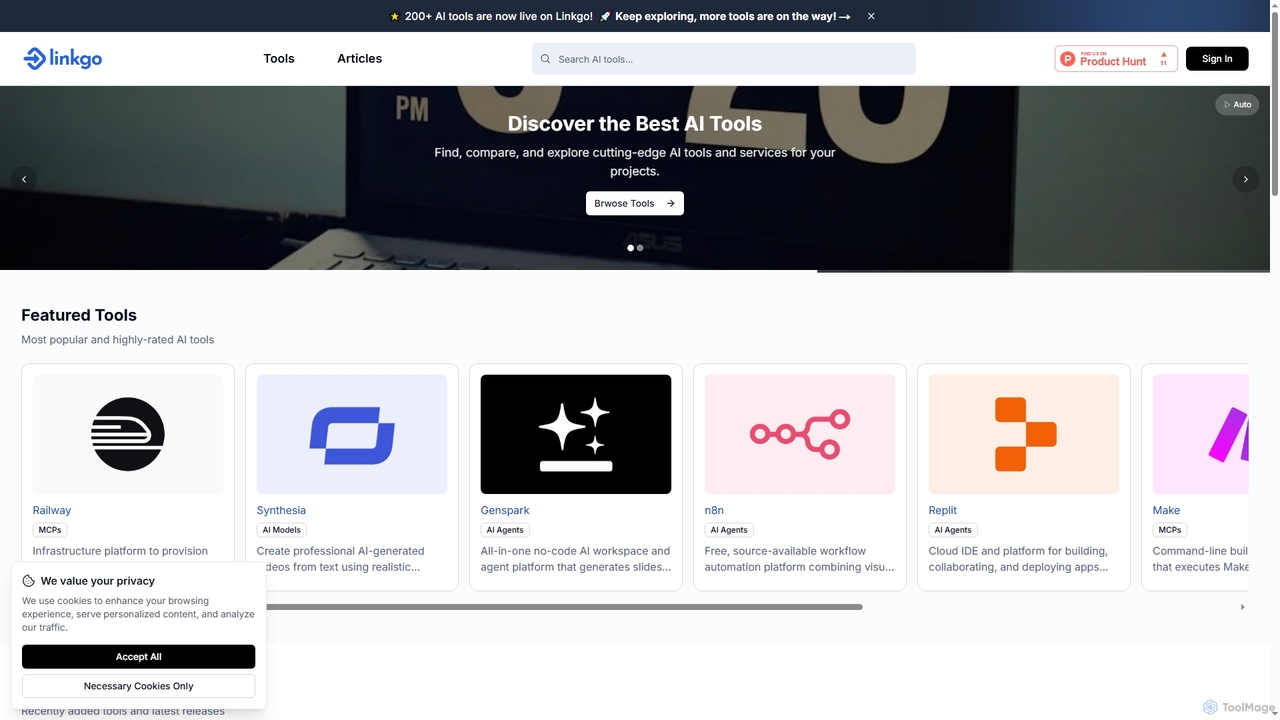
Linkgo is a comprehensive directory designed to help users discover, compare, and explore a wide array of cutting-edge …
Linkgo is a comprehensive directory designed to help users discover, compare, and explore a wide array of cutting-edge AI tools, models, and services. It features over 200 AI solutions, categorized for easy navigation and discovery.
About Ai Services
AI Services are platforms, APIs, and expert solutions that provide on-demand access to artificial intelligence capabilities. They leverage powerful, pre-trained models for complex tasks like natural language processing, computer vision, and predictive analysis. This allows businesses and developers to integrate advanced AI functions into their applications and workflows without needing to build and maintain the underlying infrastructure. The primary benefit of using AI Services is the ability to accelerate development, reduce costs, and scale AI-powered features efficiently.
Core Features
- API Access to Foundational Models: Provides programmatic access to large-scale AI models for tasks like text generation, translation, and image analysis.
- Managed Machine Learning Platforms: Offers end-to-end environments for training, deploying, and managing custom machine learning models.
- Specialized AI Solutions: Includes pre-built services for specific functions such as sentiment analysis, object detection, or fraud prevention.
- AI Consulting and Implementation: Delivers expert guidance to design, build, and integrate tailored AI systems into business operations.
Use Cases
AI Services are utilized across various sectors. Technology companies use them to build AI-native applications, e-commerce platforms leverage them for personalization and image processing, and financial institutions apply them for risk assessment. They are essential for developers prototyping new features and for enterprises seeking to automate complex internal processes without massive upfront investment in hardware and talent.
How to Choose
When selecting an AI Service, first define your specific use case—do you need a simple API call or a full platform for custom model development? Evaluate the service's documentation, scalability, and integration capabilities. Compare pricing models, such as pay-per-use versus subscription plans, and consider the level of support and customization offered. For sensitive applications, data privacy and security policies are also critical factors.
Ai ServicesUse Cases
Automating Customer Support with NLP Services
A global e-commerce company aims to reduce customer service response times and operational costs. By integrating a natural language processing (NLP) AI Service via its API, they deploy an intelligent chatbot on their website and app. This chatbot can understand user intent, answer frequently asked questions about orders and shipping, and escalate complex issues to human agents. As a result, the company automates over 60% of routine inquiries, providing 24/7 support and freeing up human agents to focus on high-value customer interactions.
Building a Personalized Content Recommendation Engine
A media streaming startup wants to increase user retention by providing highly relevant content suggestions. They use a managed machine learning platform, an AI Service, to process user viewing history and preferences. The platform allows their small development team to train and deploy a custom recommendation model without managing complex infrastructure. This new engine delivers personalized movie and show recommendations, leading to a 25% increase in user engagement and a significant reduction in churn rate within the first quarter.
Enhancing Product Imagery for E-commerce
An online fashion retailer needs to process thousands of new product photos weekly. They use a computer vision AI Service to automate image editing. The service's API allows them to programmatically remove backgrounds, adjust lighting, and automatically generate descriptive tags based on visual content (e.g., "red dress," "leather handbag"). This process reduces manual editing time from hours to minutes per batch, ensures a consistent visual style across the store, and improves product discoverability through accurate, AI-generated tags.
Analyzing Customer Feedback at Scale
A software-as-a-service (SaaS) company receives thousands of user feedback comments through surveys, support tickets, and app store reviews. To extract actionable insights, their product team uses a text analysis AI Service. The service processes all unstructured text to identify recurring themes, gauge customer sentiment (positive, negative, neutral), and flag urgent issues. This provides the team with a clear, data-driven overview of user needs, helping them prioritize feature development and bug fixes effectively.
Developing a Voice-Controlled Smart Home Application
A developer is creating a new smart home application and wants to include a hands-free interface. They integrate two separate AI Services: a speech-to-text API to convert spoken commands into text, and a text-to-speech API to provide audible feedback to the user. This allows them to build a robust voice control feature without deep expertise in speech recognition technology. Users can control lights, thermostats, and other devices simply by speaking, creating a modern and accessible user experience.
Implementing a Real-Time Fraud Detection System
A fintech company needs to protect its users from fraudulent transactions. They partner with an AI Service provider that offers specialized consulting and a machine learning platform. Together, they design and train a custom model using the company's historical transaction data. The deployed model analyzes new transactions in real-time, assigning a risk score to each one. This system successfully identifies and blocks over 98% of fraudulent attempts automatically, securing user accounts while minimizing false positives.