ToolMage
Sign in

Best 1 Directory AI tools for Ai Tool Discovery

Popular Directory AI tools in Ai Tool Discovery include cAImpare, helping you work more efficiently.

cAImpare

cAImpare

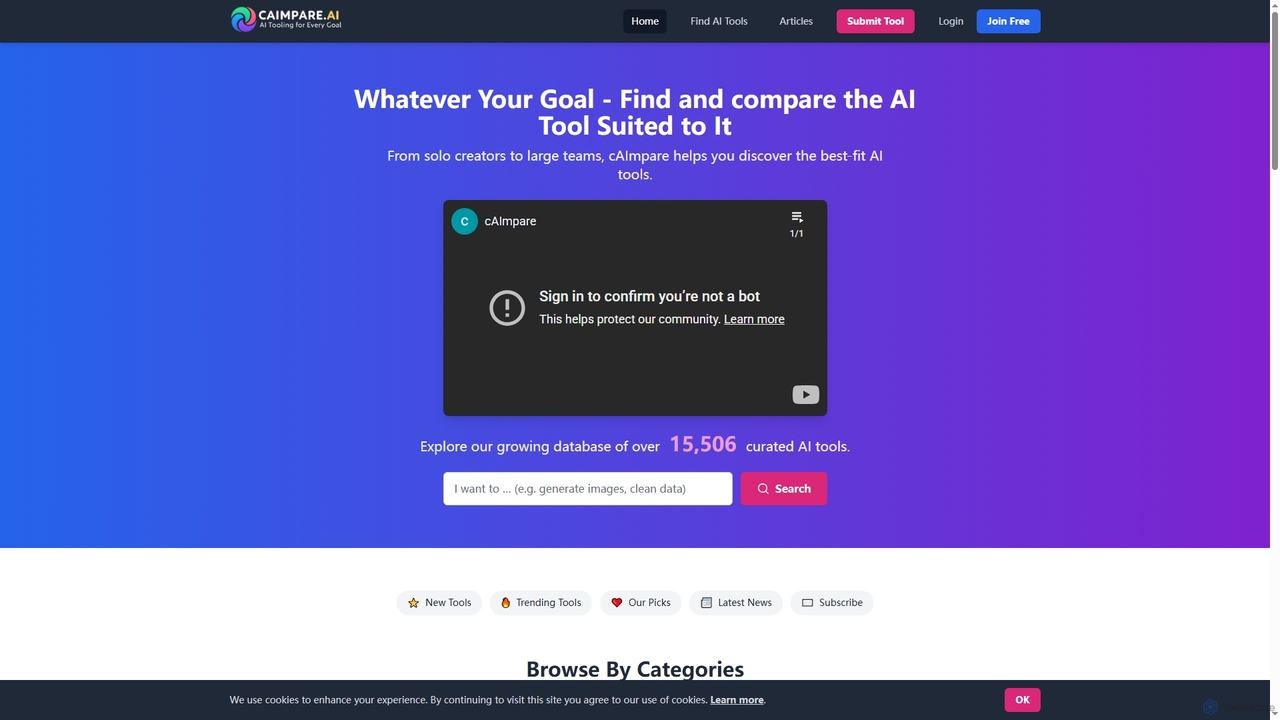
cAImpare is a leading AI tool discovery and comparison platform, offering a vast, curated database of over 20,000 AI tools. It helps individuals and teams efficiently find, evaluate, and select the best-fit AI solutions for any goal, from creative tasks to complex business operations, emphasizing real-world performance and practical applications.

Directory
Visits 5.6KFavorites 135Likes 127

About Directory

AI Tool Directory is a specialized platform designed to help users discover, categorize, and evaluate artificial intelligence tools, serving as a crucial component of AI tool discovery. These directories act as meticulously curated databases, simplifying the often overwhelming process of finding the right AI solution for specific needs across various industries. By offering structured information, authentic user reviews, and powerful comparison features, they enable efficient navigation through the rapidly expanding landscape of AI innovations, from generative AI to automation and analytics.

Core Features

  • Comprehensive Listing & Categorization: Provides extensive, organized collections of AI tools, meticulously categorized by function, industry, and application, ensuring users can explore a wide spectrum of solutions.
  • Advanced Search & Filtering: Offers robust search functionalities and granular filtering options, allowing users to quickly locate tools based on specific criteria such as pricing model, integration capabilities, or underlying technology.
  • User Reviews & Ratings: Integrates community-driven feedback, ratings, and testimonials, empowering users to assess the real-world performance, reliability, and user experience of various AI tools.
  • Detailed Tool Profiles: Presents in-depth information for each listed tool, including its core features, pricing structures, API documentation, integration possibilities, and practical use cases, aiding informed decision-making.
  • Comparison Tools: Features side-by-side comparison functionalities, enabling users to evaluate multiple AI tools simultaneously based on key attributes, performance metrics, and suitability for their specific requirements.

Applicable Scenarios

AI Tool Directories are invaluable for a diverse range of individuals and organizations seeking to effectively leverage artificial intelligence. Content creators can efficiently find AI writing assistants or image generators, while developers can discover new APIs or machine learning frameworks. Businesses, from startups to large enterprises, can identify tailored AI solutions for automation, data analysis, customer service, or marketing. These platforms serve as a central hub for exploring AI capabilities across diverse sectors like marketing, finance, healthcare, education, and software development, streamlining the adoption of cutting-edge technology.

How to Choose

When selecting an AI Tool Directory, it is essential to consider several key factors to ensure its effectiveness. Evaluate the breadth and depth of its listings, ensuring it covers a wide array of AI categories and niche tools relevant to your interests. Assess the granularity and intuitiveness of its filtering options, which are crucial for precise searches. The quality, recency, and trustworthiness of user reviews are paramount for gauging real-world performance. Furthermore, examine the depth of information provided for each tool, the frequency of updates to the directory, and whether it offers robust comparison features. A well-maintained directory with intuitive navigation, reliable data, and a strong community focus is crucial for effective and efficient AI tool discovery.

Directory use cases

1

Discovering Niche AI Tools for Specific Marketing Campaigns

A digital marketer needs an AI tool to generate highly personalized ad copy for a niche product. By using an AI directory, they can filter tools by 'ad copy generation' and 'personalization,' read reviews from other marketers, and quickly identify specialized solutions that might not appear in general search results, saving hours of research time and improving campaign relevance.

2

Discovering Niche AI Solutions for Content Creation

A content creator needs an AI tool specifically for generating short-form video scripts or unique blog post ideas. By using an AI tool directory, they can apply filters for 'content creation', 'video script generation', or 'blog idea generation' to quickly find specialized tools that meet their exact requirements, saving hours of manual research and comparison.

3

Discovering Niche AI Solutions for Marketing

A marketing manager needs an AI tool specifically for generating hyper-personalized ad copy across multiple platforms. They use an AI tool directory's advanced filters to search by "marketing," "copywriting," and "personalization," quickly identifying several specialized tools, reading reviews, and comparing features to select the best fit for their campaign, saving hours of manual research.

4

Competitive Analysis for Marketing Managers

A marketing manager wants to understand which AI tools their competitors are using for social media management or customer analytics. By browsing an AI tool directory, they can filter by industry, specific marketing functions, or even by popular tools to gain insights into market trends and competitor strategies, informing their own technology adoption decisions.

5

Comparing AI Code Generation Tools for Software Development

A software developer is evaluating several AI code generation tools for a new project, focusing on language support (Python, JavaScript), integration with IDEs, and pricing models. An AI directory allows them to view side-by-side comparisons of features, read technical reviews from other developers, and quickly assess which tool best fits their development stack and budget, streamlining the selection process.

6

Competitive Analysis for Startup Founders

A startup founder wants to understand the AI landscape their competitors operate in and identify potential gaps or opportunities. They browse an AI tool directory by industry and application, observing which AI tools are popular or emerging in their market segment. This helps them refine their product strategy and identify potential AI integrations for their own offerings, gaining a competitive edge.

7

Researching Emerging AI Trends for Journalists

A tech journalist or industry analyst needs to identify emerging AI categories, popular tools, and key players for an upcoming report. They regularly consult AI tool directories to track new listings, observe shifts in categorization, and analyze user engagement trends. This provides a real-time pulse on the AI market, informing their research and ensuring their insights are current and relevant.

8

Building a Startup's Essential AI Tool Stack

A startup founder needs to identify cost-effective and scalable AI tools for various business functions, from customer support chatbots to automated marketing. An AI tool directory allows them to compare features, pricing models, and integration capabilities across multiple tools, ensuring they select the most suitable and efficient solutions to build their initial tech stack without extensive trial and error.

9

Staying Updated on New AI Innovations and Industry Trends

An AI enthusiast or investor regularly monitors the AI landscape for emerging technologies and market shifts. By subscribing to updates or frequently browsing an AI directory's 'new tools' and 'trending' sections, they can quickly identify groundbreaking AI applications, understand their potential impact, and make informed decisions about investments or career paths, staying ahead of the curve.

10

Academic Research on AI Application Trends

A researcher is conducting a study on the proliferation and types of AI tools in specific domains like healthcare or education. By utilizing an AI tool directory, they can systematically collect data on tool categories, release dates, and reported functionalities, providing a structured overview of the current AI application landscape for their academic analysis and publications.

11

Evaluating AI Tool Alternatives for Developers

A software developer is looking for an alternative to an expensive or underperforming AI API for image recognition. They utilize an AI tool directory to search for similar tools, filtering by "image recognition," "API," and "pricing model." They compare features, performance benchmarks, and community feedback, ultimately finding a more cost-effective and efficient solution that integrates seamlessly into their project.

12

Researching AI Solutions for Business Process Automation

A small business owner wants to automate customer support and data entry. They use an AI directory to search for 'customer service AI' and 'data entry automation tools,' comparing features like chatbot capabilities, CRM integrations, and pricing tiers. This allows them to efficiently identify and evaluate AI solutions that can streamline operations and reduce manual workload, leading to significant cost savings.

13

Building an Enterprise AI Tech Stack

An enterprise architect is tasked with identifying and vetting AI tools for various departments, including HR, finance, and customer service. They leverage an AI tool directory to systematically explore solutions, evaluating tools based on enterprise-grade features, security compliance, integration capabilities with existing systems, and scalability. This structured approach ensures a cohesive and robust AI tech stack across the organization.

14

Evaluating AI Tools for Potential Investment

An investor or venture capitalist is assessing the market for AI tools in a particular sector, such as generative AI for marketing. They use AI tool directories to identify key players, evaluate their features, pricing, and user traction (via reviews), and understand the competitive landscape. This helps them perform due diligence and make informed investment decisions by quickly mapping out the ecosystem.

15

Discovering Free or Open-Source AI Alternatives for Startups

A startup founder with limited budget is looking for cost-effective AI solutions for their initial product development. By utilizing an AI directory, they can specifically filter for 'free' or 'open-source' AI tools, explore community-supported projects, and read about their capabilities and limitations. This helps them find viable alternatives to expensive commercial tools, enabling rapid prototyping and development without significant upfront investment.

16

Exploring New AI Technologies and Applications

An individual or professional keen on staying updated with the latest AI advancements uses directories as a learning resource. They can browse new listings, explore different categories, and read tool descriptions to understand emerging technologies and their practical applications. This continuous exploration fosters innovation and helps them identify potential new skills or business opportunities.

17

Evaluating AI Tools Based on User Feedback and Community Ratings

A product manager needs to select an AI-powered analytics tool but wants to avoid tools with poor user experience or unreliable performance. They consult an AI directory to review user ratings, read detailed testimonials, and identify common pain points or praises. This approach helps them make a data-driven decision based on real-world user experiences, minimizing the risk of adopting an unsuitable or underperforming tool.

18

Staying Updated on Latest AI Innovations for Consultants

An AI consultant needs to stay abreast of the latest AI innovations and new tool releases to provide cutting-edge advice to clients. They frequently visit AI tool directories, subscribing to update notifications and exploring newly added tools. This proactive approach allows them to recommend the most current and effective AI solutions, maintaining their expertise and client trust in a rapidly evolving field.

Directory FAQ

What is an AI Tool Directory?

An AI Tool Directory is an online platform that lists, categorizes, and provides detailed information about various artificial intelligence tools and services. Unlike a general search engine, it offers curated content, often including user reviews, ratings, and comparison features, specifically focused on AI solutions. Its primary purpose is to simplify the discovery and evaluation process for individuals and businesses seeking specific AI applications.

What are AI Tool Directories?

AI Tool Directories are curated online platforms that list, categorize, and provide detailed information about various artificial intelligence tools and services. They act as central hubs for discovering AI solutions across different functions and industries. Their core purpose is to simplify the search for specific AI technologies, offering structured data, user reviews, and filtering options to help users make informed choices.

What is an AI Tool Directory?

An AI Tool Directory is an online platform that lists and categorizes various artificial intelligence tools and services. It acts as a comprehensive database, helping users discover, compare, and evaluate AI solutions for different applications. These directories typically feature search filters, detailed tool profiles, and often include user reviews to guide selection.

How do AI Tool Directories help users?

AI Tool Directories significantly streamline the process of finding and evaluating AI solutions. They save users time by centralizing information, offering advanced search filters, and providing user reviews that offer practical insights. This helps users quickly identify tools that match their specific needs, compare alternatives, and stay updated on new developments in the AI landscape, ultimately leading to more informed and efficient decision-making.

How does an AI Tool Directory help users discover tools?

An AI Tool Directory streamlines discovery by centralizing information and offering robust search and filtering options. Users can quickly narrow down choices based on specific criteria like function (e.g., image generation, content writing), pricing model (free, freemium, paid), industry application, or integration capabilities. This structured approach saves significant time compared to general web searches, providing curated and relevant results.

How do AI Tool Directories help with AI tool discovery?

AI Tool Directories significantly streamline AI tool discovery by organizing a vast number of tools into searchable categories, making it easy to find solutions for specific needs like natural language processing, image generation, or data analytics. They provide advanced filtering options, user-generated reviews, and side-by-side comparisons, saving users considerable time and effort in researching and vetting potential AI tools. This structured approach ensures more informed decision-making.

What features should I look for in an AI Tool Directory?

When choosing an AI tool directory, prioritize comprehensive categorization and advanced filtering options to narrow down your search effectively. Look for detailed tool profiles that include pricing, integrations, and use cases. User reviews and ratings are crucial for real-world insights. Additionally, consider the directory's update frequency to ensure the information is current, and a user-friendly interface for an optimal discovery experience.

What should I look for when choosing an AI Tool Directory?

When selecting an AI Tool Directory, prioritize comprehensiveness, ensuring it covers a wide range of AI categories and tools. Look for robust search and filtering capabilities that allow precise queries. The quality and recency of user reviews and ratings are crucial for gauging real-world performance. Additionally, consider the depth of information provided for each tool, the frequency of directory updates, and whether it offers comparison features for efficient evaluation.

What should I look for when choosing an AI Tool Directory?

When choosing an AI Tool Directory, prioritize the breadth and depth of its listings, ensuring it covers a wide range of categories and offers numerous tools within each. Look for directories with accurate, frequently updated information and robust search/filtering capabilities. User reviews and ratings are crucial for real-world insights, and a clean, intuitive interface enhances the discovery experience. Also, consider if it tracks new tools and industry trends.

How do AI Tool Directories differ from general search engines?

Unlike general search engines that provide broad web results, AI Tool Directories offer curated, structured, and specialized information specifically about AI tools. They categorize tools by function, industry, and features, often including user reviews, pricing models, and direct links. This focused approach ensures higher relevance and quality of results for users actively seeking AI solutions, saving them from sifting through irrelevant content.

What's the difference between an AI Tool Directory and a general search engine for AI tools?

An AI Tool Directory offers curated, categorized, and often reviewed listings specifically for AI tools, providing structured information like features, pricing, and user feedback. A general search engine, while capable of finding AI tools, returns a broader, less organized set of results, including articles, news, and unrelated content. Directories focus on direct tool discovery and comparison, whereas search engines provide a wider web overview.

What's the difference between an AI Tool Directory and a general AI news site?

An AI Tool Directory primarily focuses on listing, categorizing, and providing detailed profiles of actual AI tools and services, often including user reviews and comparison features. Its main goal is to facilitate the discovery and selection of specific AI solutions. In contrast, a general AI news site focuses on articles, updates, research breakthroughs, and broader industry trends related to artificial intelligence, without necessarily providing a structured database of tools for direct evaluation.

Who benefits most from using an AI Tool Directory?

AI Tool Directories primarily benefit individuals and organizations actively seeking to integrate AI into their workflows or products. This includes content creators, marketers, developers, small business owners, and enterprise decision-makers. They are particularly useful for those who need to quickly identify, compare, and evaluate AI solutions without spending excessive time on fragmented research, ensuring they find the most suitable tools efficiently.

Who benefits most from using AI Tool Directories?

A wide range of users benefits from AI Tool Directories. Individual content creators, marketers, and small business owners can quickly find tools to enhance productivity. Developers and researchers use them to discover new APIs, frameworks, or specialized AI models. Enterprise decision-makers leverage directories to identify scalable solutions for their organizations. Essentially, anyone looking to efficiently navigate the complex and rapidly evolving AI landscape to find suitable tools will find these directories invaluable.

Who benefits most from using AI Tool Directories?

A wide range of users benefits from AI Tool Directories. This includes startups and small businesses looking to integrate AI cost-effectively, marketing and sales professionals seeking competitive advantages, developers and researchers exploring new technologies, and content creators or designers needing specialized AI assistance. Essentially, anyone looking to efficiently discover, compare, and select AI tools for specific tasks or strategic planning will find these directories invaluable.