ToolMage
Sign in

Best 1 Discovery AI tools for Ai Tools Directory

Popular Discovery AI tools in Ai Tools Directory include Top AI Tools, helping you work more efficiently.

Top AI Tools
Free

Top AI Tools

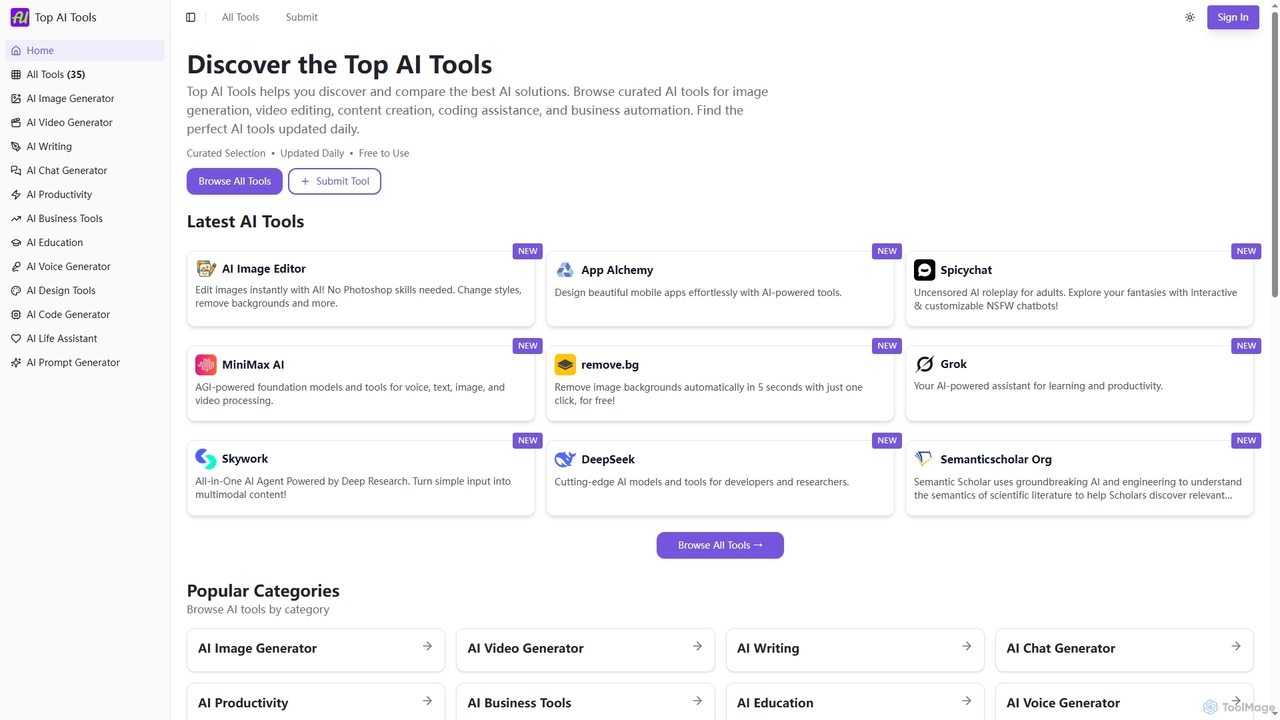
Top AI Tools is a comprehensive, free-to-use directory that helps users discover, compare, and explore the best AI-powered software solutions across various categories. It provides curated listings, detailed information on features and pricing, and daily updates to simplify the search for the perfect AI tool for any need.

Discovery
Visits 13.1KFavorites 134Likes 129

About Discovery

AI Discovery tools are specialized platforms designed to help users find, compare, and select the most suitable artificial intelligence solutions from a vast ecosystem. They function as intelligent search engines and curated directories, often using semantic search and recommendation algorithms to match user needs with specific tool capabilities. These platforms are invaluable for developers, marketers, and businesses, saving significant time in research and enabling informed decision-making. By aggregating data, reviews, and feature sets, they provide a centralized hub for navigating the complex landscape of AI technology.

Core Features

  • Curated Directories: Aggregating and categorizing a wide range of AI tools with detailed, structured information.
  • Semantic Search: Enabling users to search by problem, function, or natural language queries, not just keywords.
  • Comparison Engines: Providing side-by-side analysis of tools based on features, pricing, and user ratings.
  • Personalized Recommendations: Suggesting relevant tools based on user profiles, project requirements, or browsing history.

Use Cases

These tools are essential for technology consultants identifying solutions for clients, marketing teams searching for the latest automation software, and developers looking for specific APIs or models. For instance, a startup founder can use a discovery platform to quickly compare different AI chatbot providers for their customer service, evaluating features and pricing in one place.

How to Choose

When selecting an AI Discovery tool, consider the breadth and depth of its database—does it cover the categories you need? Evaluate the quality of its search and filtering capabilities. Also, check for the presence of authentic user reviews, community feedback, and the frequency of updates to ensure the information is current and reliable.

Discovery use cases

1

Finding the Right API for a New Application

A mobile app developer needs to integrate a text-to-speech feature. Instead of manually searching through countless web pages, they use an AI Discovery platform. They can filter by 'Text-to-Speech API,' compare options based on crucial criteria like language support, pricing models (e.g., per character), and the quality of developer documentation. This structured approach allows them to identify and evaluate the most suitable API in minutes, saving hours of fragmented research.

2

Selecting a Social Media Content Generator

A marketing manager wants to automate social media post creation. They use a discovery tool to search for 'AI content generation for social media.' The platform displays a list of tools, which they can compare based on supported platforms (e.g., Instagram, LinkedIn), content formats (text, image, video), and integration with scheduling tools. This allows for a direct comparison of capabilities, helping them choose a tool that fits their specific workflow and content strategy.

3

Evaluating AI-Powered Business Software

A small business owner is looking to upgrade their Customer Relationship Management (CRM) system with AI features. Using a discovery platform, they can filter the CRM category for tools with 'AI lead scoring' or 'sales forecasting'. The platform allows them to read detailed comparisons, user reviews from similar businesses, and understand pricing structures without needing to sign up for multiple product demos, streamlining the procurement process.

4

Tracking Emerging AI Models and Research

An academic researcher needs to stay updated on the latest advancements in Large Language Models (LLMs). They use a specialized discovery platform that aggregates not just tools, but also new research papers, open-source models from hubs like Hugging Face, and trending projects. This provides a centralized dashboard for tracking the state-of-the-art in their field, ensuring they don't miss critical developments.

5

Discovering Niche AI Art Generators

A digital artist is looking for an AI image generator with a specific aesthetic, like 'anime' or 'pixel art.' General-purpose search engines yield overwhelming results. They use an AI discovery tool with advanced tagging and style filters to quickly find and compare niche generators. By viewing sample outputs and reading reviews from other artists within the platform, they can find the perfect tool for their creative style without endless trial and error.

6

Conducting Competitive Landscape Analysis

A product manager is planning a new AI-powered feature. They use a discovery platform to analyze the competitive landscape. They can identify all existing tools in a specific niche, compare their feature sets, understand their pricing models, and gauge their market popularity through user ratings. This data is crucial for defining their product's unique value proposition and strategic positioning, providing a clear market overview that would be difficult to assemble manually.

Discovery FAQ

What are AI Discovery tools?

AI Discovery tools are online platforms, such as directories or specialized search engines, that help users find, compare, and learn about other AI tools and services. They aggregate and structure information from across the web, using smart search and filtering to simplify navigation of the vast AI ecosystem. Their primary goal is to streamline the research process and empower users to make informed decisions quickly.

How to choose the right AI Discovery platform?

To choose the right platform, consider these key factors:

  • Database Scope: Does it cover the tool categories and niches you are interested in? A comprehensive database is crucial.
  • Data Freshness: How often is the information updated? The AI space evolves rapidly, so current data is essential.
  • Search & Filtering Quality: Does it offer advanced filters (e.g., by price, features, integrations) to effectively narrow down results?
  • Community & Reviews: Are there genuine, unbiased user reviews and ratings to provide social proof and real-world insights?
What's the difference between an AI Discovery tool and a regular search engine?

A regular search engine provides broad, uncurated results based on keyword matching, often mixing in articles, ads, and irrelevant content. An AI Discovery tool offers a structured, curated, and specialized experience. It provides categorized listings, detailed feature comparisons, standardized information, and user reviews, all focused specifically on AI tools. This saves users from sifting through noise and provides a much more efficient research process.

Are AI Discovery tools free to use?

Most AI Discovery platforms, especially directories and community-driven sites, are free for users who are searching for tools. They typically generate revenue through other means, such as featured listings for tool developers, advertising, or affiliate partnerships. Some advanced platforms that offer deep market analysis or enterprise-level recommendation services may operate on a subscription model, but the core discovery function is usually accessible to everyone.

Who should use AI Discovery tools?

Anyone looking for an AI solution can benefit. This includes a wide range of users:

  • Developers searching for specific APIs or models.
  • Marketers evaluating automation and content creation software.
  • Business Owners seeking to integrate AI into their operations.
  • Researchers tracking new models and academic papers.
  • Students and Hobbyists exploring the possibilities of creative AI tools.

They are particularly useful for anyone who wants to save time and make a well-informed choice without being an expert in every AI domain.