Hippo Scribe
Hippo Scribe is an AI-powered medical scribe for healthcare professionals like physical therapists, OTs, and SLPs. It uses …
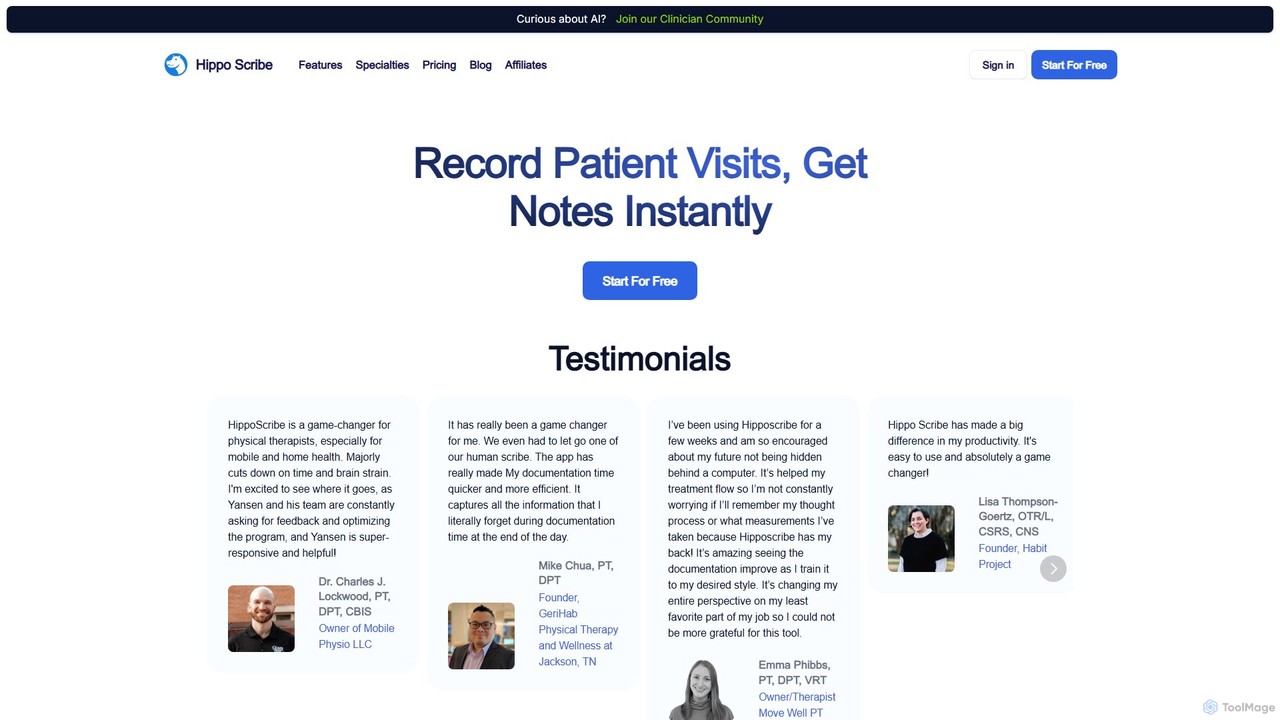
Hippo Scribe is an AI-powered medical scribe for healthcare professionals like physical therapists, OTs, and SLPs. It uses ambient listening to record patient visits and automatically generates HIPAA-compliant clinical notes in seconds. By integrating with EMR systems via a Chrome extension and offering customizable templates, it drastically reduces documentation time, minimizes burnout, and allows practitioners to focus entirely on patient care. It's a game-changer for improving efficiency and workflow in clinical settings.
About Medical Scribe
AI Medical Scribes are specialized tools designed to automate clinical documentation by transcribing and structuring doctor-patient conversations in real-time. Leveraging advanced speech recognition and natural language processing (NLP), these tools accurately capture medical terminology, patient history, and treatment plans directly from dialogue. Their primary value is to significantly reduce the administrative burden on healthcare professionals, freeing up time for direct patient care and mitigating burnout. They transform spoken interactions into organized, editable medical notes compatible with electronic health records (EHRs).
Core Features
- Ambient Listening & Transcription: Passively captures and transcribes conversations during patient encounters without intrusive recording procedures.
- Structured Note Generation: Automatically organizes transcribed text into standard clinical formats like SOAP notes, H&P, and consultation summaries.
- Medical Terminology Recognition: Accurately identifies and spells complex medical terms, drug names, and acronyms specific to various specialties.
- EHR/EMR Integration: Seamlessly syncs generated documentation with major electronic health record systems, streamlining the charting process.
- Speaker Diarization: Distinguishes between the voices of the clinician and the patient for accurate attribution in the notes.
Use Cases
AI Medical Scribes are primarily used in clinical settings where detailed documentation is crucial. This includes primary care practices, specialty clinics (such as cardiology, oncology, and orthopedics), hospitals for inpatient rounds, and telehealth consultations. Physicians, nurse practitioners, and physician assistants use these tools to automate note-taking during patient visits, allowing for more focused and empathetic patient interaction.
How to Choose
When selecting an AI Medical Scribe, consider the following: First, evaluate its transcription accuracy, especially for your specific medical specialty's vocabulary. Second, verify its integration capabilities with your existing EHR/EMR system for a smooth workflow. Third, ensure the tool is compliant with healthcare regulations like HIPAA. Finally, assess the level of customization available for note templates to match your charting style.
Medical ScribeUse Cases
Automating Primary Care SOAP Notes
A primary care physician uses an AI Medical Scribe during a routine patient check-up. The tool operates ambiently in the background on a tablet or computer, capturing the entire conversation. It automatically distinguishes between the doctor's questions and the patient's responses, identifies key symptoms, diagnoses, and prescribed medications. Immediately after the visit, a structured SOAP (Subjective, Objective, Assessment, Plan) note is generated. The physician spends 2-3 minutes reviewing and editing the note before syncing it directly to the EHR, saving an average of 10-15 minutes of manual typing per patient.
Streamlining Specialist Consultation Reports
A cardiologist consults with a patient about their complex condition and treatment options. The AI Medical Scribe captures the detailed discussion, including technical terminology related to cardiac tests and procedures. After the consultation, the tool generates a comprehensive report summarizing the patient's history, examination findings, assessment, and a multi-step treatment plan. This draft is then quickly edited by the cardiologist and formatted into a formal consultation letter to be sent to the referring primary care physician, ensuring clear and timely communication between providers and improving care coordination.
Documenting Telehealth and Virtual Care Sessions
During a telehealth video call, a mental health therapist uses an AI scribe integrated with their virtual care platform. The tool transcribes the session, paying close attention to nuances in the patient's speech that might indicate their emotional state. It generates a progress note that summarizes the key topics discussed, patient-reported outcomes, and the therapist's interventions. This allows the therapist to remain fully engaged and present with the patient during the call, rather than being distracted by typing notes, which is especially critical for building rapport in a virtual setting.
Improving Hospital Inpatient Rounding Efficiency
A hospitalist team uses a mobile AI scribe application during their daily inpatient rounds. As they move from room to room, the physician discusses the patient's progress with them and the nursing staff. The AI scribe captures these brief but critical updates. The tool can differentiate between conversations about different patients and correctly assigns the information. This creates a running log of daily progress notes that can be reviewed and finalized at the end of rounds, eliminating the need to recall details from many patient encounters and reducing the risk of documentation errors from memory lapses.
Assisting in Medical Education and Training
In a teaching hospital, a medical resident conducts a patient interview under the supervision of an attending physician. An AI Medical Scribe records and transcribes the entire interaction. Later, the attending physician and resident review the transcript together. This provides a powerful educational tool to analyze the resident's communication skills, diagnostic questioning techniques, and patient rapport. The AI-generated summary also helps the resident learn how to structure clinical notes effectively, bridging the gap between conversation and formal documentation.
Reducing Documentation in Emergency Departments
An emergency room physician uses a wearable or mobile AI scribe to document patient encounters in a high-pressure, fast-paced environment. As they quickly assess a patient, the tool captures vital information, chief complaints, and orders for tests or medications. This allows the physician to move between patients more efficiently without falling behind on charting. The AI scribe generates initial notes that can be quickly reviewed and signed off, ensuring that critical information for billing, handoffs, and patient records is captured accurately and immediately, improving patient flow and reducing physician stress.