
ToolMage
Sign in

Best 1 Content Improvement AI tools for Ai Writing

Popular Content Improvement AI tools in Ai Writing include FreshRank, helping you work more efficiently.

FreshRank
Freemium

FreshRank

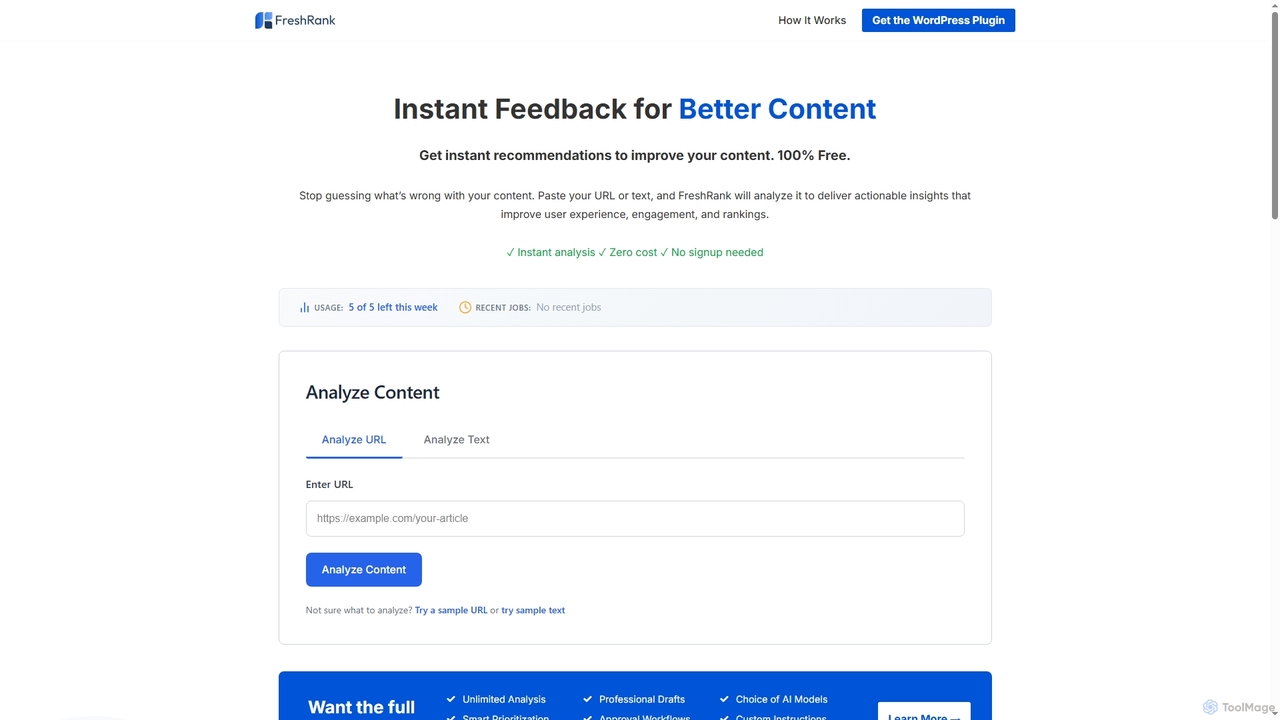
FreshRank is a free AI-powered content optimization tool that provides instant, actionable recommendations to improve your content for better user experience, engagement, and search engine rankings. Analyze URLs or text without signup.

Content Improvement
Visits 5.5KFavorites 146Likes 121

About Content Improvement

Content Improvement tools are AI-powered applications designed to refine and enhance written text. Leveraging advanced natural language processing (NLP) and machine learning, these tools analyze content for grammar, style, tone, and readability. They help users elevate the quality, clarity, and impact of their writing across diverse platforms, going beyond basic proofreading to offer sophisticated suggestions for overall textual excellence within the broader field of AI writing.

Core Features

  • Grammar & Spelling Correction: Automatically identifies and corrects grammatical errors, punctuation mistakes, and spelling inaccuracies for polished text.
  • Style & Tone Adjustment: Analyzes and suggests modifications to align content with a desired style (e.g., formal, casual) or tone (e.g., persuasive, informative).
  • Readability Enhancement: Evaluates text complexity and offers suggestions to simplify sentences, improve flow, and make content easier for the target audience to understand.
  • Conciseness & Clarity Suggestions: Identifies wordy phrases, redundancies, and ambiguous statements, proposing more direct and clear alternatives.
  • Plagiarism Detection: Scans text against vast databases to identify potential instances of unoriginal content, ensuring authenticity.

Use Cases

These tools are invaluable for professionals across various sectors. Content creators utilize them to refine blog posts, articles, and social media updates for better engagement and SEO. Marketers leverage them to optimize ad copy and email campaigns for clarity and persuasive impact. Students and academics employ them to enhance the coherence and grammatical accuracy of essays and research papers, ensuring high-quality submissions.

How to Choose

When selecting an AI content improvement tool, consider its range of features, from basic proofreading to advanced style and SEO suggestions. Evaluate its accuracy and language support, especially if working with multiple languages. Look for integration capabilities with your existing writing platforms and assess its ease of use. Finally, compare pricing models and ensure the tool aligns with your specific content goals and budget.

Content Improvement use cases

1

Enhancing Blog Post Readability

Content creators use AI tools to analyze blog posts, suggesting improvements for sentence structure, vocabulary, and overall flow. This ensures the content is engaging and easy for the target audience to understand, leading to higher retention rates and better SEO performance.

2

Refining Marketing Copy for Campaigns

Marketing specialists use AI content improvement tools to optimize headlines, ad descriptions, and email subject lines. The tools analyze text for conciseness, persuasive language, and emotional impact, suggesting revisions that enhance click-through rates and conversion, ensuring messages resonate effectively with target audiences.

3

Enhancing Academic & Research Papers

Students and researchers leverage these tools to elevate the quality of their essays, theses, and journal articles. The AI identifies complex sentence structures, grammatical errors, and inconsistencies in academic tone, providing suggestions for clarity, coherence, and adherence to specific style guides, leading to more professional submissions.

4

Optimizing Marketing Copy for SEO

Digital marketers employ content improvement AI to refine website copy, product descriptions, and ad creatives. The tools provide suggestions for keyword density, meta descriptions, and headline optimization, helping content rank higher in search results and attract more organic traffic.

5

Refining Professional Emails for Tone

Business professionals utilize these tools to review important emails, ensuring the tone is appropriate—whether formal, persuasive, or empathetic. This helps prevent misunderstandings, builds stronger professional relationships, and enhances the overall effectiveness of business communications.

6

Polishing Professional Business Communications

Business professionals, including managers and HR personnel, utilize AI to refine internal reports, client proposals, and official emails. The tools ensure communications are clear, professional, and error-free, helping to convey messages effectively, maintain a credible corporate image, and avoid misunderstandings.

7

Proofreading Academic Papers and Reports

Students and researchers rely on AI content improvement for meticulous proofreading of academic essays, theses, and research papers. The tools catch complex grammatical errors, stylistic inconsistencies, and provide suggestions for academic clarity, ensuring high-quality submissions.

8

Optimizing Blog Posts for Readability and SEO

Bloggers and content writers employ AI content improvement tools to enhance their articles for both human readers and search engines. The tools suggest improvements in sentence flow, paragraph structure, keyword integration, and overall readability scores, contributing to higher engagement and better search engine rankings.

9

Ensuring Brand Voice Consistency Across Platforms

Content teams in larger organizations use AI to enforce a consistent brand voice and style guide across all written content, from website copy to social media posts. The tools analyze text against predefined guidelines, flagging deviations and suggesting adjustments to maintain a unified brand identity.

10

Adapting Content for Different Audiences

Marketers and communicators use AI to adjust the complexity and tone of content for diverse target audiences. For instance, a technical document can be simplified for a general audience or made more formal for industry experts, ensuring messages resonate effectively with each group.

11

Adapting Content Tone for Different Audiences

Content strategists use AI to modify the tone and complexity of existing content to suit various target demographics or platforms. For instance, a technical document can be rephrased for a general audience, or a formal announcement can be adapted into a more casual social media update, maximizing audience reach and impact.

12

Summarizing Long Documents for Key Insights

Professionals in various fields use content improvement tools to quickly generate concise summaries of lengthy reports, articles, or meeting transcripts. This helps in rapidly grasping core information, saving time, and facilitating quicker decision-making processes.

Content Improvement FAQ

What are AI Content Improvement tools?

AI Content Improvement tools are specialized software applications that use artificial intelligence, particularly natural language processing (NLP), to analyze and enhance written text. Unlike basic spell checkers, they offer sophisticated suggestions for grammar, style, tone, readability, and even SEO, aiming to elevate the overall quality and effectiveness of content.

What are AI Content Improvement tools?

AI Content Improvement tools are advanced software applications that utilize artificial intelligence, particularly natural language processing (NLP), to analyze and enhance written text. They go beyond basic spell-checking to offer sophisticated suggestions for grammar, punctuation, style, tone, clarity, and readability. Their primary goal is to help users produce higher-quality, more impactful, and error-free content efficiently.

How do AI Content Improvement tools differ from basic grammar checkers?

While basic grammar checkers primarily focus on identifying and correcting grammatical errors and misspellings, AI Content Improvement tools offer a much broader range of functionalities. They analyze text for stylistic nuances, suggest improvements for conciseness and clarity, help adjust the tone to suit the audience, enhance overall readability, and can even detect plagiarism. They provide more comprehensive and context-aware suggestions for holistic content refinement.

How to choose the best AI content improvement tool?

To choose the best tool, consider its accuracy in detecting errors and providing relevant suggestions, especially for your specific language and industry. Evaluate the breadth of its features, such as advanced style guides, tone analysis, and integration capabilities with your existing writing platforms. Also, assess its user-friendliness, pricing structure, and customer support to ensure it meets your workflow and budget requirements.

What types of content can be improved using these AI tools?

AI Content Improvement tools are versatile and can enhance virtually any type of written content. This includes marketing copy (ads, emails, social media posts), academic papers (essays, theses, research articles), professional communications (reports, proposals, emails), blog posts, website content, creative writing, and even technical documentation. They are designed to benefit anyone looking to elevate their writing quality.

What specific types of content can AI improvement tools enhance?

AI content improvement tools can enhance a wide range of content types, including blog posts, articles, marketing copy, social media updates, emails, academic papers, reports, and creative writing. They are versatile enough to improve clarity, conciseness, engagement, and adherence to specific style guidelines across virtually any written material.

How do AI content improvement tools differ from general AI writing assistants?

AI content improvement tools primarily focus on refining and optimizing existing text, identifying areas for enhancement in grammar, style, tone, and readability. In contrast, general AI writing assistants are designed to generate new content from scratch based on prompts, often producing drafts for articles, stories, or marketing copy. While some overlap exists, improvement tools specialize in polishing, while writing assistants specialize in creation.

How do I choose the best AI Content Improvement tool for my needs?

To select the best tool, first identify your primary needs: are you focused on grammar, style, SEO, or all of the above? Evaluate the tool's accuracy, the breadth of its features, and its support for your required languages. Consider integration with your existing writing workflows (e.g., browser extensions, document editors). Check user reviews for reliability and ease of use, and compare pricing plans to find one that fits your budget and usage frequency.

Can AI Content Improvement tools help with SEO?

Yes, many AI Content Improvement tools offer features specifically designed to assist with SEO. They can help by suggesting improvements to readability, which is a key ranking factor, and by identifying opportunities to naturally integrate relevant keywords without keyword stuffing. Some tools also provide insights into content structure, heading optimization, and overall content quality, all of which contribute to better search engine visibility and performance.

What are the main benefits and potential limitations of using AI for content improvement?

The main benefits include significant time savings in editing, improved content quality and consistency, enhanced readability, and better SEO performance. They can also help writers overcome writer's block by suggesting alternative phrasing. Potential limitations include occasional misinterpretations of context, a lack of true human creativity or nuance, and the need for human oversight to ensure suggestions align with the original intent and brand voice.