ToolMage
Sign in

Best 1 Ai Platform for All In One

Popular Ai Platform in All In One include Miniflow.ai, helping you work more efficiently.

Miniflow.ai
Freemium

Miniflow.ai

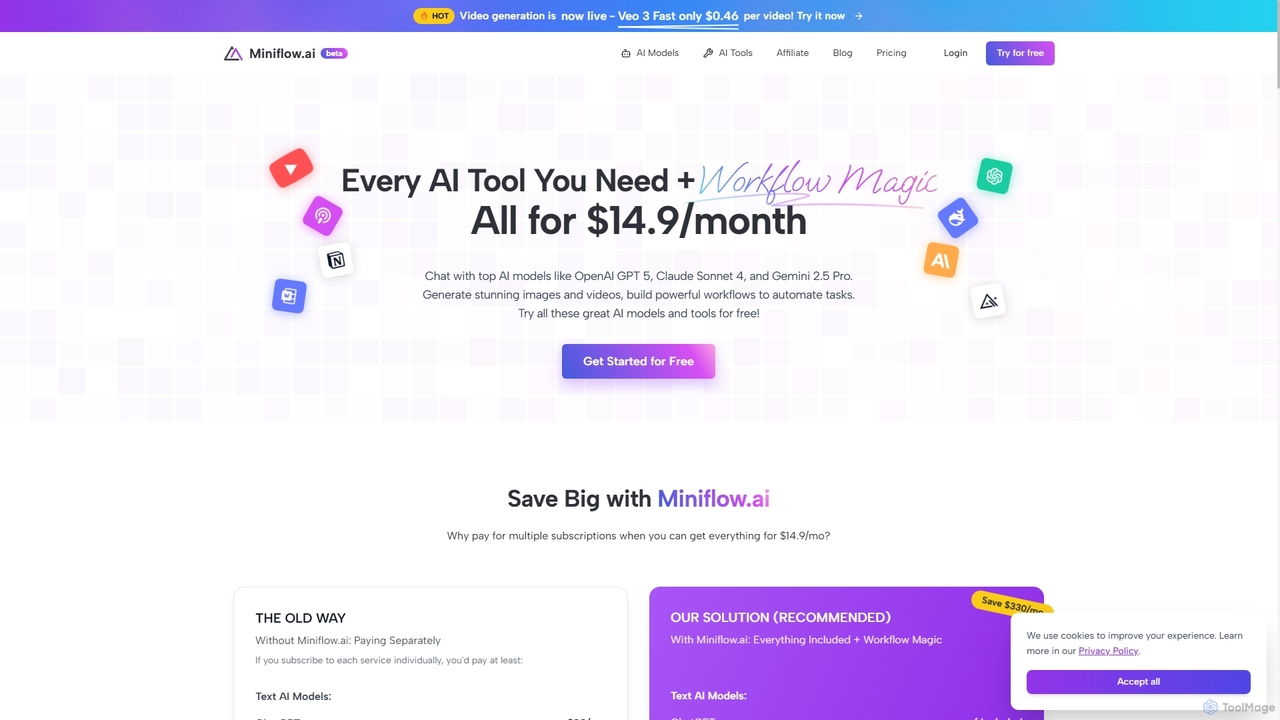
Miniflow.ai is an all-in-one AI platform that consolidates top AI models for text, image, and video generation into a single subscription. It features a powerful no-code visual workflow builder, allowing users to chain multiple AI models and automate complex tasks, saving significant costs compared to individual subscriptions.

Ai Platform
Visits 10.6KFavorites 130Likes 141

About Ai Platform

AI Platforms are integrated environments that provide comprehensive tools and infrastructure for developing, deploying, and managing artificial intelligence models and applications. As a foundational component within broader All-In-One AI solutions, these platforms streamline the entire AI lifecycle, from data preparation and model training to deployment and ongoing monitoring. They empower data scientists, developers, and enterprises to build, scale, and operationalize custom AI solutions efficiently.

Core Features

  • Data Management & Preparation: Tools for ingesting, cleaning, labeling, and transforming diverse datasets for AI model training.
  • Model Training & Experimentation: Environments supporting various machine learning frameworks, GPU acceleration, and experiment tracking for iterative model development.
  • Model Deployment & Inference: Capabilities to deploy trained models as APIs, integrate into applications, and manage real-time or batch predictions at scale.
  • MLOps & Lifecycle Management: Features for automating AI workflows, versioning models, monitoring performance, and ensuring governance throughout the model lifecycle.
  • Pre-built Services & APIs: Access to pre-trained models and APIs for common AI tasks like natural language processing, computer vision, and speech recognition.

Use Cases

AI Platforms are crucial for organizations aiming to develop and manage their own proprietary AI solutions. They are utilized by data science teams to build custom predictive models for fraud detection, by product development teams to embed AI functionalities into new applications, and by IT departments to standardize and scale AI operations across the enterprise.

How to Choose

Selecting an AI Platform requires evaluating its scalability to handle data volume and model complexity, compatibility with preferred AI frameworks (e.g., TensorFlow, PyTorch), robust MLOps capabilities for automation and monitoring, and integration potential with existing cloud infrastructure and data sources. Consider also the cost model and the platform's ease of use for your team.

Ai Platform use cases

1

Building Custom Recommendation Engines

E-commerce companies use AI platforms to develop and deploy personalized product recommendation systems. By analyzing customer behavior data, these platforms enable the creation of models that suggest relevant items, significantly increasing sales and improving the customer shopping experience.

2

Automating Predictive Maintenance

Manufacturing firms leverage AI platforms to build models that predict equipment failures based on sensor data. This enables proactive maintenance, significantly reducing unexpected downtime, optimizing operational costs, and extending the lifespan of machinery.

3

Developing Advanced Fraud Detection Systems

Financial institutions utilize AI platforms to create sophisticated machine learning models that identify anomalous transactions and potential fraud patterns in real-time. This enhances security, minimizes financial losses, and ensures compliance with regulatory standards.

4

Deploying Computer Vision for Quality Control

Industrial manufacturers implement AI platforms to train and deploy computer vision models that automatically inspect products for defects on assembly lines. This ensures consistent quality, reduces manual inspection errors, and accelerates production throughput.

5

Creating Intelligent Customer Service Bots

Enterprises use AI platforms to develop and manage advanced natural language processing (NLP) models for chatbots and virtual assistants. These intelligent bots provide more accurate and context-aware customer support, improving satisfaction and reducing call center volumes.

6

Streamlining Drug Discovery and Research

Pharmaceutical companies employ AI platforms to accelerate drug discovery by analyzing vast biological and chemical datasets. These platforms enable the prediction of molecular interactions, optimization of experimental designs, and identification of potential drug candidates, significantly shortening research timelines.

Ai Platform FAQ

What are AI Platforms?

AI Platforms are integrated software environments that provide a comprehensive suite of tools and services for the entire artificial intelligence lifecycle. They enable users to prepare data, train machine learning models, deploy them into production, and monitor their performance, acting as a central hub for AI development and operations.

How do AI Platforms differ from general "All-In-One" AI tools?

While "All-In-One" AI tools often provide ready-to-use AI functionalities (like image generation or text summarization), AI Platforms focus on providing the infrastructure and tools for building and managing custom AI models and applications. They offer deeper control over the AI development process, MLOps, and scalability, rather than just consuming pre-built services.

What are the key benefits of using an AI Platform?

Using an AI Platform offers several benefits, including accelerated AI development cycles, improved model performance through robust experimentation tools, streamlined deployment and management of models in production, enhanced collaboration among data science teams, and better governance and monitoring of AI assets across an organization.

What features should I look for when choosing an AI Platform?

When selecting an AI Platform, prioritize features such as comprehensive data management capabilities, support for various machine learning frameworks, robust MLOps functionalities (e.g., versioning, monitoring, automation), scalable deployment options, and strong integration with your existing data ecosystem. Also, consider the platform's security, compliance, and cost-effectiveness.

Who typically uses AI Platforms?

AI Platforms are primarily used by data scientists, machine learning engineers, AI developers, and enterprise IT teams. Data scientists and engineers leverage them for model development and experimentation, while IT and MLOps teams use them for deploying, managing, and scaling AI solutions across the organization, ensuring operational efficiency and governance.