Artificial Intelligence Best in category 1 results Market Prediction AI Tool

Popular AI tools in the Market Prediction field of Artificial Intelligence include QuantSignals, etc., helping you quickly improve efficiency.

QuantSignals

QuantSignals

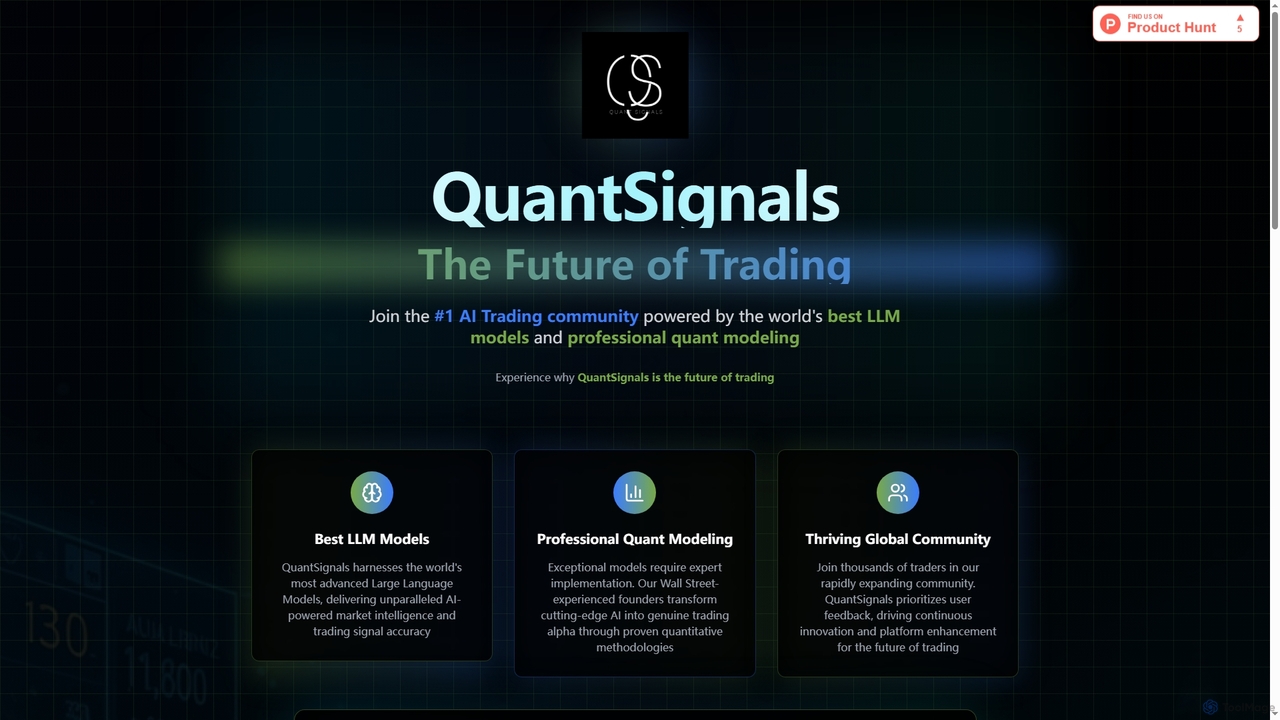
QuantSignals is a leading AI trading community leveraging advanced Large Language Models and professional quantitative modeling to deliver …

28.3K

About Market Prediction

Market Prediction tools are a specialized category of AI that use machine learning algorithms and historical data to forecast future market trends, asset prices, and economic indicators. They analyze vast datasets, including price movements, trading volumes, news sentiment, and macroeconomic factors, to identify patterns and generate predictive models. These tools are valuable for investors, financial analysts, and businesses seeking to make data-driven decisions, manage risk, and optimize investment strategies. Their ability to process complex information surpasses traditional analysis methods, offering probabilistic insights into market behavior.

Core Features

  • Time-Series Forecasting: Analyzes sequential data points like stock prices or commodity values to predict future movements.
  • Sentiment Analysis: Gauges market mood by processing news articles, social media, and financial reports for positive or negative sentiment.
  • Backtesting Engine: Simulates trading strategies on historical data to evaluate potential profitability and risk before live deployment.
  • Risk Assessment Models: Quantifies potential investment losses and market volatility using statistical models like Value at Risk (VaR).
  • Alternative Data Integration: Incorporates non-traditional data sources, such as satellite imagery or web traffic, for a more comprehensive market view.

Use Cases

These tools are primarily used in the finance and investment sectors. Quantitative analysts and hedge funds employ them for developing algorithmic trading strategies. Portfolio managers use them for asset allocation and risk management. Individual retail investors leverage them to supplement their research and identify potential trading opportunities in stocks, crypto, and forex markets.

How to Choose

When selecting a Market Prediction tool, consider the following: the range of supported markets (e.g., stocks, crypto, commodities), the frequency and quality of data sources, the level of model customizability, integration capabilities via API for automated trading, and whether the user interface is suited for professional analysts or retail investors.

Market PredictionUse Cases

1

Develop Algorithmic Trading Strategies

A quantitative analyst at a hedge fund uses a market prediction tool to design and validate a new trading strategy. They hypothesize that a combination of specific technical indicators and positive news sentiment precedes a stock price increase. The analyst uses the tool's backtesting engine to run this strategy against 10 years of historical stock data. The AI provides detailed performance metrics, including Sharpe ratio, maximum drawdown, and overall profitability. This data-driven validation allows the firm to deploy the strategy with a higher degree of confidence, potentially generating alpha by automating trades based on proven patterns.

2

Forecast Cryptocurrency Price Trends

A retail crypto investor wants to make a more informed decision about their Bitcoin holdings. They use an AI prediction tool that integrates on-chain data, social media sentiment from platforms like X (formerly Twitter), and historical price patterns. The tool generates a probabilistic forecast for the next 7 days, indicating a 65% chance of an upward trend based on current whale activity and positive social media buzz. This insight helps the investor decide to hold their position rather than panic-selling during a minor dip, aligning their strategy with data-driven probabilities instead of emotional reactions.

3

Manage Stock Portfolio Risk

A portfolio manager for a mutual fund is responsible for minimizing risk across a diverse portfolio of stocks. They use a market prediction tool to perform daily risk assessments. The AI analyzes market volatility, correlations between different assets in the portfolio, and macroeconomic news. It flags that a specific tech stock's risk profile has increased due to new regulatory news. The system recommends reducing the holding size by 15% to rebalance the portfolio's overall risk exposure. This proactive alert enables the manager to protect the fund's capital from potential downturns in that specific stock.

4

Predict Real Estate Market Prices

A real estate investment trust (REIT) analyst needs to identify cities with high growth potential. They use a market prediction tool specialized in real estate. The AI model processes demographic data, local economic indicators (like job growth), historical sales prices, and even zoning regulations. The tool forecasts that a mid-sized city is poised for a 12% increase in property values over the next two years due to a new tech hub development. This insight directs the REIT's acquisition team to focus their efforts and capital on this promising market, ahead of competitors.

5

Forecast Commodity Prices for Supply Chain

A procurement manager at a large manufacturing company needs to optimize the purchasing of raw materials like aluminum. They use an AI prediction tool that analyzes global supply and demand data, geopolitical news, and shipping logistics. The model predicts a 7% price increase in aluminum over the next quarter due to anticipated strikes at a major mining facility. Armed with this forecast, the manager decides to purchase a larger quantity of aluminum now at the current lower price, locking in costs and preventing future production delays. This saves the company a significant amount on material costs.

6

Enhance Equity Research and Stock Selection

An equity research analyst at an investment bank is tasked with finding undervalued tech stocks. Instead of manually screening hundreds of companies, they use an AI market prediction tool. The tool scans the entire tech sector, analyzing financial statements, earnings call transcripts for sentiment, and patent filing data. It generates a shortlist of five stocks that show strong fundamentals, positive management sentiment, and innovative activity not yet reflected in their stock price. This allows the analyst to focus their deep-dive fundamental analysis on a pre-qualified list, increasing their efficiency by over 70%.

Market PredictionFrequently Asked Questions