Claio
Claio is an AI-powered scribe designed for healthcare professionals to streamline clinical documentation. It transcribes patient visits in …
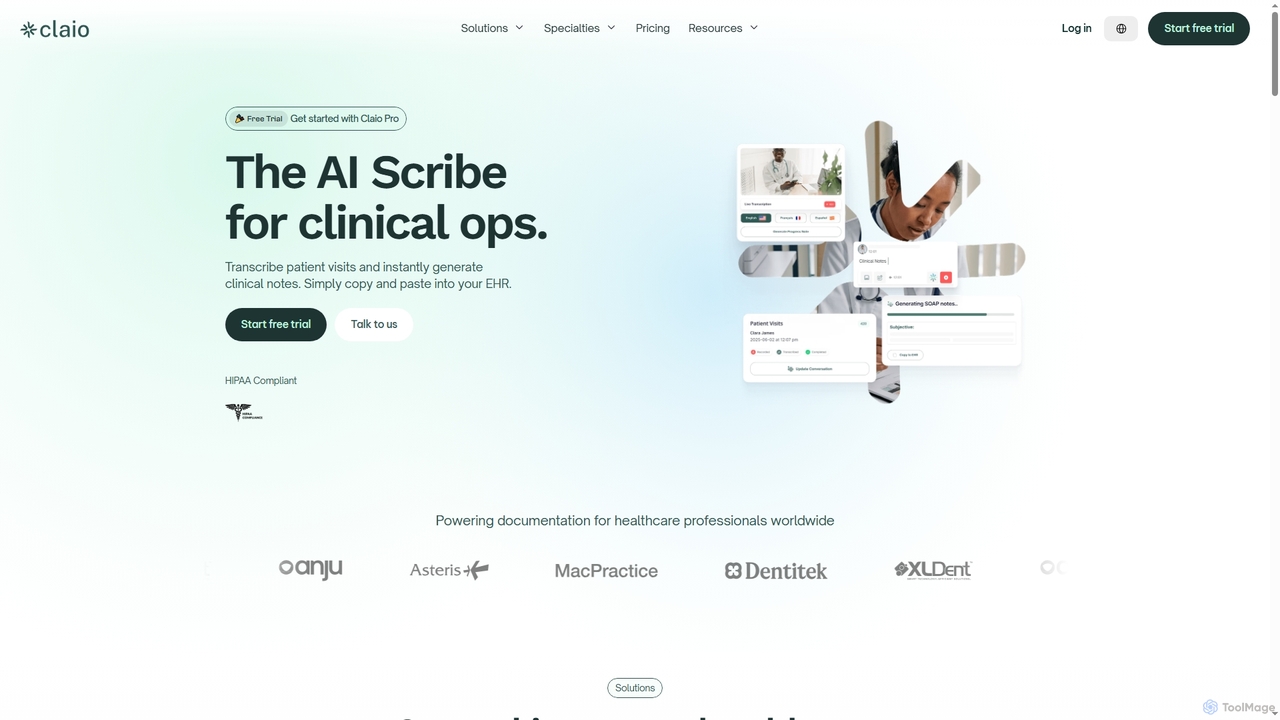
Claio is an AI-powered scribe designed for healthcare professionals to streamline clinical documentation. It transcribes patient visits in real-time, generates accurate clinical notes and billing codes, and integrates seamlessly with existing EHRs via copy-paste, ensuring HIPAA compliance and reducing administrative burden.
About Healthcare Assistant
AI Healthcare Assistants are specialized tools designed to support medical professionals, administrative staff, and patients by automating tasks and analyzing health-related data. Leveraging natural language processing (NLP) and machine learning, these assistants can interpret clinical notes, manage patient communications, and provide preliminary diagnostic insights. They are primarily used to enhance efficiency in clinical settings, reduce administrative workload, and improve the quality of patient care. Their ability to integrate with Electronic Health Record (EHR) systems makes them a powerful component in modern digital healthcare workflows.
Core Features
- Medical Scribing & Documentation: Automatically converts doctor-patient conversations into structured clinical notes and summaries.
- Patient Triage & Symptom Checking: Provides initial assessment of patient symptoms to guide them to the appropriate level of care.
- Appointment Management: Automates the scheduling, rescheduling, and reminding of patient appointments.
- Medical Coding Automation: Suggests or assigns appropriate billing codes (like ICD-10) based on clinical documentation.
- Clinical Decision Support: Analyzes patient data and medical literature to provide evidence-based suggestions to clinicians.
Use Cases
AI Healthcare Assistants are widely used in hospitals, private clinics, telehealth platforms, and medical billing companies. Clinicians use them to reduce time spent on documentation, allowing more focus on patient interaction. Administrative staff leverage these tools for streamlining patient scheduling and communication. Patients can also interact with them for initial symptom checks or to get answers to common health questions, improving access to basic medical information.
How to Choose
When selecting an AI Healthcare Assistant, prioritize regulatory compliance, such as HIPAA or GDPR, to ensure patient data protection. Evaluate its integration capabilities with your existing EHR/EMR systems for seamless workflow. Assess the accuracy and reliability of its medical knowledge base and algorithms. Also, consider the user interface's intuitiveness for both clinicians and patients, as well as the vendor's customer support and training resources.

Healthcare AssistantUse Cases
Automating Clinical Note Generation
A primary care physician uses an AI Healthcare Assistant during patient consultations. The tool listens to the conversation in the background and automatically generates a structured SOAP (Subjective, Objective, Assessment, Plan) note in real-time. This eliminates the need for manual note-taking after hours. The physician can quickly review, edit, and sign off on the note directly within the EHR system, saving an estimated 1-2 hours of administrative work per day and reducing the risk of documentation errors and burnout.
Streamlining Patient Appointment Scheduling
A busy specialty clinic's administrative staff uses an AI Healthcare Assistant to manage their appointment calendar. The AI interacts with patients via the clinic's website or phone system to find suitable appointment slots based on the doctor's availability and the reason for the visit. It automatically sends confirmation and reminder messages, and can process rescheduling or cancellation requests 24/7 without human intervention. This reduces phone call volume by over 50% and minimizes no-shows, improving clinic efficiency and patient satisfaction.
Providing Preliminary Patient Symptom Triage
A telehealth platform integrates an AI Healthcare Assistant as the first point of contact for users. When a patient reports symptoms like a cough and fever, the AI asks a series of dynamic, clinically validated questions to gather more information about the symptom's duration, severity, and associated factors. Based on the responses, it provides a preliminary risk assessment and recommends the next step, such as scheduling a video consultation with a doctor, visiting an urgent care center, or providing self-care advice for minor issues. This ensures patients are directed to the right level of care efficiently.
Automating Medical Coding and Billing
A medical billing company employs an AI Healthcare Assistant to improve coding accuracy and speed. The AI analyzes unstructured clinical notes, physician dictations, and lab results to identify billable procedures and diagnoses. It then suggests the most appropriate CPT and ICD-10 codes, highlighting any potential compliance issues or documentation gaps. This reduces the manual workload for human coders, decreases claim denial rates by ensuring greater accuracy, and accelerates the revenue cycle for healthcare providers.
Answering Patient FAQs and Providing Education
A hospital's patient portal deploys an AI Healthcare Assistant to provide 24/7 support. Patients can ask common questions about pre-operative instructions, medication side effects, or billing inquiries. The AI, trained on the hospital's verified knowledge base, provides instant, accurate answers. It can also deliver educational content, such as videos on managing diabetes or articles on post-surgery recovery, tailored to the patient's condition. This empowers patients to manage their health proactively and frees up nursing staff from answering repetitive questions.
Supporting Clinical Trial Data Management
A pharmaceutical research organization uses an AI Healthcare Assistant to streamline its clinical trial processes. The tool helps in screening potential participants by analyzing their EHR data against complex inclusion/exclusion criteria. During the trial, it assists researchers by automating data entry from patient-reported outcomes and wearable devices. It can also monitor for adverse events in real-time by analyzing patient communications and data streams, enabling faster intervention. This improves data quality, accelerates trial timelines, and enhances patient safety.