
Jeeliz
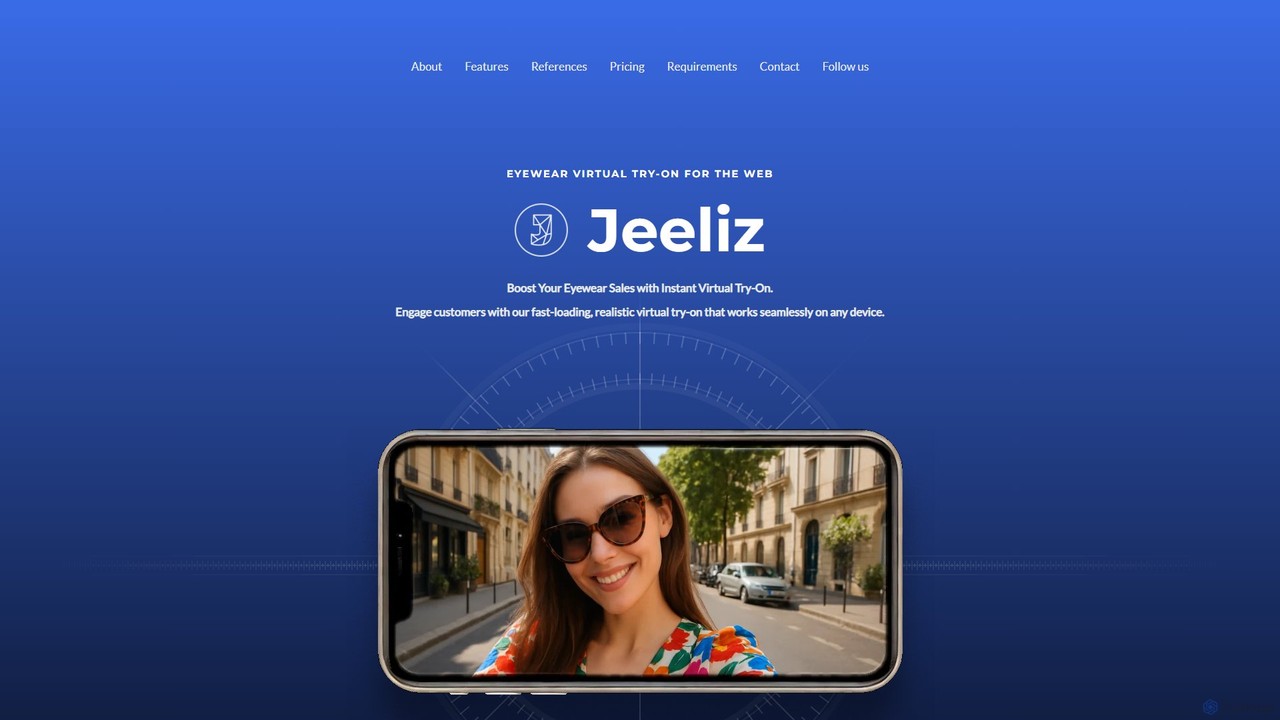
Jeeliz is a generative AI-powered virtual try-on (VTO) solution for eyewear e-commerce. It enables customers to realistically try …
Jeeliz is a generative AI-powered virtual try-on (VTO) solution for eyewear e-commerce. It enables customers to realistically try on glasses via the web on any device. Featuring seamless one-snippet integration, ultra-fast loading, and high-fidelity 3D rendering, it helps brands boost engagement, increase conversions, and reduce returns.
About Webar
Webar is a type of augmented reality (AR) experience that runs directly in a web browser, eliminating the need for users to download a dedicated application. This technology leverages web standards like WebXR to deliver interactive 3D content overlaid onto the real world through a smartphone or tablet camera. Webar significantly lowers the barrier to entry for AR, making immersive experiences more accessible and shareable via a simple URL or QR code. It empowers businesses and creators to deploy engaging AR content quickly across various platforms.
Core Features
- Browser-Based Access: Users can access AR experiences instantly through a web browser, without any app downloads.
- Cross-Platform Compatibility: Works across different operating systems (iOS, Android) and devices that support modern web browsers.
- Easy Sharing: AR content can be shared effortlessly via a simple link, QR code, or embedded directly into websites.
- Interactive 3D Content: Supports the display of 3D models, animations, videos, and interactive elements in real-world environments.
- Real-time Tracking: Utilizes device sensors and computer vision for marker-based or markerless tracking to anchor virtual objects.
Use Cases
Webar is widely adopted in marketing, e-commerce, and education. It allows brands to create interactive campaigns, enables customers to virtually try on products or place furniture in their homes, and provides educators with tools for immersive learning experiences. Its ease of access makes it ideal for broad audience engagement without installation hurdles.
How to Choose
When selecting a Webar solution, consider its ease of content creation and management, compatibility with various browsers and devices, and the accuracy of its AR tracking capabilities. Evaluate the types of 3D models and interactive elements it supports, its analytics features for tracking user engagement, and the pricing model. Integration with existing marketing or e-commerce platforms is also a key factor for seamless deployment.
WebarUse Cases
Interactive Product Visualization for E-commerce
E-commerce businesses can use Webar to allow customers to virtually try on products like glasses or clothing, or place 3D models of furniture in their own homes before purchasing. By scanning a QR code on a product page, users instantly launch an AR experience in their browser, enhancing confidence in their purchase decisions and reducing return rates. This provides a highly engaging and convenient shopping experience without requiring any app downloads.
Engaging Marketing Campaigns and Advertisements
Marketing professionals can create dynamic Webar campaigns that are easily accessible via QR codes on posters, flyers, or product packaging. Users can scan the code to instantly view AR content, such as animated characters, product demos, or interactive games, directly in their web browser. This approach significantly boosts engagement rates for promotional materials, offering a novel and memorable brand interaction without the friction of app installation.
Immersive Educational Content and Training
Educators and trainers can leverage Webar to create interactive learning modules. Students can scan a QR code in a textbook or on a worksheet to bring 3D models of anatomical structures, historical artifacts, or complex machinery to life in their physical space. This browser-based AR enhances comprehension and engagement, allowing for hands-on exploration of concepts without the need for specialized equipment or software installation in classrooms or remote learning environments.
Augmented Reality for Cultural Heritage and Tourism
Museums, historical sites, and tourism boards can use Webar to offer visitors enriched experiences. By scanning a QR code at an exhibit or landmark, tourists can view AR overlays that reconstruct ancient buildings, animate historical figures, or provide interactive information about artifacts directly on their smartphones. This browser-based approach makes cultural content more accessible and engaging, transforming static displays into dynamic, interactive narratives without requiring a dedicated museum app.
Augmented Reality for Real Estate Showings
Real estate agents can utilize Webar to enhance property viewings. Prospective buyers can scan a QR code at a property or from a brochure to visualize virtual furniture, appliances, or renovation possibilities directly within the empty rooms of a house using their smartphone browser. This allows for a more imaginative and personalized viewing experience, helping buyers envision the potential of a space without the need for physical staging or complex app installations.
Interactive Event Engagement and Entertainment
Event organizers can deploy Webar experiences to enhance attendee engagement at conferences, festivals, or trade shows. Participants can scan QR codes at various points to unlock AR filters, interactive games, or virtual mascots that appear in their physical surroundings. This browser-based solution provides a fun and memorable way to interact with event content, sponsors, and other attendees, driving participation without requiring any pre-installation or specific hardware beyond a smartphone.