ToolMage
Sign in

Best 1 B2B Solutions AI tools

Popular B2B Solutions AI tools include UpTrade, helping you work more efficiently.

UpTrade

UpTrade

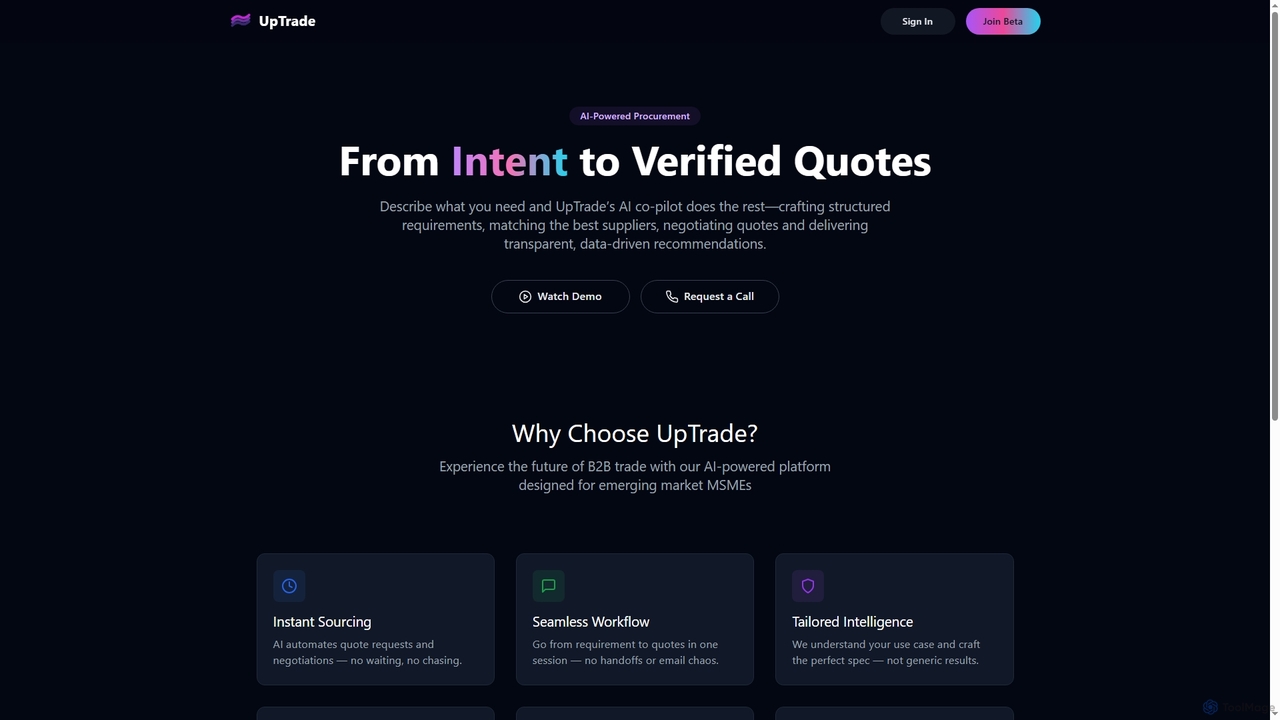
UpTrade is an AI-powered B2B procurement platform designed for emerging market MSMEs. It automates the entire sourcing cycle, from crafting structured requirements and matching verified suppliers to negotiating quotes and delivering data-driven recommendations, significantly reducing manual effort and accelerating deal closures.

Vendor Management
Visits 11.3KFavorites 189Likes 181

About B2B Solutions

B2B Solutions are AI-powered tools designed to optimize business operations, enhance decision-making, and drive growth across various industries. These solutions leverage advanced AI technologies like machine learning, natural language processing, and predictive analytics to automate complex tasks, personalize customer interactions, and provide actionable insights. They empower businesses to streamline workflows, reduce operational costs, and gain a competitive edge in the market.

Core Features

  • Process Automation: Automate repetitive tasks and complex workflows across departments like finance, HR, and operations.
  • Predictive Analytics: Analyze vast datasets to forecast market trends, customer behavior, and operational risks, enabling proactive strategies.
  • Personalized Engagement: Deliver tailored customer experiences through AI-driven chatbots, recommendation engines, and targeted marketing.
  • Data Insights & Reporting: Transform raw business data into clear, actionable intelligence for strategic planning and performance monitoring.
  • Resource Optimization: Allocate resources more efficiently by identifying bottlenecks and suggesting optimal utilization strategies.

Use Cases

Businesses across sectors like manufacturing, retail, finance, and healthcare utilize B2B AI solutions to address specific challenges. For instance, a manufacturing firm might use AI for predictive maintenance to minimize downtime, while a retail company could deploy AI for inventory optimization and demand forecasting. Financial institutions leverage these tools for fraud detection and risk assessment, enhancing security and compliance.

How to Choose

Selecting the right B2B AI solution requires evaluating several factors. Consider the specific business problem you aim to solve and the solution's alignment with your existing infrastructure. Assess its scalability, integration capabilities with current systems, and the vendor's support and security protocols. Finally, evaluate the total cost of ownership, including implementation, maintenance, and potential ROI.

B2B Solutions use cases

1

Automating Customer Support Interactions

For large enterprises, managing high volumes of customer inquiries is resource-intensive. B2B AI solutions, specifically AI chatbots and virtual assistants, automate first-line support, answer FAQs, and route complex issues to human agents. This reduces response times, improves customer satisfaction, and frees up human agents for more critical tasks, leading to significant operational savings.

2

Optimizing Supply Chain & Logistics

Supply chain managers face challenges like demand variability, inventory management, and route optimization. AI-powered B2B solutions analyze historical data, real-time market conditions, and weather patterns to predict demand, optimize inventory levels, and plan the most efficient delivery routes. This minimizes waste, reduces shipping costs, and ensures timely product delivery.

3

Enhancing Sales & Marketing Personalization

Sales and marketing teams in B2B companies need to deliver highly personalized content and outreach. AI tools analyze prospect data, engagement history, and industry trends to identify high-potential leads, recommend relevant products/services, and personalize communication at scale. This boosts conversion rates, strengthens client relationships, and maximizes marketing ROI.

4

Streamlining HR & Talent Management

HR departments in growing businesses struggle with recruitment, onboarding, and employee engagement. AI-driven B2B solutions automate resume screening, personalize learning paths, and analyze employee sentiment to identify retention risks. This streamlines the hiring process, improves employee experience, and helps retain top talent by addressing their needs proactively.

5

Detecting Financial Fraud & Risk

Financial institutions and e-commerce platforms are constantly battling sophisticated fraud attempts. AI-powered B2B solutions analyze transaction patterns, user behavior, and network anomalies in real-time to detect and flag suspicious activities. This significantly reduces financial losses, enhances security, and ensures compliance with regulatory standards, protecting both the business and its customers.

6

Predictive Maintenance for Industrial Assets

Manufacturing and industrial companies rely on expensive machinery, where unexpected breakdowns lead to costly downtime. B2B AI solutions integrate with IoT sensors on equipment to collect operational data. They use machine learning to predict potential failures before they occur, allowing for scheduled maintenance. This minimizes unplanned downtime, extends asset lifespan, and reduces maintenance costs.

B2B Solutions FAQ

What are B2B Solutions in AI?

B2B Solutions in AI are specialized artificial intelligence tools designed to address the unique needs and challenges of businesses. They leverage AI technologies like machine learning, natural language processing, and computer vision to automate processes, enhance data analysis, improve decision-making, and optimize various business functions, from customer service to supply chain management.

How do B2B AI Solutions benefit businesses?

B2B AI Solutions offer numerous benefits, including increased operational efficiency through automation, reduced costs by optimizing resource allocation, enhanced customer experience via personalization, and improved decision-making with data-driven insights. They also help businesses innovate, scale faster, and maintain a competitive edge in dynamic markets.

What are the key considerations when implementing B2B AI?

When implementing B2B AI, key considerations include clearly defining business objectives, ensuring data quality and availability, assessing integration capabilities with existing systems, evaluating the solution's scalability and security features, and planning for user adoption and training. It's also crucial to start with a pilot project to validate ROI.

Can B2B AI Solutions integrate with existing enterprise systems?

Yes, most modern B2B AI Solutions are designed with integration in mind. They often provide APIs (Application Programming Interfaces) or connectors to seamlessly integrate with common enterprise resource planning (ERP), customer relationship management (CRM), and other business intelligence (BI) systems. This ensures data flow and avoids siloed operations.

What's the difference between B2B AI and general AI tools?

General AI tools might serve broad purposes or individual users (e.g., consumer-facing chatbots, image generators). B2B AI Solutions, however, are specifically tailored to solve business-level problems, focusing on enterprise-grade features like scalability, robust security, complex data integration, compliance, and multi-user collaboration, directly impacting organizational performance and profitability.