Actimo Labs
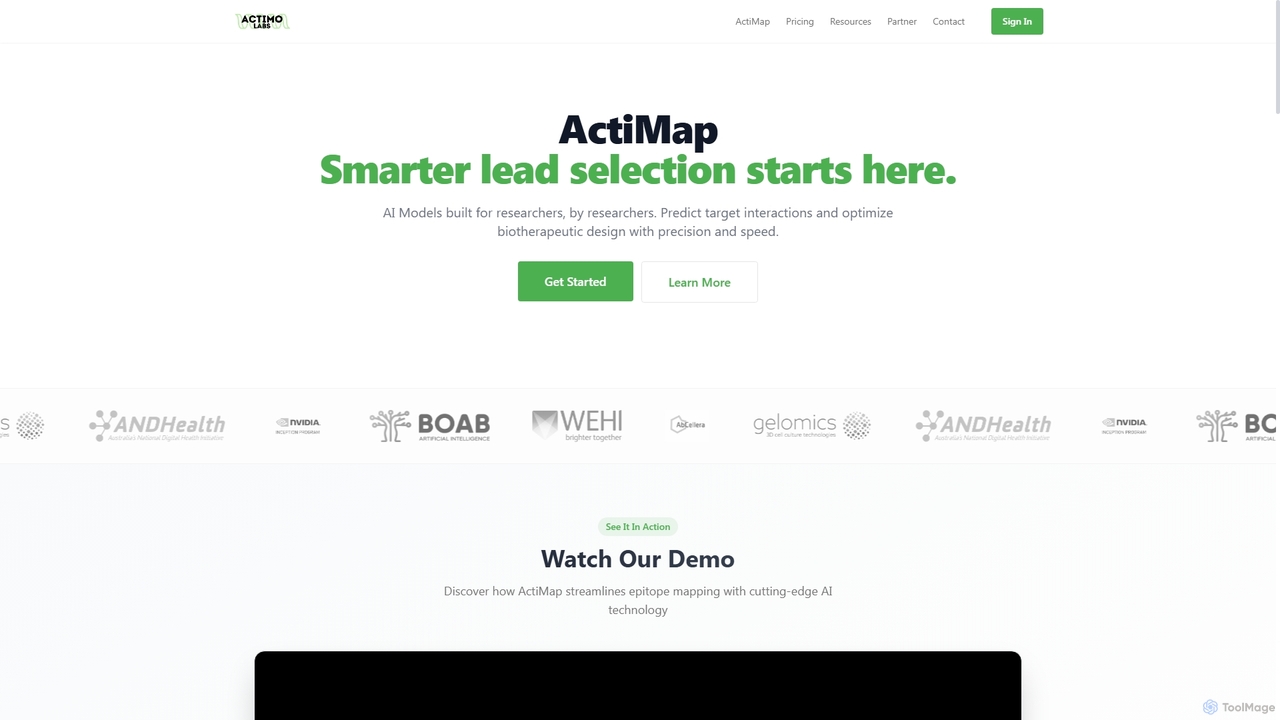
Actimo Labs offers ActiMap, an advanced AI-powered platform for precise and rapid epitope mapping. Designed for researchers in …
Actimo Labs offers ActiMap, an advanced AI-powered platform for precise and rapid epitope mapping. Designed for researchers in academia, pharma, and biotech, it accelerates antibody discovery and biotherapeutic design by predicting target interactions from protein sequences in minutes, significantly reducing costs and development timelines.
About Bioinformatics
Bioinformatics tools are AI-powered platforms that apply computational and statistical methods to analyze vast amounts of biological data. These tools leverage advanced algorithms to interpret complex genomic, proteomic, and other life science information, bridging the gap between biology and computer science. They are crucial for accelerating scientific discovery, particularly within the broader field of biotechnology, by enabling deeper insights into biological systems. This technology is indispensable for researchers and professionals seeking to understand life at a molecular level.
Core Features
- Sequence Alignment & Analysis: Compares DNA, RNA, or protein sequences to identify similarities, evolutionary relationships, and functional regions.
- Gene Expression Profiling: Analyzes how genes are activated or deactivated under various conditions, crucial for disease mechanisms and drug response.
- Protein Structure Prediction: Utilizes AI to predict the three-dimensional structure of proteins from their amino acid sequences, vital for understanding function and drug design.
- Phylogenetic Tree Construction: Reconstructs evolutionary relationships between species, genes, or proteins based on sequence data.
- Variant Calling & Annotation: Identifies genetic variations (SNPs, indels) from sequencing data and annotates their potential functional impact.
Applicable Scenarios
Bioinformatics tools are extensively used in academic research for hypothesis generation and data validation, in the pharmaceutical industry for drug discovery and development, and in agricultural science for crop improvement. They support tasks ranging from basic biological understanding to complex clinical applications, providing the computational backbone for modern life sciences.
How to Choose
When selecting bioinformatics tools, consider their data handling capacity for large datasets (e.g., next-generation sequencing), the sophistication and accuracy of their algorithms, and their compatibility with existing laboratory information management systems (LIMS). Evaluate the user interface for ease of use, the availability of specific analytical modules (e.g., for epigenomics or metabolomics), and the scalability to accommodate future research needs.

BioinformaticsUse Cases
Accelerating Drug Discovery through Genomic Analysis
Pharmaceutical researchers utilize AI-powered bioinformatics tools to analyze vast genomic datasets, identifying potential drug targets and biomarkers associated with diseases. By rapidly screening millions of genetic variations and protein interactions, these tools help prioritize promising compounds, significantly reducing the time and cost of early-stage drug development and clinical trials.
Analyzing Genomic Variants for Disease Research
Genetic researchers use bioinformatics tools to analyze whole-genome or exome sequencing data from patient cohorts. They identify single nucleotide polymorphisms (SNPs), insertions, and deletions, then correlate these genetic variations with disease phenotypes to discover potential biomarkers or therapeutic targets. This process helps in understanding disease mechanisms and developing diagnostic tests.
Interpreting Genomic Variants for Disease Diagnosis
Clinical researchers utilize bioinformatics tools to analyze whole-genome or exome sequencing data from patients. By aligning sequences, calling variants, and annotating them against known disease databases, they can identify specific genetic mutations linked to hereditary diseases or cancer. This enables precise diagnosis, risk assessment, and informs personalized treatment strategies, significantly reducing the time and cost compared to manual analysis.
Personalized Medicine for Cancer Treatment
Oncologists and genetic counselors leverage bioinformatics platforms to analyze a patient's tumor genome and compare it with healthy tissue. This allows for the identification of specific mutations driving the cancer, enabling the selection of targeted therapies that are most likely to be effective for that individual, thereby improving treatment outcomes and minimizing adverse effects.
Predicting Protein Structures for Drug Design
Pharmaceutical scientists employ bioinformatics platforms to predict the 3D structure of novel proteins based on their amino acid sequences. This structural information is critical for understanding protein function, identifying active sites, and virtually screening potential drug compounds that can bind to these sites, significantly accelerating the early stages of drug discovery.
Accelerating Drug Target Identification in Pharma
Pharmaceutical scientists leverage bioinformatics platforms to identify novel drug targets from vast omics datasets (genomics, proteomics, transcriptomics). By analyzing gene expression patterns in diseased vs. healthy tissues, predicting protein-protein interactions, and performing pathway analysis, they can pinpoint key molecules involved in disease progression. This significantly streamlines the early stages of drug discovery, leading to more effective and targeted therapeutic development.
Optimizing Crop Yields and Disease Resistance
Agricultural scientists employ bioinformatics tools to analyze plant genomes, identifying genes responsible for traits like drought resistance, pest immunity, or increased yield. By understanding these genetic markers, they can develop improved crop varieties through selective breeding or genetic engineering, contributing to global food security and sustainable agriculture practices.
Constructing Phylogenetic Trees for Evolutionary Studies
Evolutionary biologists utilize bioinformatics software to compare DNA or protein sequences across multiple species. By aligning these sequences and applying phylogenetic algorithms, they construct evolutionary trees that illustrate the genetic relationships and divergence times between organisms, providing insights into species evolution and adaptation.
Optimizing Crop Yield and Disease Resistance
Agricultural scientists employ bioinformatics tools to analyze plant genomic data, identifying genes associated with desirable traits like drought resistance, increased yield, or pest immunity. By comparing genetic markers across different crop varieties, they can predict which crosses will produce the most robust offspring. This data-driven approach significantly accelerates selective breeding programs, leading to more resilient and productive agricultural systems globally.
Understanding Microbial Communities in Environmental Science
Environmental researchers use bioinformatics to analyze metagenomic data from soil, water, or gut microbiomes. This helps in understanding the composition, diversity, and functional roles of microbial communities, which is vital for monitoring ecosystem health, identifying bioremediation agents, or studying the impact of environmental changes on microbial populations.
Identifying Gene Expression Changes in Cancer Studies
Oncologists and molecular biologists use bioinformatics tools to process RNA sequencing data from tumor and normal tissue samples. They identify genes that are significantly up- or down-regulated in cancer, helping to pinpoint genes involved in tumor growth, metastasis, and resistance to therapy, which can lead to new diagnostic markers or treatment strategies.
Analyzing Microbiome Data for Health Insights
Researchers in microbiology and medicine use bioinformatics to process and interpret complex microbiome sequencing data (e.g., 16S rRNA or shotgun metagenomics). By identifying microbial species, quantifying their abundance, and correlating them with host health or environmental factors, they can uncover links between microbial communities and diseases like IBS or obesity. This analysis provides critical insights for developing targeted probiotics or therapeutic interventions.
Predicting Protein Structures for Functional Insights
Structural biologists and biochemists employ AI-driven bioinformatics tools to predict the 3D structures of proteins from their amino acid sequences. Accurate structural predictions are fundamental for understanding protein function, designing novel enzymes, or developing inhibitors for disease-causing proteins, thereby advancing basic biological research and therapeutic development.
Integrating Multi-omics Data for Systems Biology
Systems biologists leverage bioinformatics platforms to integrate diverse datasets, such as genomics, transcriptomics, proteomics, and metabolomics, from a single biological system. This comprehensive integration allows for a holistic understanding of complex biological processes, identifying cross-talk between different molecular layers and revealing emergent properties.
Predicting Protein Function and Interactions
Biochemists and structural biologists utilize bioinformatics tools to predict the function of newly discovered proteins and their interactions with other molecules. By comparing protein sequences to known functional domains, modeling 3D structures, and simulating molecular docking, they can infer a protein's role in cellular processes or its potential as a drug target. This computational approach significantly reduces the need for costly and time-consuming experimental validation.
Identifying Pathogens and Tracking Outbreaks
Public health agencies and epidemiologists use bioinformatics for rapid pathogen identification and genomic surveillance. By sequencing and analyzing microbial genomes from patient samples or environmental sources, they can quickly identify infectious agents, track the spread of outbreaks, detect antibiotic resistance, and inform public health interventions, crucial for global health security.
Automating Microbial Genome Annotation
Microbiologists and biotechnologists use specialized bioinformatics pipelines to automatically annotate newly sequenced microbial genomes. These tools identify genes, predict their functions, and map metabolic pathways, providing a rapid and standardized way to characterize microorganisms for industrial applications, environmental studies, or pathogen surveillance.
Comparative Genomics for Evolutionary Studies
Evolutionary biologists and geneticists use bioinformatics to perform comparative genomics across different species. By aligning entire genomes or specific gene families, they can identify conserved regions, gene duplications, and evolutionary divergences. This helps reconstruct phylogenetic trees, understand adaptation mechanisms, and trace the evolutionary history of life, providing fundamental insights into biodiversity and species relationships.