Actimo Labs
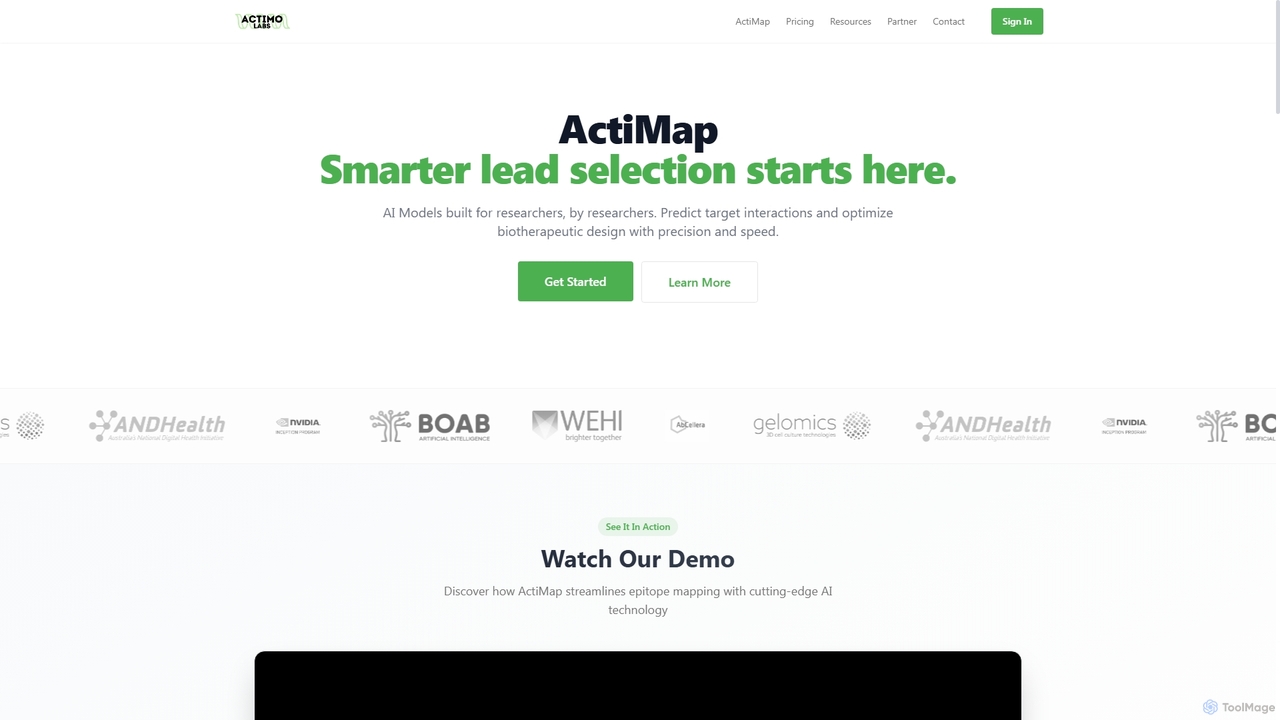
Actimo Labs offers ActiMap, an advanced AI-powered platform for precise and rapid epitope mapping. Designed for researchers in …
Actimo Labs offers ActiMap, an advanced AI-powered platform for precise and rapid epitope mapping. Designed for researchers in academia, pharma, and biotech, it accelerates antibody discovery and biotherapeutic design by predicting target interactions from protein sequences in minutes, significantly reducing costs and development timelines.
About Biotechnology
Biotechnology AI tools are a class of advanced software solutions that leverage artificial intelligence and machine learning to accelerate and enhance research, development, and application in biological sciences. These tools integrate complex algorithms with vast biological datasets, enabling breakthroughs in areas like genomics, proteomics, drug discovery, and personalized medicine. They empower scientists and researchers to analyze intricate biological systems, predict molecular interactions, and design novel biological entities with unprecedented speed and accuracy.
Core Features
- Genomic and Proteomic Analysis: Advanced algorithms for sequencing data interpretation, variant calling, protein structure prediction, and functional annotation.
- Drug Discovery and Development: AI-driven platforms for target identification, lead compound optimization, virtual screening, and predicting drug efficacy and toxicity.
- Bioinformatics Data Integration: Tools for consolidating and analyzing diverse biological datasets, including omics data, clinical records, and scientific literature.
- Biomarker Identification: Machine learning models to discover and validate novel biomarkers for disease diagnosis, prognosis, and therapeutic response.
- Synthetic Biology Design: AI-assisted platforms for designing genetic circuits, metabolic pathways, and novel proteins with desired functions.
Use Cases
Biotechnology AI tools are indispensable across various scientific and industrial sectors. Researchers in academia and pharmaceutical companies utilize them for accelerating drug discovery pipelines, from identifying potential therapeutic targets to optimizing lead compounds. Clinical scientists employ these tools for personalized medicine, analyzing patient genomic data to predict disease risk and tailor treatment strategies. Agricultural biotechnologists leverage AI for crop optimization, designing disease-resistant varieties and enhancing yield through genomic editing and predictive modeling.
How to Choose
Selecting the right Biotechnology AI tool requires evaluating several factors. Consider the specific research domain (e.g., genomics, drug discovery) and the types of data you'll be working with (e.g., sequencing, imaging, clinical). Assess the tool's algorithmic sophistication, its ability to handle large and complex datasets, and its integration capabilities with existing laboratory information management systems (LIMS) or bioinformatics pipelines. User-friendliness, scalability, and the availability of robust support and documentation are also crucial for effective implementation and long-term utility.
BiotechnologyUse Cases
Accelerating Drug Discovery and Development
Pharmaceutical researchers utilize biotechnology AI tools to rapidly identify potential drug candidates and predict their efficacy and toxicity. By analyzing vast datasets of molecular structures and biological pathways, AI algorithms can pinpoint promising compounds, simulate their interactions with target proteins, and optimize lead compounds, significantly reducing the time and cost associated with traditional drug development cycles.
Accelerating Drug Target Identification
Pharmaceutical researchers utilize AI biotechnology tools to rapidly analyze vast genomic, proteomic, and transcriptomic datasets. By applying machine learning algorithms, they can identify potential disease-causing genes or proteins, predict their functional roles, and prioritize novel drug targets much faster than traditional experimental methods. This significantly shortens the initial drug discovery phase, leading to more efficient R&D pipelines and potentially life-saving therapies.
Accelerating Drug Discovery and Development
Pharmaceutical researchers utilize AI biotechnology tools to rapidly screen millions of potential drug compounds against specific disease targets. By leveraging machine learning algorithms, they can predict compound efficacy, toxicity, and binding affinity, significantly reducing the time and cost associated with traditional experimental methods. This allows for faster identification of promising drug candidates, streamlining the preclinical development phase and bringing life-saving treatments to patients more quickly.
Accelerating Novel Drug Target Identification
Pharmaceutical researchers utilize Biotechnology AI tools to rapidly analyze vast genomic, proteomic, and clinical datasets, identifying novel disease targets and potential drug candidates with unprecedented speed. By sifting through millions of data points, AI can pinpoint biomarkers and pathways implicated in diseases, significantly reducing the time and cost associated with early-stage drug discovery and increasing the likelihood of successful therapeutic development.
Accelerating Drug Target Identification
Pharmaceutical researchers utilize AI biotechnology tools to rapidly identify potential drug targets by analyzing vast genomic, proteomic, and clinical datasets. AI algorithms can pinpoint genes or proteins associated with specific diseases, predict their functional roles, and prioritize candidates for further experimental validation, significantly reducing the time and cost involved in early-stage drug discovery.
Personalized Medicine and Diagnostics
Clinical scientists and medical researchers employ AI in biotechnology to analyze individual patient genomic data, medical history, and lifestyle factors. These tools help in identifying specific disease biomarkers, predicting patient response to treatments, and designing personalized therapeutic strategies. This leads to more accurate diagnoses and tailored interventions, improving patient outcomes and treatment effectiveness.
Optimizing Biomanufacturing Processes
Biotech engineers deploy AI models to monitor and control complex bioreactor conditions in real-time, such as temperature, pH, dissolved oxygen, and nutrient levels. These tools predict optimal parameters for cell growth and product formation, minimizing batch variations and maximizing the yield and purity of biologics like vaccines, therapeutic antibodies, or enzymes. This automation reduces operational costs and accelerates time-to-market for biopharmaceutical products.
Personalized Medicine and Diagnostics
Clinicians and medical researchers leverage AI biotechnology tools to analyze individual patient genomic data, electronic health records, and lifestyle factors. This enables the development of highly personalized treatment plans, predicting patient response to specific therapies, and identifying individuals at high risk for certain diseases. For example, AI can pinpoint genetic markers associated with adverse drug reactions, allowing doctors to prescribe safer and more effective medications tailored to each patient's unique biological makeup, improving treatment outcomes and reducing side effects.
Optimizing Biomanufacturing Processes for Therapeutics
Biotech engineers deploy AI-driven systems to monitor and control complex biomanufacturing processes, such as fermentation and cell culture for therapeutic protein production. These tools predict optimal conditions for cell growth, product yield, and quality, making real-time adjustments to parameters like temperature, pH, and nutrient levels. This leads to reduced batch failures, improved efficiency, and higher purity of critical biopharmaceuticals, saving significant operational costs.
Personalized Cancer Treatment Planning
Oncologists and clinical researchers employ AI tools to analyze a patient's unique genomic profile and tumor characteristics. By comparing this data with extensive databases of cancer genomics and treatment outcomes, AI can predict a patient's response to various therapies, identify optimal drug combinations, and recommend personalized treatment strategies, leading to more effective and less toxic interventions.
Optimizing Agricultural Yields and Crop Resilience
Agricultural scientists and farmers leverage biotechnology AI tools to enhance crop performance and sustainability. By analyzing genetic data of plants, soil conditions, and environmental factors, AI can predict optimal planting strategies, identify disease-resistant crop varieties, and even design genetically modified organisms with improved traits. This leads to increased food production, reduced resource consumption, and more resilient agricultural systems.
Personalized Cancer Therapy Selection
Oncologists and clinical researchers leverage AI biotechnology tools to analyze a patient's unique tumor genomic data, alongside their clinical history and response to previous treatments. AI algorithms identify specific mutations, predict drug sensitivity or resistance, and recommend the most effective chemotherapy or immunotherapy regimen tailored to the individual. This precision medicine approach improves treatment efficacy, minimizes adverse effects, and enhances patient outcomes.
Optimizing Agricultural Crop Yields
Agricultural scientists and farmers employ AI biotechnology tools to analyze vast datasets related to soil composition, weather patterns, crop genetics, and pest infestations. AI algorithms can identify optimal planting strategies, predict disease outbreaks, and recommend precise irrigation and fertilization schedules. This leads to significantly improved crop yields, reduced resource consumption (water, pesticides), and the development of more resilient and productive plant varieties, contributing to global food security and sustainable farming practices.
Personalizing Cancer Treatment Strategies
Oncologists and clinical researchers leverage Biotechnology AI to analyze a patient's unique genomic profile, tumor characteristics, and medical history. The AI predicts individual responses to various cancer therapies, identifying the most effective and least toxic treatment plan. This personalized approach minimizes trial-and-error, improves patient outcomes, and advances precision medicine by tailoring interventions to the specific biological makeup of each patient's cancer.
Optimizing Crop Yield and Disease Resistance
Agricultural scientists use AI-powered biotechnology platforms to analyze plant genomic data, environmental factors, and phenotypic traits. These tools can predict which genetic modifications will enhance crop yield, improve nutrient uptake, or confer resistance to specific pests and diseases, enabling the development of more resilient and productive crops through precision breeding or genetic engineering.
Advancing Synthetic Biology and Bioengineering
Bioengineers and synthetic biologists use AI-powered tools to design and construct novel biological components, devices, and systems. These tools can simulate complex genetic circuits, predict the behavior of engineered organisms, and optimize experimental protocols for gene editing or metabolic pathway engineering. This accelerates the development of new biofuels, biomaterials, and therapeutic cells, pushing the boundaries of what's possible in biotechnology.
Designing Novel Enzymes for Industrial Use
Industrial biochemists and synthetic biologists utilize AI-driven protein engineering platforms to design enzymes with enhanced stability, activity, or specificity for various applications. By simulating protein folding and function, AI can predict optimal amino acid sequences for enzymes used in biofuels, detergents, food processing, or chemical synthesis. This accelerates the development of sustainable industrial processes, reducing energy consumption and waste.
Environmental Bioremediation Strategies
Environmental scientists and engineers utilize AI biotechnology tools to design and optimize bioremediation strategies for contaminated sites. AI algorithms can analyze microbial community data, pollutant types, and environmental conditions to predict the most effective biological agents and methods for breaking down harmful substances. This allows for the development of targeted and efficient cleanup plans for oil spills, industrial waste, and other environmental pollutants, accelerating ecological restoration and protecting ecosystems.
Predicting Complex Protein Structures for Drug Design
Structural biologists and biochemists use advanced deep learning models within AI biotechnology tools to accurately predict the intricate 3D structures of proteins from their amino acid sequences. This capability is fundamental for understanding protein function, identifying binding sites for drug molecules, and designing novel therapeutic agents or enzymes. It dramatically accelerates the initial stages of rational drug design and protein engineering, which traditionally relied on time-consuming experimental methods.
Predicting Protein Structure and Function
Structural biologists and biochemists leverage AI models to accurately predict the 3D structure of proteins from their amino acid sequences. This capability is crucial for understanding protein function, designing novel enzymes, and developing therapeutic antibodies. AI significantly reduces the need for time-consuming experimental methods like X-ray crystallography or cryo-EM.
Enhancing Environmental Bioremediation
Environmental scientists and engineers apply biotechnology AI tools to develop more effective bioremediation strategies. By analyzing microbial communities and their metabolic capabilities, AI can identify optimal microorganisms or design engineered microbes to degrade pollutants in contaminated sites. This accelerates the cleanup of oil spills, industrial waste, and other environmental contaminants, offering sustainable solutions for ecological restoration.
Predicting Crop Disease Resistance
Agricultural scientists employ AI biotechnology tools to analyze extensive plant genomic data, environmental factors, and pathogen interactions. Machine learning models identify genes associated with disease resistance or drought tolerance, predict crop performance under different conditions, and accelerate the breeding of resilient, high-yield crop varieties. This helps improve food security, reduce reliance on pesticides, and adapt agriculture to climate change.
Protein Structure Prediction and Engineering
Biochemists and structural biologists utilize AI biotechnology tools to predict the complex 3D structures of proteins from their amino acid sequences. Advanced deep learning models can accurately model protein folding, which is crucial for understanding protein function and designing novel proteins with desired properties. This capability significantly accelerates research in enzyme engineering, vaccine development, and the creation of therapeutic proteins, overcoming a long-standing challenge in molecular biology and enabling innovative biotechnological applications.
Enhancing Crop Resilience and Yield in Agriculture
Agricultural scientists apply Biotechnology AI to analyze plant genomics, environmental data, and phenotypic traits. These tools identify genetic markers associated with higher yields, disease resistance, or drought tolerance, guiding selective breeding programs or genetic modification efforts. By predicting optimal growing conditions and identifying resilient crop varieties, AI contributes to sustainable agriculture, ensuring food security and reducing reliance on pesticides and fertilizers.
Enhancing Vaccine Design and Development
Immunologists and vaccinologists utilize AI biotechnology tools to analyze pathogen genomes and identify optimal antigenic targets for vaccine development. AI can predict the immunogenicity of various epitopes, design multi-epitope vaccines, and simulate immune responses, accelerating the design and testing phases of new vaccines against infectious diseases.
Streamlining Biomanufacturing Processes
Industrial biotechnologists and process engineers utilize AI in biotechnology to optimize biomanufacturing workflows for producing pharmaceuticals, enzymes, and other bio-based products. AI models can predict fermentation yields, identify bottlenecks in production lines, and suggest adjustments to improve efficiency and product quality. This leads to reduced operational costs, faster time-to-market, and more sustainable production of valuable biological compounds.
Automating Scientific Literature Review & Data Extraction
Researchers across all biotechnology fields use AI-powered natural language processing (NLP) tools to rapidly scan, summarize, and extract key information from thousands of scientific papers, patents, and clinical trial reports. These tools identify trends, discover novel connections between genes and diseases, and pinpoint gaps in current research, saving hundreds of hours of manual review and accelerating knowledge discovery and hypothesis generation.
Biomanufacturing Process Optimization
Biomanufacturing engineers and process scientists deploy AI biotechnology tools to optimize the production of biologics, vaccines, and other bioproducts. AI models can analyze real-time sensor data from bioreactors, predict optimal growth conditions for cell cultures, and identify potential bottlenecks or contamination risks. This leads to increased yield, improved product quality, reduced batch failures, and more efficient resource utilization in large-scale bioproduction facilities, ensuring consistent and cost-effective manufacturing of critical biological materials.
Automating and Interpreting Genomic Sequencing Data
Clinical geneticists and researchers utilize AI tools to rapidly process and interpret raw genomic sequencing data, identifying genetic variants associated with inherited diseases, predispositions, or pharmacogenomic responses. AI automates complex bioinformatics pipelines, reducing manual errors and analysis time from days to hours. This acceleration enables quicker diagnoses, more timely interventions, and a deeper understanding of genetic contributions to health and disease.
Automating Bioinformatics Workflow and Data Analysis
Bioinformatics specialists and lab technicians use AI tools to automate complex data processing and analysis pipelines for high-throughput experiments (e.g., next-generation sequencing). AI can handle quality control, alignment, variant calling, and functional annotation, streamlining the workflow, reducing manual errors, and enabling faster interpretation of large biological datasets.