Kibu
Kibu is an AI-powered platform for disability service providers, designed to streamline operations, ensure compliance, and empower staff. …
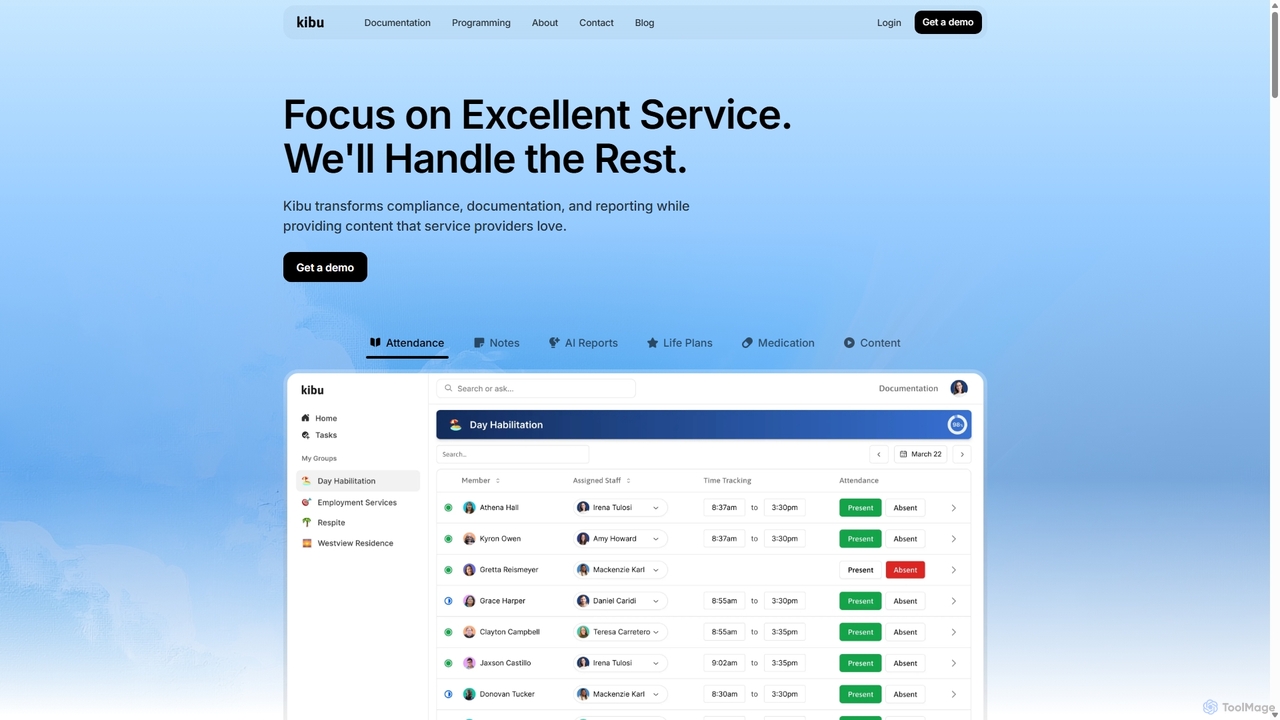
Kibu is an AI-powered platform for disability service providers, designed to streamline operations, ensure compliance, and empower staff. It simplifies documentation with AI-assisted service notes, manages member records, tracks tasks and goals, and provides instant compliance reporting. The platform is mobile-ready, HIPAA compliant, and built to help Direct Support Professionals (DSPs) focus on delivering exceptional care.
About Compliance Management
Compliance Management tools are AI-powered platforms designed to help organizations automate the process of adhering to legal, regulatory, and industry standards. These tools leverage machine learning and natural language processing (NLP) to continuously monitor regulatory changes, analyze internal data for risks, and streamline reporting. By automating these complex tasks, they enable businesses to proactively manage obligations, reduce the risk of costly penalties, and maintain operational integrity in a dynamic regulatory landscape. This specialized category within Business software focuses specifically on mitigating legal and financial risks associated with non-compliance.
Core Features
- Regulatory Monitoring: Automatically tracks and analyzes updates from thousands of global regulatory bodies in real-time.
- Risk Assessment & Mitigation: Uses predictive analytics to identify, score, and prioritize potential compliance risks based on internal data.
- Automated Reporting: Generates customizable reports for internal audits, board meetings, and regulatory submissions.
- Policy & Procedure Management: Centralizes the entire lifecycle of internal policies, from creation and distribution to employee attestation.
- Audit Trail Automation: Creates an immutable, time-stamped record of all compliance-related activities for defensibility.
Use Cases
These tools are critical in highly regulated industries such as finance (for AML, KYC), healthcare (for HIPAA), and technology (for GDPR, CCPA). They are primarily used by compliance officers, legal counsels, risk managers, and IT security teams to ensure the entire organization operates within legal boundaries. For example, a bank can use it to monitor transactions for suspicious activity, while a hospital can ensure patient data handling meets privacy laws.
How to Choose
When selecting a Compliance Management tool, first verify its coverage of regulations specific to your industry and geography. Assess its integration capabilities with your existing systems like ERP or CRM for seamless data flow. Evaluate the sophistication of its AI-powered risk detection engine and the customizability of its reporting dashboards. Finally, consider the user interface's intuitiveness for non-technical users, such as legal and compliance staff.
Compliance ManagementUse Cases
Automating GDPR/CCPA Data Privacy Audits
A Data Protection Officer (DPO) at a global e-commerce company is responsible for ensuring continuous compliance with data privacy laws like GDPR and CCPA. They use an AI Compliance Management tool to automate quarterly audits. The tool connects to various data repositories, scans for personal identifiable information (PII), and maps data flows. It automatically flags data storage or processing activities that violate policy, such as unencrypted PII or unauthorized cross-border data transfers. The DPO receives a detailed report with prioritized risks, enabling them to remediate issues 75% faster than with manual audits.
Real-time Financial Regulation Monitoring
A compliance team at a fast-growing FinTech startup needs to stay ahead of constantly changing financial regulations from bodies like the SEC and FINRA. They deploy an AI tool that monitors thousands of regulatory sources in real-time. When a new rule or an amendment relevant to their business is published, the AI analyzes its content, summarizes the key changes, and assesses its potential impact. The compliance team receives an immediate alert with an actionable summary, allowing them to update internal policies and systems promptly, avoiding potential violations and fines that could jeopardize their operations.
Managing Healthcare Compliance (HIPAA)
A hospital's IT security manager is tasked with ensuring all digital systems and employee practices are HIPAA compliant. They use a compliance management platform to continuously monitor access logs for electronic health records (EHR). The AI establishes a baseline of normal access patterns for each role. It then automatically flags anomalies, such as a nurse accessing records of patients not under their care or an administrator downloading an unusually large volume of data. This proactive monitoring helps the hospital prevent data breaches, protect patient privacy, and demonstrate due diligence during HIPAA audits.
Streamlining Internal Policy Adherence
The HR department of a multinational corporation needs to ensure all 10,000+ employees read and acknowledge the updated Code of Conduct policy. Instead of manually tracking via email, they use a compliance tool. The platform distributes the new policy to all employees, tracks who has opened and attested to it, and sends automated reminders to those who haven't. The dashboard provides the HR team with a real-time view of completion rates by department and region. This automates a time-consuming administrative task and creates a clear, auditable record of policy acknowledgment, which is crucial for legal defense.
Automating Anti-Money Laundering (AML) Checks
A financial institution's compliance unit is overwhelmed by the high volume of transaction alerts, most of which are false positives. They integrate an AI-powered AML tool into their transaction monitoring system. The AI analyzes complex transaction patterns, customer behavior, and network relationships to more accurately identify suspicious activities. It significantly reduces false positives by over 80%, allowing analysts to focus their investigations on high-risk cases. The tool also automatically generates Suspicious Activity Reports (SARs) with supporting evidence, streamlining the reporting process to regulatory authorities.
Managing Environmental, Social, and Governance (ESG) Reporting
A sustainability officer at a large manufacturing company is responsible for compiling the annual ESG report. This requires collecting disparate data from operations, HR, and supply chain departments. They use a compliance tool with an ESG module. The platform automates data collection, maps it to various ESG frameworks (like GRI and SASB), and calculates key performance indicators. It also monitors news and public data for potential reputational risks related to their supply chain. This centralizes the entire process, ensuring data accuracy and consistency, and reduces the time to generate the final report by weeks.