Helpfull
Helpfull is a hybrid feedback platform that provides rapid insights from both a panel of over 50,000 real …
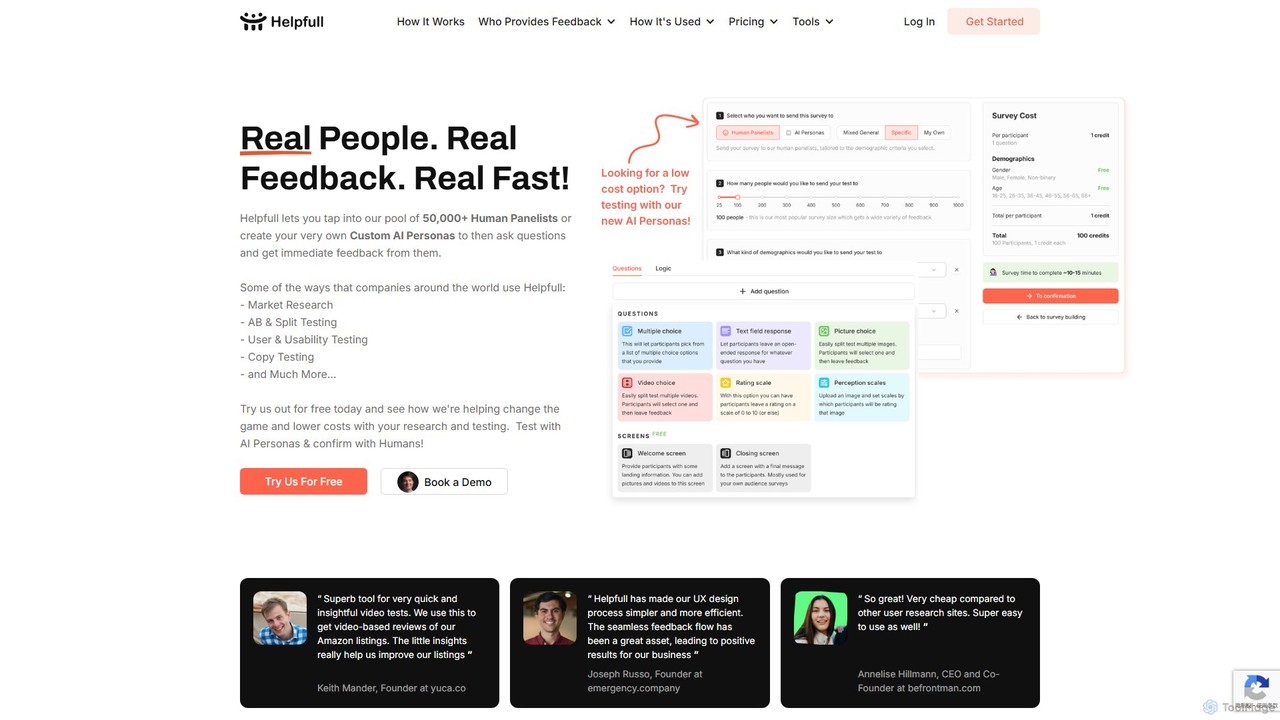
Helpfull is a hybrid feedback platform that provides rapid insights from both a panel of over 50,000 real human testers and custom-generated AI personas. It's designed for fast, affordable market research, A/B testing, usability studies, and idea validation, delivering actionable feedback in minutes.
About Feedback
Feedback AI tools are specialized platforms that leverage artificial intelligence to automate the collection, analysis, and interpretation of qualitative and quantitative feedback data. These tools utilize natural language processing (NLP) and machine learning to extract insights from customer reviews, survey responses, social media comments, and support tickets. Their primary value lies in transforming raw, unstructured feedback into actionable intelligence, enabling businesses to understand customer sentiment, identify emerging trends, and make data-driven decisions for product development, service improvement, and overall customer experience enhancement.
Core Features
- Sentiment Analysis: Automatically detects and categorizes the emotional tone (positive, negative, neutral) within text feedback.
- Topic Extraction: Identifies recurring themes, keywords, and common issues mentioned across large volumes of feedback.
- Automated Tagging: Applies predefined or AI-suggested tags to feedback entries for easier categorization and filtering.
- Trend Monitoring: Tracks changes in sentiment and topic frequency over time to spot emerging issues or successes.
- Feedback Aggregation: Consolidates feedback from multiple sources (surveys, reviews, social media) into a unified dashboard.
Applicable Scenarios
Product managers use these tools to prioritize features based on user pain points and requests. Marketing teams analyze customer sentiment to refine messaging and campaigns. Customer service departments leverage insights to improve agent training and resolve common issues proactively. UX/UI designers gain valuable input for interface improvements.
How to Choose
When selecting a Feedback AI tool, consider its integration capabilities with existing CRM or survey platforms, the accuracy of its NLP models for your specific industry language, the range of data sources it can process, and its reporting and visualization features. Evaluate the scalability for your feedback volume and the level of customization offered for tagging and analysis rules.

FeedbackUse Cases
Analyzing Customer Reviews for Product Improvement
Product managers in e-commerce use AI feedback tools to automatically process thousands of online product reviews. The tool identifies common complaints about specific features or recurring praise for others, allowing the team to prioritize bug fixes, plan new feature developments, and refine product messaging based on direct customer input, significantly reducing manual review analysis time.
Understanding Employee Sentiment from Internal Surveys
HR departments in large corporations deploy AI feedback tools to analyze open-ended responses from annual employee engagement surveys. The AI identifies key themes like "work-life balance," "career development," or "management communication," along with the associated sentiment. This helps HR pinpoint areas of concern or satisfaction across different departments, informing targeted initiatives to improve workplace culture and retention.
Monitoring Brand Perception Across Social Media
Marketing teams utilize AI feedback tools to continuously monitor mentions of their brand, products, and competitors across various social media platforms. The tool performs sentiment analysis on these mentions, alerting the team to sudden shifts in public perception or emerging crises. This enables rapid response to negative feedback and strategic amplification of positive brand narratives.
Prioritizing Customer Support Issues
Customer service managers integrate AI feedback tools with their ticketing systems. The AI analyzes the text of incoming support tickets and chat logs, automatically categorizing issues by topic (e.g., "billing," "technical bug," "feature request") and sentiment. This allows agents to quickly identify urgent or widespread problems, prioritize responses, and escalate critical issues more efficiently, improving resolution times.
Gathering User Experience Insights for Software Development
UX/UI designers and software development teams use AI feedback tools during beta testing phases. Users provide open-ended feedback on new features or interface designs. The AI processes this qualitative data to identify usability issues, confusing elements, or highly praised functionalities, providing actionable insights that guide design iterations and ensure a more user-friendly final product.
Evaluating Training Program Effectiveness
Learning and development departments employ AI feedback tools to analyze participant comments and suggestions from post-training evaluations. The AI extracts common themes regarding course content, instructor effectiveness, and learning environment, along with sentiment. This helps L&D teams understand what aspects of the training are working well and where improvements are needed, leading to more impactful educational programs.