ToolMage
Sign in

Best 1 Lead Management AI tools for Business

Popular Lead Management AI tools in Business include Skarbe, helping you work more efficiently.

Skarbe
Paid

Skarbe

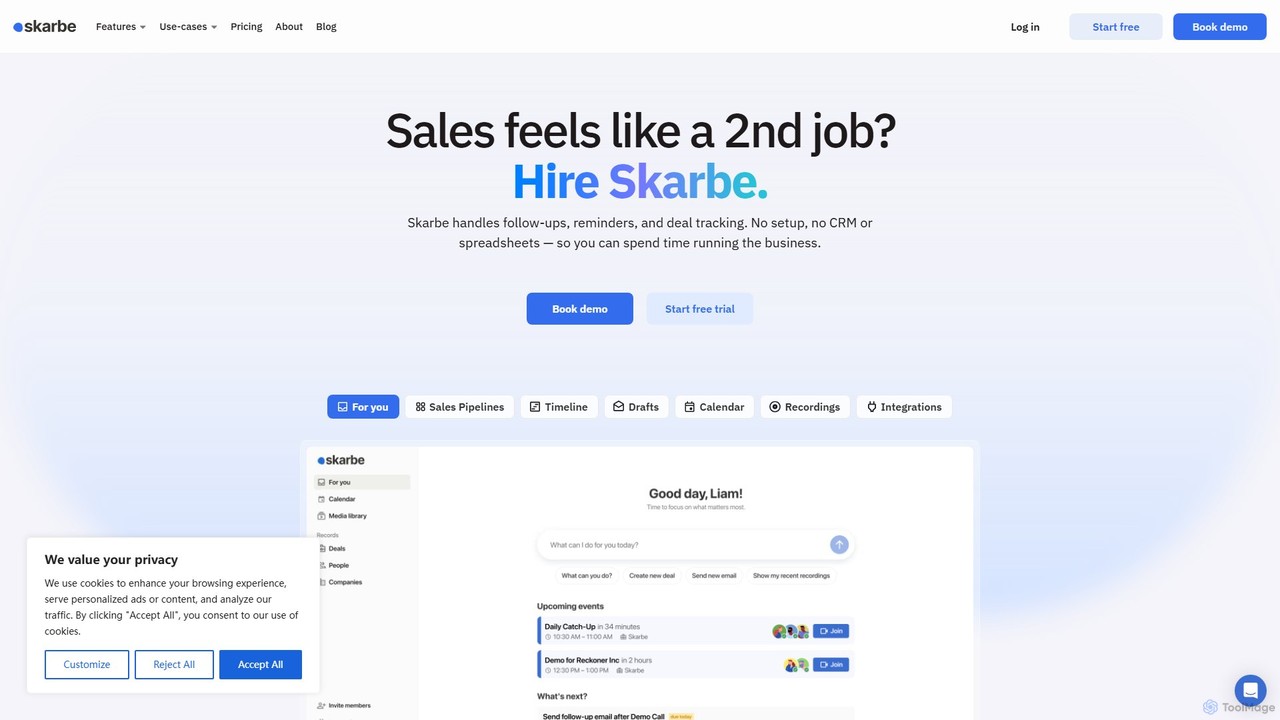
Skarbe is an AI-powered 'invisible CRM' that automates sales workflows by integrating directly with your email and calendar. It eliminates manual data entry by automatically capturing contacts, tracking deals, and managing your pipeline, allowing sales professionals to focus on selling rather than administrative tasks.

Lead Management
Visits 6.5KFavorites 119Likes 120

About Lead Management

AI Lead Management tools are specialized platforms designed to automate and optimize the process of capturing, qualifying, and nurturing potential customers. These tools leverage machine learning for predictive lead scoring, natural language processing for intelligent communication, and data analytics to identify high-value prospects. By automating repetitive tasks, they enable sales and marketing teams to focus on building relationships with the most promising leads, ultimately shortening sales cycles and increasing conversion rates. This focused approach distinguishes them within the broader Business tools category by concentrating specifically on the top of the sales funnel.

Core Features

  • Predictive Lead Scoring: Uses AI to analyze lead data and behavior to rank their likelihood to convert.
  • Automated Nurturing Workflows: Creates and deploys personalized email or message sequences based on lead actions.
  • Intelligent Lead Routing: Automatically assigns new leads to the most suitable sales representative based on predefined rules.
  • AI Chatbot Integration: Captures and qualifies leads from website visitors 24/7 through conversational AI.
  • Data Enrichment: Automatically finds and appends missing information to lead profiles, such as job title or company size.

Use Cases

AI Lead Management tools are widely used by B2B sales and marketing teams, particularly in sectors like SaaS, real estate, financial services, and education. Sales Development Representatives (SDRs) use them to prioritize outreach efforts, while marketing managers automate follow-up campaigns to move leads through the funnel more efficiently. They are essential for any business dealing with a high volume of inbound inquiries that needs a systematic way to manage them.

How to Choose

When selecting an AI Lead Management tool, first consider its integration capabilities with your existing CRM (e.g., Salesforce, HubSpot). Evaluate the sophistication and customizability of its lead scoring model. Assess the flexibility of its automation workflow builder to ensure it matches your sales process. Finally, examine the depth of its analytics and reporting features to measure performance and ROI effectively.

Lead Management use cases

1

Automate B2B Lead Qualification

A sales development representative (SDR) at a SaaS company uses an AI lead management tool to handle hundreds of daily inbound leads from web forms and content downloads. The AI automatically scores each lead based on firmographics (company size, industry) and behavioral data (pages visited, emails opened). It instantly flags high-scoring leads as 'sales-ready' and routes them to the appropriate account executive's calendar, while placing lower-scoring leads into an automated email nurturing sequence. This process eliminates hours of manual vetting and ensures sales focuses only on the most qualified prospects.

2

24/7 Lead Capture via Website Chatbot

A real estate agency implements an AI chatbot on its website, powered by their lead management system. When a visitor browses property listings after hours, the chatbot proactively engages them, asking about their preferences like location, budget, and property type. It answers common questions and, if the visitor is interested, collects their contact information to schedule a viewing. This lead is automatically created in the system, tagged with all the collected details, and assigned to an agent specializing in that area. This ensures no potential client is lost, regardless of when they visit the site.

3

Personalized Nurturing for High-Value Leads

A financial advisory firm uses an AI lead management tool to nurture high-net-worth individuals who have downloaded an investment guide. The system triggers a personalized email sequence. The first email thanks them and offers a related article. Based on whether they click the link, the AI sends a follow-up: a case study for engaged leads or a different educational piece for less engaged ones. If a lead visits the pricing page, the system alerts a senior advisor to make a personal phone call. This automated, behavior-driven approach keeps leads warm and ensures timely, relevant communication without manual tracking.

4

Intelligent Lead Routing for Sales Teams

A large technology company with multiple product lines uses an AI lead management platform to distribute incoming leads. The AI analyzes data from the inquiry form, such as industry, company size, and the specific product mentioned. Based on this, it instantly routes the lead to the sales team best equipped to handle it. For example, a lead from a large enterprise in the healthcare sector is sent to a senior enterprise sales rep specializing in healthcare, while a small business inquiry goes to the SMB team. This ensures faster response times from the most knowledgeable representative, improving the customer experience and increasing the likelihood of a sale.

5

Enrich Lead Data for Better Personalization

A marketing manager at a B2B software company receives a lead with only a name and an email address. The AI lead management tool automatically enriches this data by scanning public sources and proprietary databases. Within seconds, it appends the lead's job title, company name, company size, industry, and even a link to their LinkedIn profile. With this complete profile, the marketing team can enroll the lead in a highly targeted nurturing campaign specific to their industry and role, significantly increasing the relevance of the communication and the chances of engagement, rather than sending a generic welcome email.

6

Prioritize Sales Calls with Predictive Scoring

A sales team at an educational institution is tasked with following up on thousands of inquiries for various courses. Their AI lead management tool analyzes historical data to build a predictive model. It scores new leads not just on demographics, but on subtle behavioral signals that correlate with enrollment, such as time spent on the financial aid page or downloading multiple course syllabi. Each morning, the system generates a prioritized call list for each sales representative, showing the top 20% of leads most likely to enroll. This allows the team to focus their energy on high-potential candidates, dramatically improving their call-to-enrollment conversion rate.

Lead Management FAQ

What is AI Lead Management?

AI Lead Management refers to using artificial intelligence-powered software to automate and enhance the process of attracting, qualifying, and nurturing potential customers (leads). Instead of manual tracking, these tools use machine learning to score leads based on their likelihood to buy, automate personalized communication, and intelligently route them to the right sales representatives. The primary goal is to increase the efficiency of sales and marketing teams by allowing them to focus on the most promising opportunities, leading to higher conversion rates and faster sales cycles.

How to choose the right AI Lead Management tool?

Choosing the right tool depends on your specific needs. Consider these factors:

  • CRM Integration: Ensure it seamlessly integrates with your existing Customer Relationship Management (CRM) system (e.g., Salesforce, HubSpot) to maintain a single source of truth for customer data.
  • Scoring Customization: Look for a tool that allows you to customize the lead scoring model based on the criteria that are most important to your business.
  • Automation Capabilities: Evaluate the flexibility of its workflow builder. Can it support your complex nurturing sequences and routing rules?
  • Analytics and Reporting: The tool should provide clear, actionable insights into your lead funnel, campaign performance, and team productivity.
  • Ease of Use: The platform should be intuitive for both marketing and sales users to adopt and manage effectively.
What's the difference between Lead Management and a CRM?

While related, they serve different primary functions. A Lead Management system is a specialized tool focused on the top of the sales funnel: capturing, scoring, nurturing, and qualifying leads until they are 'sales-ready'. Its main goal is to efficiently filter and prepare leads for the sales team. A Customer Relationship Management (CRM) system is a broader platform for managing the entire customer lifecycle. It stores all interactions with prospects and existing customers, manages sales pipelines, and handles post-sale relationships. Many CRMs have lead management features, but dedicated AI lead management tools often offer more advanced, AI-driven capabilities specifically for lead qualification and nurturing.

What are the key features of AI Lead Management tools?

Most AI Lead Management tools share a set of core features designed to optimize the sales funnel. Key features typically include:

  • Predictive Lead Scoring: AI algorithms analyze various data points to predict which leads are most likely to become customers.
  • Automated Workflows: Tools to build 'if-this-then-that' rules for lead nurturing, such as sending a specific email sequence if a lead visits a certain webpage.
  • Lead Enrichment: Automatically populating lead profiles with publicly available data like company size, industry, and job title.
  • Intelligent Routing: Automatically assigning leads to the correct salesperson based on territory, expertise, or availability.
  • AI-Powered Chatbots: Engaging website visitors to capture and qualify leads in real-time, 24/7.
Who should use AI Lead Management tools?

AI Lead Management tools are most beneficial for businesses that handle a significant volume of inbound leads and want to improve the efficiency and effectiveness of their sales and marketing efforts. Key users include:

  • Sales Teams: Particularly Sales Development Representatives (SDRs) who need to prioritize their outreach to the most qualified leads.
  • Marketing Departments: To automate lead nurturing campaigns and ensure a smooth handoff of marketing-qualified leads (MQLs) to sales.
  • Business Owners: In small to medium-sized businesses who need a systematic way to manage growth and convert more inquiries into customers.

Industries such as SaaS, real estate, education, and financial services often see a high return on investment from these tools.