Aidea
Aidea is an AI-powered notepad designed to transform your raw ideas into actionable business plans. Simply jot down …
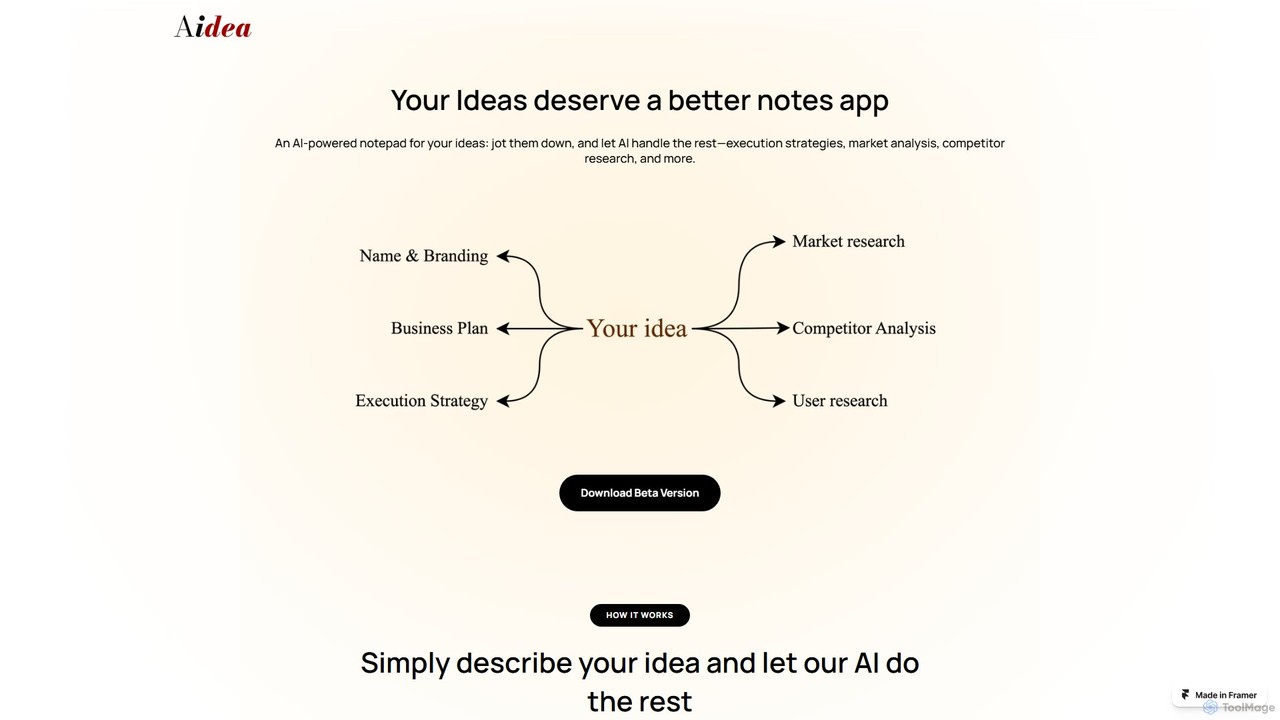
Aidea is an AI-powered notepad designed to transform your raw ideas into actionable business plans. Simply jot down your concept, and Aidea's AI will automatically generate comprehensive execution strategies, market analysis, competitor research, monetization models, and even a pitch deck. It's the ultimate tool for aspiring entrepreneurs and innovators to quickly validate and structure their vision.
About Startup Tools
AI Startup Tools are a specialized suite of applications designed to accelerate the journey of early-stage companies. These tools leverage artificial intelligence to automate and enhance critical tasks such as idea validation, market research, business planning, and fundraising preparation. They provide data-driven insights and generate essential assets, enabling founders to launch and scale faster with limited resources. This focused approach helps startups navigate uncertainty and increase their chances of success.
Core Features
- Idea Validation & Market Analysis: Uses AI to analyze market trends, competitor landscapes, and potential customer demand to assess business viability.
- Business Plan & Pitch Deck Generation: Automatically creates structured business plans, financial projections, and persuasive investor pitch decks from user inputs.
- MVP & Landing Page Builders: Enables the rapid creation of minimum viable products (MVPs) and high-converting landing pages, often with no-code interfaces.
- Automated Financial Modeling: Generates detailed financial forecasts, including profit and loss statements, cash flow analysis, and cap table management.
- Growth Hacking Automation: Identifies target customer segments and automates initial outreach for marketing and lead generation campaigns.
Use Cases
These tools are primarily used by aspiring entrepreneurs, early-stage founders, and teams within incubators or accelerators. For instance, a solo founder can use an AI tool to validate a new app idea against market data before development. A small team can generate a professional pitch deck and financial model in hours, not weeks, to prepare for a seed funding round.
How to Choose
When selecting an AI Startup Tool, consider your current stage; tools for ideation differ from those for scaling. Evaluate the scope of features—do you need an all-in-one platform or a specialized tool for a single task like pitch deck creation? Assess integration capabilities with other software you use, and consider the tool's scalability to ensure it can support your company's growth.
Startup ToolsUse Cases
Validate a New Business Idea
An aspiring entrepreneur has an idea for a subscription box service for eco-friendly products. Before investing time and money, they use an AI startup tool to conduct market analysis. They input their concept, target audience (eco-conscious millennials), and potential product categories. The AI scans market reports, social media trends, and competitor data to generate a viability score. It highlights a high demand for sustainable home goods but low interest in subscription models for this niche. This data-driven insight helps the founder pivot their idea to an e-commerce store instead, saving months of pursuing a less viable model.
Create a Pitch Deck for Investors
A small tech startup with two co-founders needs to raise a seed round. They lack design skills and are short on time. Using an AI pitch deck generator, they input key information: the problem they solve, their solution, target market size, business model, and team bios. The AI tool structures this information into a standard 10-slide investor deck format. It suggests compelling visuals, generates concise copy for each slide, and even creates initial financial projection charts. Within two hours, they have a professional, well-structured presentation ready for investor meetings, a task that would have previously taken them several days.
Build a No-Code MVP Landing Page
A non-technical founder wants to test demand for a new B2B SaaS product. Instead of hiring a developer, she uses an AI landing page builder. She describes her product and target audience in plain English. The AI generates several design layouts, writes persuasive headline and feature copy, and selects relevant stock imagery. She can then easily customize the colors and branding. The tool also integrates a simple email sign-up form to collect leads from interested visitors. In under a day, she launches a professional-looking landing page to start gathering user feedback and building a waitlist, validating her concept with real market interest.
Generate a Go-to-Market Strategy
A startup is ready to launch its mobile app but has a limited marketing budget. The team uses an AI strategy tool to develop a go-to-market plan. They provide details about their app's features, ideal customer profile, and budget constraints. The AI analyzes this information and proposes a multi-channel strategy. It suggests focusing on organic social media content for TikTok and Instagram, identifies three niche subreddits for community engagement, and generates a list of micro-influencers for potential collaboration. It also drafts initial ad copy and suggests a small starting budget for targeted Facebook ads, providing a clear, actionable launch plan.
Automate Financial Projections
A founder preparing for an angel investor meeting needs a three-year financial forecast but isn't an expert in finance. They use an AI financial modeling tool. They input their pricing model ($20/month subscription), estimated customer acquisition cost ($50), and projected monthly user growth (15%). The AI automatically generates a detailed profit and loss statement, cash flow forecast, and balance sheet. It also calculates key metrics like customer lifetime value (LTV) and churn rate assumptions. This allows the founder to present a credible and comprehensive financial plan with confidence, without needing to spend weeks learning complex spreadsheet formulas.
Draft Initial Legal Documents
Two co-founders are officially starting their company and need a founder's agreement. To save on initial legal costs, they use an AI legal document generator. They answer a series of questions about equity split, roles and responsibilities, vesting schedules, and intellectual property ownership. Based on their answers, the tool generates a standard, customizable founder's agreement. While this document is not a substitute for advice from a qualified lawyer, it provides a solid, comprehensive starting point for their discussions and helps them formalize their partnership quickly and cost-effectively, allowing them to focus on building the product.