ToolMage
Sign in

Best 1 Cost Management AI tools for Cloud

Popular Cost Management AI tools in Cloud include Granica, helping you work more efficiently.

Granica
Paid

Granica

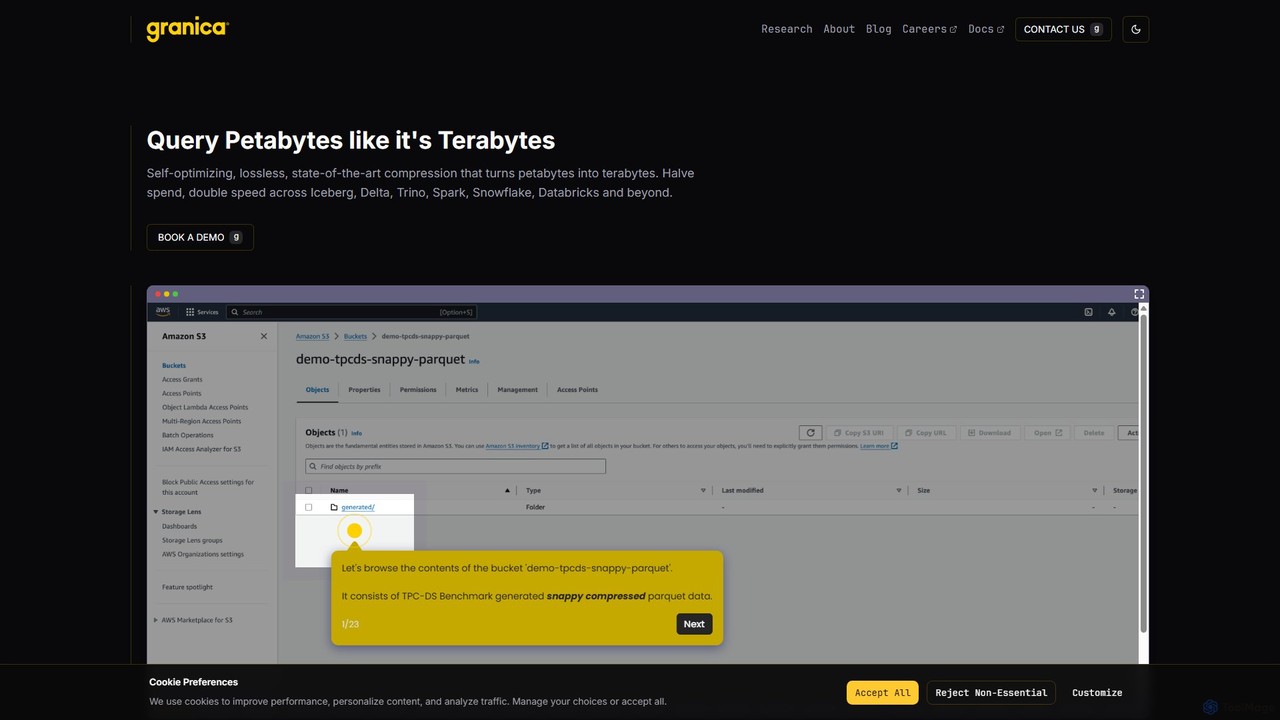
Granica is an AI-powered data infrastructure platform that provides self-optimizing, lossless compression for petabyte-scale data lakes. It dramatically reduces cloud storage and compute costs while accelerating query performance across platforms like Snowflake, Databricks, Spark, and more.

Cost Management
Visits 10KFavorites 130Likes 130

About Cost Management

Cost Management AI tools are specialized solutions designed to help organizations monitor, analyze, and optimize their expenditures, particularly within complex cloud environments. These tools leverage artificial intelligence and machine learning algorithms to process vast amounts of financial data, identify spending patterns, detect anomalies, and provide actionable insights. Their primary value lies in enabling businesses to reduce operational costs, improve resource utilization, and ensure budget adherence, making them crucial for efficient cloud resource governance and strategic financial planning. By automating the often-manual and complex task of tracking cloud spend, these AI tools empower finance and operations teams to make data-driven decisions.

Core Features

  • Automated Spend Tracking: Continuously monitors, categorizes, and visualizes expenditures across various cloud platforms and services, offering real-time visibility.
  • Anomaly Detection: Utilizes AI-driven pattern recognition to proactively identify unusual spending spikes, unexpected resource consumption, or deviations from expected budgets.
  • Resource Optimization Recommendations: Provides intelligent suggestions for right-sizing underutilized resources, terminating idle instances, or recommending optimal reserved instance/savings plan purchases to significantly reduce waste.
  • Budget Forecasting & Alerting: Predicts future cloud costs based on historical usage data and trends, automatically alerting stakeholders when spending approaches or exceeds predefined limits.
  • Cost Allocation & Chargeback: Accurately attributes cloud costs to specific projects, teams, departments, or even individual customers, enhancing accountability and facilitating internal billing.

Use Cases

These tools are vital for cloud architects, finance teams, and IT managers seeking to gain granular visibility and control over their cloud infrastructure spending. They are used to prevent budget overruns, optimize resource provisioning, and ensure compliance with financial policies. For instance, a SaaS company might use them to analyze per-customer infrastructure costs to refine pricing models, or a large enterprise to manage spending across multiple cloud providers and business units, ensuring efficient resource allocation and cost recovery.

How to Choose

When selecting a Cost Management AI tool, consider its integration capabilities with your existing cloud providers (e.g., AWS, Azure, GCP) and financial systems, ensuring seamless data ingestion. Evaluate the granularity and customizability of its reporting and analytics dashboards, as well as its ability to provide actionable, context-aware optimization recommendations. Assess the accuracy and adaptability of its forecasting models, the flexibility of its alerting mechanisms, and its robust support for multi-cloud and hybrid cloud environments. User interface intuitiveness, ease of setup, and the level of automation offered for cost-saving actions are also key factors for successful adoption.

Featured tool rankings

Cost Management use cases

1

Optimizing Cloud Spend for SaaS Products

SaaS companies often face fluctuating cloud infrastructure costs tied to customer usage. AI Cost Management tools enable finance and engineering teams to analyze granular spending data per service, per customer, and per feature. This allows them to identify inefficient resource allocations, right-size instances, and optimize database costs, directly impacting profitability and enabling more accurate pricing strategies for their offerings.

2

Detecting and Mitigating Cloud Cost Anomalies

For large enterprises with complex cloud footprints, unexpected cost spikes can go unnoticed until it's too late. AI-powered tools continuously monitor spending patterns, automatically flagging unusual deviations caused by misconfigurations, runaway processes, or unauthorized resource provisioning. This proactive anomaly detection allows IT operations to investigate and mitigate issues rapidly, preventing significant financial losses and maintaining budget control.

3

Automating Budget Allocation and Tracking for Projects

Project managers and department heads need clear visibility into their allocated cloud budgets and actual spend. Cost Management AI tools facilitate the creation of granular budgets for specific projects or teams, automatically tracking consumption against these limits. They provide real-time dashboards and alerts, empowering teams to manage their own spend responsibly and ensuring that projects stay within financial guardrails without manual oversight.

4

Forecasting Future Cloud Costs with High Accuracy

Accurate financial planning is crucial for any organization leveraging cloud services. AI Cost Management solutions analyze historical usage, growth trends, and market data to generate highly accurate forecasts of future cloud expenditures. This predictive capability helps CFOs and procurement teams anticipate upcoming costs, negotiate better deals with cloud providers, and allocate capital more effectively for future expansion or new initiatives.

5

Right-Sizing and Decommissioning Underutilized Resources

Many organizations over-provision cloud resources "just in case," leading to significant waste. AI tools analyze actual resource utilization (CPU, memory, network) over time and recommend precise adjustments, such as downgrading instance types or decommissioning idle virtual machines and storage volumes. This ensures that resources are perfectly matched to demand, drastically reducing unnecessary expenditure and improving overall cloud efficiency.

6

Generating Comprehensive Cost Reports for Stakeholders

Financial transparency and accountability are paramount. AI Cost Management platforms automate the generation of detailed, customizable cost reports for various stakeholders, from executive leadership to individual project teams. These reports can break down costs by service, region, tag, or business unit, providing clear insights into where money is being spent and demonstrating the ROI of cloud investments for informed decision-making.

Cost Management FAQ

What are AI Cost Management tools?

AI Cost Management tools are software solutions that use artificial intelligence and machine learning to help businesses monitor, analyze, and optimize their spending, especially on cloud services. They automate the process of tracking expenditures, identifying cost-saving opportunities, and forecasting future costs. Their core purpose is to provide granular visibility and control over financial outflows, ensuring efficient resource utilization and budget adherence.

How do AI tools specifically optimize cloud costs?

AI tools optimize cloud costs by performing several key functions. They analyze usage patterns to recommend right-sizing instances, identify and flag idle or underutilized resources for termination, and detect anomalies that could indicate wasteful spending. Furthermore, they can suggest optimal purchasing strategies like reserved instances or savings plans based on predicted future usage, significantly reducing overall cloud expenditure through data-driven insights.

What are the key benefits of using AI for cost management?

The key benefits of using AI for cost management include enhanced financial visibility, proactive cost control, and improved resource efficiency. AI tools provide real-time insights into spending, automate the detection of budget overruns or anomalies, and offer actionable recommendations for optimization. This leads to significant cost savings, better budget adherence, reduced manual effort in financial tracking, and more strategic decision-making regarding resource allocation.

How should I choose an AI Cost Management solution for my business?

When choosing an AI Cost Management solution, consider its compatibility with your existing cloud providers (multi-cloud support is often crucial) and integration with your financial systems. Evaluate the depth of its analytics and reporting capabilities, its ability to provide actionable optimization recommendations, and the accuracy of its forecasting models. Also, assess its user-friendliness, the level of automation it offers for cost-saving actions, and the quality of customer support. A free trial can help determine the best fit.

What's the difference between AI Cost Management and traditional financial reporting?

Traditional financial reporting typically provides historical data on expenditures, often requiring manual aggregation and analysis. AI Cost Management, while including historical data, goes further by using AI to proactively identify patterns, predict future costs, and offer prescriptive recommendations for optimization. It's more dynamic, automated, and focused on actionable insights for cost reduction and efficiency, especially in the complex, dynamic environment of cloud computing, unlike static, backward-looking traditional reports.