AI Doc Suite
AI Doc Suite is an advanced, browser-based AI workspace for creating, editing, and converting professional documents, slides, spreadsheets, …
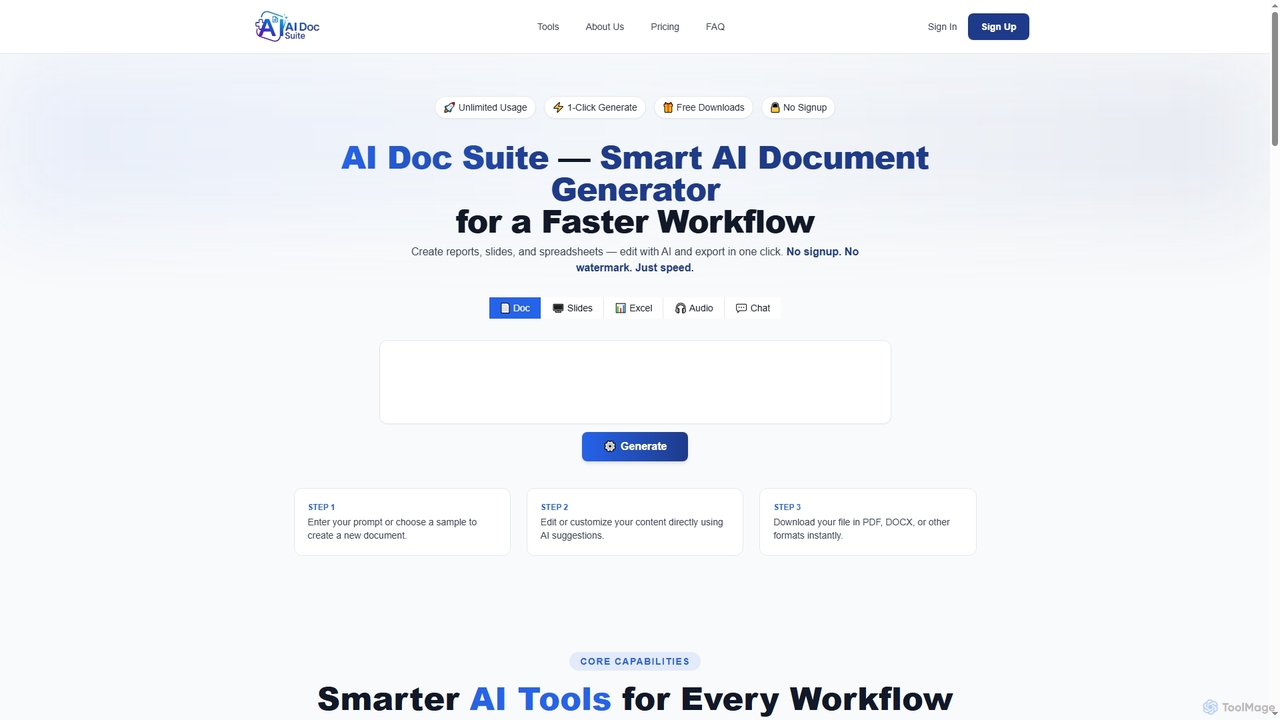
AI Doc Suite is an advanced, browser-based AI workspace for creating, editing, and converting professional documents, slides, spreadsheets, audio, images, and videos. It streamlines content generation with intelligent automation and customizable templates, offering a comprehensive solution for various creative and business needs.
About Collaboration Tools
AI Collaboration Tools are a class of software that leverages artificial intelligence to enhance teamwork, streamline communication, and automate workflows. These tools utilize technologies like Natural Language Processing (NLP) and machine learning to analyze conversations, manage tasks, and surface relevant information. They are designed to reduce manual administrative work, break down communication barriers, and provide data-driven insights to improve project outcomes. By automating routine processes like meeting summarization and status reporting, teams can focus on more strategic and creative work.
Core Features
- Intelligent Meeting Summaries: Automatically transcribes, summarizes, and identifies action items from voice or video meetings.
- Automated Task Management: Suggests task assignments, prioritizes work, and predicts project timelines based on team activity.
- Real-time Language Translation: Facilitates seamless communication in multilingual teams by translating chat messages and documents instantly.
- Contextual Knowledge Discovery: Proactively surfaces relevant files, conversations, and data from across the organization's knowledge base.
- Workflow Automation: Automates routine processes such as status updates, report generation, and information routing between team members.
Use Cases
These tools are particularly valuable for remote and hybrid teams that rely on digital communication. They are widely used in agile development for sprint planning and progress tracking, in marketing for managing cross-functional campaigns, and in large enterprises to coordinate global projects across different time zones and languages. Any team looking to improve efficiency and reduce meeting fatigue can benefit.
How to Choose
When selecting an AI Collaboration Tool, first consider its integration capabilities with your existing software stack (e.g., Slack, Google Workspace, Jira). Evaluate the specific AI features offered and match them to your team's primary pain points, whether it's meeting overload or project tracking. Also, assess the tool's security protocols, scalability for team growth, and the intuitiveness of its user interface to ensure smooth adoption.

Collaboration ToolsUse Cases
Automate Meeting Summaries and Action Items
A project manager for a remote team spends hours each week re-watching meeting recordings to draft summaries and assign tasks. By using an AI collaboration tool, the entire process becomes automated. The tool connects to their video conferencing platform, automatically transcribes the conversation, generates a concise summary highlighting key decisions, and creates a checklist of action items with suggested assignees based on the discussion. This reduces administrative overhead by over 80%, prevents key tasks from being missed, and ensures everyone is aligned on next steps immediately after the meeting concludes.
Streamline Cross-Functional Project Updates
A marketing team launching a new product collaborates with engineering, sales, and support teams. Keeping everyone informed with manual status updates is time-consuming and prone to error. They adopt an AI collaboration platform that integrates with their different work tools (Jira for engineering, Salesforce for sales). The AI automatically pulls progress data from each system, analyzes it to identify potential delays or dependencies, and generates a unified, real-time project dashboard. This provides a single source of truth, eliminates the need for weekly status meetings, and allows team leads to proactively address risks highlighted by the AI.
Overcome Language Barriers in Global Teams
An international corporation has teams located in Germany, Japan, and Mexico. Communication breakdowns due to language differences are common, slowing down projects. They implement an AI collaboration tool with built-in, real-time translation. Now, a team member in Mexico can type a message in Spanish in a shared channel, and their colleagues in Germany and Japan will see it instantly in German and Japanese, respectively. This feature also applies to documents and comments, fostering a more inclusive and efficient environment where ideas can be shared freely without the delay or cost of external translation services.
Proactively Identify Project Risks
A software development team follows an agile methodology, but often struggles to identify roadblocks until they become critical. Their new AI collaboration tool analyzes communication patterns in chat channels, task completion velocity, and code commit comments. The AI flags conversations with negative sentiment, identifies tasks that are consistently delayed, and highlights potential integration issues between different developers' work. This provides the team lead with an early warning system, allowing them to intervene, offer support, or reallocate resources before a small issue escalates into a major project delay.
Accelerate New Hire Onboarding
An HR department is overwhelmed with repetitive questions from new employees during their first few weeks. They set up a dedicated onboarding channel within their AI collaboration tool. The AI is trained on company policies, process documents, and past Q&A. When a new hire asks a question like "How do I set up my benefits?" or "Where can I find the brand guidelines?", the AI instantly provides a direct answer with links to relevant documents. This frees up HR personnel to focus on more personalized onboarding tasks and provides new hires with immediate, 24/7 support, improving their initial experience.
Enhance Decision-Making with Data Insights
A leadership team needs to understand team productivity and well-being without micromanaging. Their AI collaboration tool provides anonymized, high-level analytics. It visualizes communication flows to show which teams are collaborating effectively and which might be siloed. It also tracks metrics like 'focus time' versus 'meeting time' across the organization and analyzes sentiment trends in public channels to gauge overall morale. These data-driven insights help leadership make informed decisions about process improvements, resource allocation, and initiatives to prevent burnout, all while respecting individual privacy.