Considerful
Considerful is an AI-powered communication platform designed for productive teams. It fosters focused, asynchronous, topic-based discussions to encourage …
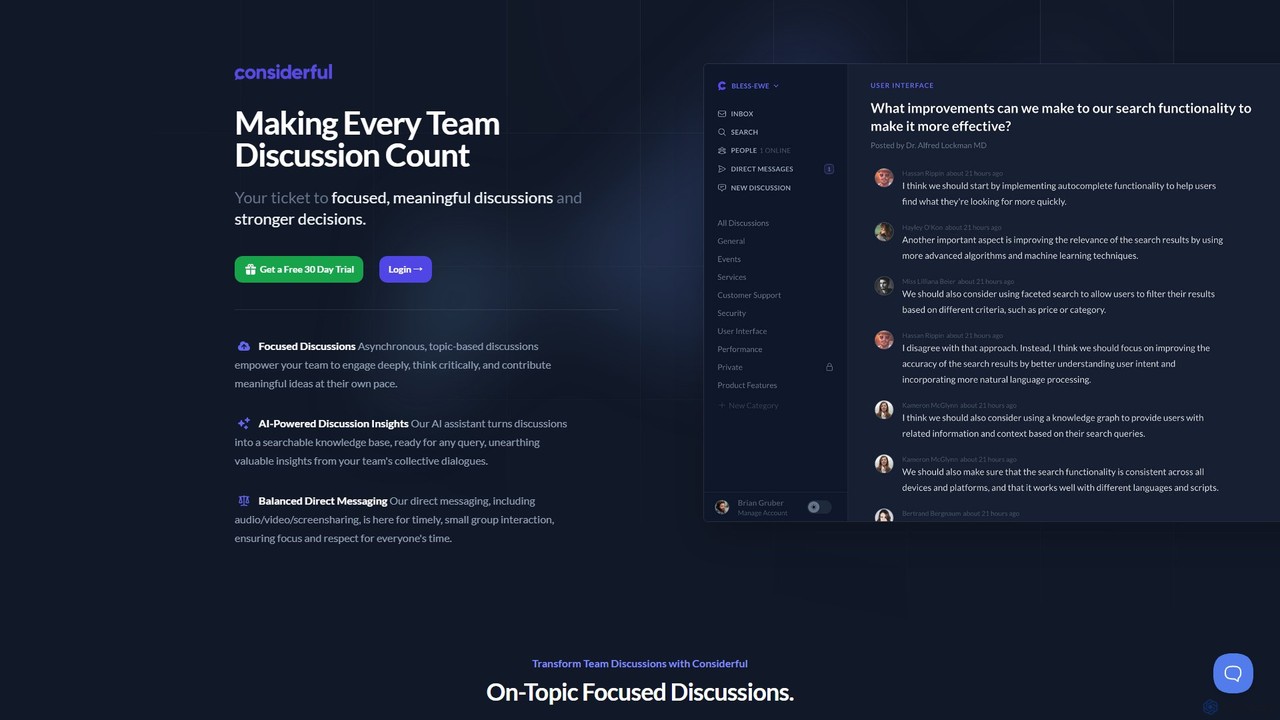
Considerful is an AI-powered communication platform designed for productive teams. It fosters focused, asynchronous, topic-based discussions to encourage deep thinking and meaningful contributions, while its AI assistant transforms conversations into a searchable knowledge base. It also includes balanced direct messaging for timely interactions.
About Knowledge Management
Knowledge Management tools are AI-powered platforms designed to capture, organize, and retrieve an organization's collective intelligence. They utilize technologies like Natural Language Processing (NLP) and semantic search to index information from various sources, including documents, emails, and chat conversations. This allows users to find precise answers and insights based on context, not just keywords. As a key component of modern communication strategies, these tools create a centralized, searchable "single source of truth," reducing redundant questions and accelerating knowledge sharing across teams.
Core Features
- Semantic Search: Understands the intent and context behind a query to deliver highly relevant results.
- Automated Content Curation: AI automatically tags, categorizes, and links related pieces of information from different sources.
- Knowledge Graph Visualization: Creates interactive maps that show relationships between topics, documents, and people.
- Proactive Knowledge Delivery: Suggests relevant documents or experts to users based on their current tasks or projects.
- Multi-Source Integration: Connects with and indexes data from platforms like Slack, Google Drive, Confluence, and Notion.
Applicable Scenarios
These tools are invaluable for remote-first companies needing to centralize information, large enterprises struggling with data silos, and fast-growing startups aiming to scale their internal knowledge. They are commonly used by customer support teams to power self-service portals, engineering teams to manage technical documentation, and HR departments to streamline employee onboarding.
Selection Criteria
When choosing a Knowledge Management tool, evaluate its integration capabilities with your existing software stack. Assess the accuracy and speed of its search functionality. Consider the robustness of its security features and access control settings. Finally, analyze its ability to handle diverse content formats (text, PDFs, videos, code) and its overall ease of use for all employees.
Knowledge ManagementUse Cases
Create a Self-Service Customer Support Hub
Customer support teams use AI knowledge management tools to build an intelligent, internal knowledge base. The system ingests information from past support tickets, help articles, product manuals, and community forums. When a support agent or a customer asks a question in natural language, such as "How do I reset my password if I lost my recovery email?", the AI provides a direct, synthesized answer with links to the source documents. This significantly reduces agent response times and empowers customers to find solutions independently, deflecting a high volume of common tickets.
Centralize Engineering and Product Documentation
For software development and product teams, these tools act as a collective brain. They connect to services like GitHub, Jira, and Confluence to index technical specifications, architectural decision records, code comments, and project updates. An engineer can ask, "What was the reasoning behind the API authentication change in Q3?" and the tool will surface the relevant documents, meeting notes, and even Slack conversations related to that decision. This accelerates developer onboarding and prevents the loss of critical project context.
Streamline New Employee Onboarding
HR and department managers can create a seamless onboarding experience by centralizing all necessary information. The tool indexes company handbooks, policy documents, training videos, and departmental wikis. A new hire can simply ask questions like "What is the company's remote work policy?" or "Who do I contact for IT support?". The AI provides immediate, accurate answers, guiding them to the right resources without them needing to constantly ask colleagues. This empowers new employees to become productive faster and feel more integrated.
Preserve and Discover Institutional Knowledge
In large organizations, valuable expertise is often lost when experienced employees leave. A knowledge management system captures this tacit knowledge by indexing project reports, research papers, presentations, and expert-identified best practices. Its knowledge graph can reveal hidden connections between different projects or departments. A researcher looking into a new material can discover previous, related experiments conducted years ago, preventing redundant work and fostering innovation by building on past discoveries.
Empower Sales Teams with Instant Information
Sales enablement relies on providing the sales team with the right content at the right time. An AI knowledge management tool connects to the CRM, cloud storage, and marketing platforms. A salesperson preparing for a client call can quickly ask, "Find me a case study for a financial services company with over 500 employees" or "What are our key differentiators against Competitor X?". The system instantly retrieves the most relevant and up-to-date materials, improving sales preparedness and shortening the sales cycle.
Simplify Compliance and Internal Audits
For legal and compliance departments, navigating vast amounts of regulatory documents and internal policies is a major challenge. These tools can index all compliance-related materials, including contracts, audit trails, and government regulations. An auditor can use semantic search to find all instances of a specific policy clause across thousands of documents, regardless of the exact wording used. This dramatically speeds up the audit process, reduces the risk of non-compliance, and ensures consistent policy application across the organization.