Faindly
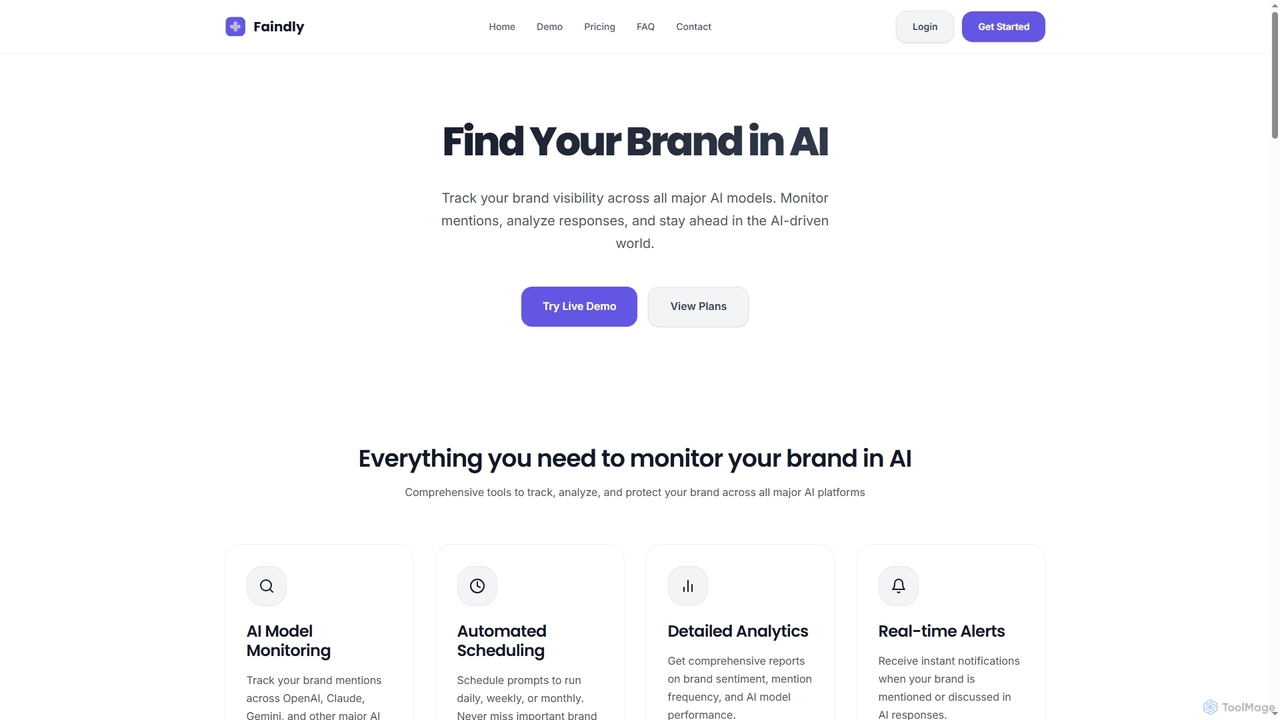
Faindly is an AI visibility tracker that monitors your brand's presence across major AI models like ChatGPT, Claude, …
Faindly is an AI visibility tracker that monitors your brand's presence across major AI models like ChatGPT, Claude, and Gemini. It provides real-time alerts, detailed analytics on sentiment and mention frequency, and automated scheduling for prompts, helping businesses protect their reputation and identify growth opportunities in the AI-driven landscape.
About Market Research
AI Market Research tools are a specialized category of software designed to automate the collection, analysis, and interpretation of market data. As a key component of competitive intelligence, they focus specifically on understanding consumer behavior, market trends, and public sentiment. These tools leverage natural language processing (NLP) and machine learning to analyze vast datasets from sources like social media, customer reviews, and surveys. This enables businesses to gain deep, actionable insights into their target audience and competitive landscape without extensive manual effort.
Core Features
- Sentiment Analysis: Automatically gauges the emotional tone (positive, negative, neutral) within customer feedback and online conversations.
- Trend Identification: Detects emerging topics, keywords, and patterns from real-time data streams to spot market shifts early.
- Audience Segmentation: Groups consumers into distinct personas based on demographics, interests, and online behavior.
- Automated Data Synthesis: Aggregates and summarizes findings from multiple data sources into concise, easy-to-understand reports.
- Competitor Benchmarking: Tracks and compares brand mentions, customer sentiment, and market share against key competitors.
Applicable Scenarios
These tools are invaluable for product managers, marketing teams, and business strategists. They are used for validating new product ideas by assessing market demand, refining marketing campaigns by understanding audience preferences, and monitoring brand health by tracking public perception in real-time.
Selection Criteria
When choosing a tool, consider the breadth and quality of its data sources (e.g., social media platforms, review sites, forums). Evaluate the sophistication of its analytical capabilities, such as trend forecasting and root cause analysis. Also, assess its integration options with your existing CRM or BI systems and its user interface's ease of use.

Market ResearchUse Cases
Validate a New Product Idea
A startup founder wants to launch a new productivity app but needs to validate market demand first. Using an AI market research tool, they analyze thousands of online discussions on forums like Reddit and product reviews of existing apps. The AI identifies a recurring complaint: users struggle with integrating project tasks with their personal calendars. The tool quantifies this pain point, showing it's a major source of negative sentiment. Based on this data-driven insight, the founder pivots their product strategy to focus on a seamless calendar integration feature, significantly increasing their chances of market fit.
Monitor Brand Sentiment After a Campaign Launch
A marketing manager for a consumer electronics brand launches a major advertising campaign. They use an AI market research tool to monitor real-time public reaction across social media, news sites, and blogs. The tool's dashboard shows a spike in brand mentions. The sentiment analysis feature reveals that while overall sentiment is positive, a specific segment of users in a key demographic is reacting negatively to a particular message in the ad. This allows the marketing team to quickly adjust their messaging for that segment, mitigating potential damage and optimizing campaign performance mid-flight.
Identify Gaps in a Competitor's Product
A product manager for a SaaS company wants to gain a competitive edge. They use an AI tool to analyze thousands of public reviews for their main competitor's product. Instead of reading each review, the AI automatically categorizes feedback into themes like 'Pricing', 'User Interface', 'Feature Requests', and 'Bugs'. The analysis highlights that a significant number of the competitor's users are requesting an 'integration with Salesforce'. This uncovers a clear product gap and a strategic opportunity. The team can now prioritize building this integration to attract dissatisfied customers from their competitor.
Discover Emerging Consumer Trends
A strategy team at a food and beverage company is tasked with identifying the 'next big thing' in healthy snacks. They use an AI market research tool to scan millions of social media posts, food blogs, and online recipes. The tool's trend detection algorithm identifies a rapidly growing but still niche conversation around 'upcycled ingredients' – using byproducts from food production. The data shows a 300% increase in mentions over six months, concentrated among eco-conscious millennials. This early signal allows the company to begin R&D on a new product line, positioning them as a first-mover in an emerging market trend.
Create Data-Driven Customer Personas
A marketing team needs to move beyond generic customer personas. They feed their AI market research tool with data from customer surveys, CRM data, and public social media profiles of their followers. The AI clusters the audience into several distinct segments based on behavior, interests, and language patterns, not just demographics. It reveals a new, high-value persona: 'The Weekend DIY Enthusiast,' who engages with the brand primarily on Saturdays and uses specific technical jargon. This allows the team to create highly targeted content and ad campaigns that resonate deeply with this specific group, improving engagement and conversion rates.
Optimize Content Strategy with Audience Insights
A content marketing manager is planning their editorial calendar. They use an AI market research tool to analyze what questions their target audience is asking online related to their industry. The tool scrapes forums, Q&A sites, and social media comments, then clusters the questions by topic and urgency. It identifies 'how to choose between X and Y technology' as a top, unanswered question cluster. The manager now has a data-backed topic for a high-value blog post and video. This approach ensures content directly addresses audience needs, leading to higher search rankings, traffic, and authority.