FluffFilter
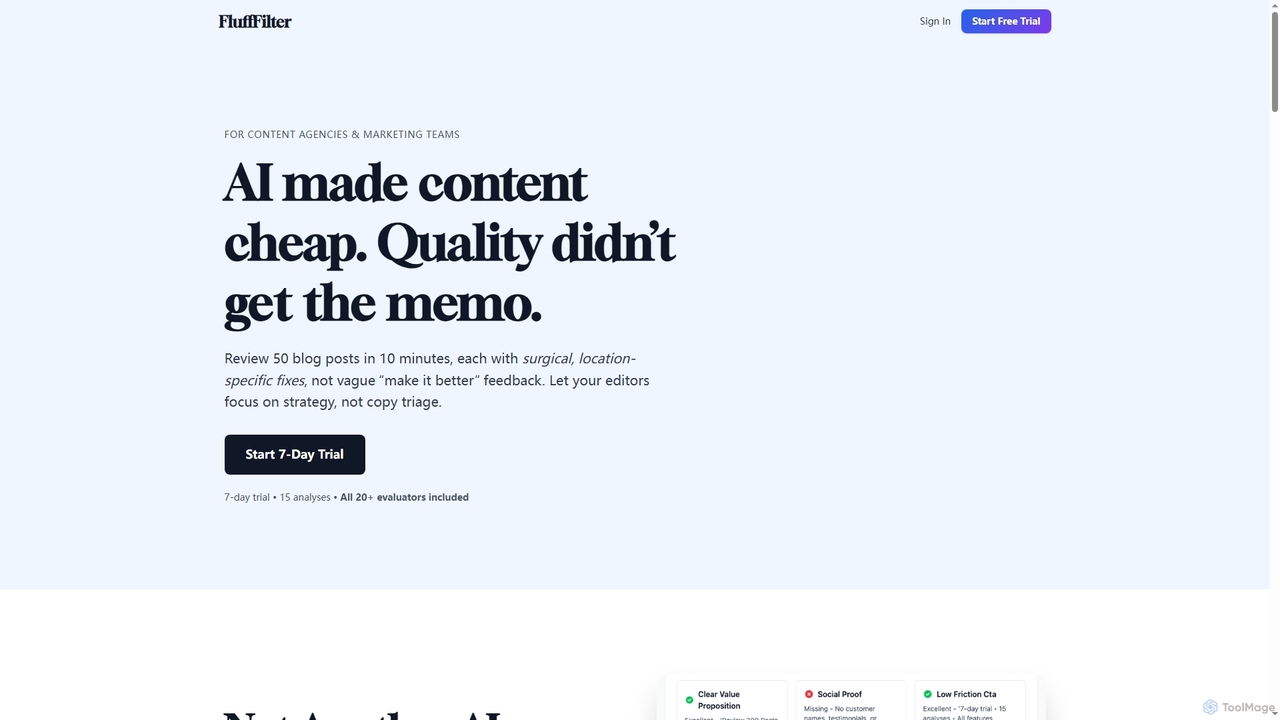
FluffFilter is an AI-powered content quality tool for marketing teams and content agencies. It provides surgical, location-specific fixes …
FluffFilter is an AI-powered content quality tool for marketing teams and content agencies. It provides surgical, location-specific fixes and detailed feedback for over 20 content types, helping editors streamline reviews and ensure high-quality, actionable content at scale.
About Content Quality
Content Quality tools are AI-powered applications designed to analyze, score, and enhance written text. These tools leverage Natural Language Processing (NLP) to go beyond basic spell checking, evaluating grammar, style, tone, clarity, and readability. They help writers, editors, and marketers produce clear, consistent, and effective content that resonates with the target audience and aligns with brand standards. By providing real-time feedback and data-driven suggestions, these platforms streamline the editing process and elevate the overall quality of communication.
Core Features
- Advanced Grammar and Style Checking: Identifies complex grammatical errors, suggests stylistic improvements, and enhances sentence structure for better flow.
- Readability Analysis: Scores text based on established metrics (e.g., Flesch-Kincaid) and recommends simpler words and shorter sentences to improve comprehension.
- Plagiarism Detection: Scans documents and compares them against a vast database of web pages and academic papers to identify unoriginal content.
- Tone and Brand Voice Consistency: Analyzes the tone of the text (e.g., formal, confident, friendly) and ensures it aligns with predefined brand voice guidelines.
- SEO Content Optimization: Provides recommendations on keyword usage, content structure, and meta-data to improve search engine rankings.
Use Cases
These tools are widely used by content marketing teams to ensure blog posts and articles are error-free and SEO-friendly. Academic institutions and students use them to check papers for plagiarism and clarity. Corporate communications departments rely on them to maintain a consistent brand voice across press releases, emails, and reports.
How to Choose
When selecting a Content Quality tool, consider the scope of its features—do you need basic grammar checking or advanced SEO and plagiarism detection? Evaluate its integration capabilities with your existing workflow, such as browser extensions or plugins for Google Docs and Microsoft Word. Also, assess the level of customization for style guides and the accuracy of its language support, especially for non-English content.

Content QualityUse Cases
Optimizing Blog Posts for SEO and Readability
A content marketing team is tasked with increasing organic traffic. Before publishing a new blog post, the editor uses a Content Quality tool to analyze the draft. The tool provides a readability score, suggests replacing jargon with simpler terms, and flags sentences that are too long. It also checks for target keyword density and suggests related LSI keywords to include. This process ensures the final article is not only grammatically perfect but also easy for readers to understand and optimized for search engines, contributing to higher rankings and engagement.
Ensuring Academic Integrity and Clarity
A university student is finalizing their thesis. To ensure academic integrity, they run the entire document through a Content Quality tool with a robust plagiarism checker. The tool scans billions of sources and highlights passages that are too similar to existing publications, allowing the student to properly cite or rephrase them. Additionally, the tool's style checker helps convert informal language to a more appropriate academic tone and improves the overall clarity of complex arguments, making the thesis more professional and credible.
Maintaining Brand Voice in Corporate Communications
A large corporation needs to ensure all external communications, from press releases to social media updates, maintain a consistent, professional brand voice. The communications team integrates a Content Quality tool with a customizable style guide. This guide includes rules for tone (e.g., 'confident but not arrogant'), specific terminology, and formatting. As team members write, the tool provides real-time alerts if the text deviates from these guidelines, ensuring every piece of content reinforces the company's brand identity uniformly.
Improving Writing Skills for Non-Native Speakers
An employee for whom English is a second language needs to write professional emails and reports for international clients. They use a Content Quality tool as a writing assistant. The tool not only corrects grammatical mistakes but also suggests more natural-sounding phrasings and idiomatic expressions. It helps them understand the nuances of sentence structure and word choice, effectively acting as a personal writing coach. Over time, this consistent feedback helps the employee improve their English writing proficiency and communicate more confidently and effectively in a business context.
Streamlining the Editorial Workflow for Publishers
A digital publishing house manages dozens of articles from freelance writers daily. To standardize quality and speed up editing, they implement a Content Quality tool across their editorial team. Before an editor even sees a draft, writers are required to run their submissions through the tool to fix basic errors. This reduces the editor's workload, allowing them to focus on higher-level aspects like narrative structure and factual accuracy. The tool's shared style guide ensures all articles adhere to the publication's standards from the first draft, cutting down revision cycles by over 30%.
Enhancing Legal Document Clarity and Precision
A legal team drafts complex contracts and agreements where precision is critical. They use a specialized Content Quality tool to enforce clarity and eliminate ambiguity. The tool is configured to flag vague terms (e.g., 'reasonable effort'), identify overly long and convoluted sentences, and ensure consistent use of defined terms throughout the document. This helps prevent potential misunderstandings and legal disputes down the line. By automating this meticulous review process, lawyers can draft more robust and clear-cut legal documents in less time.