
Solemnsir
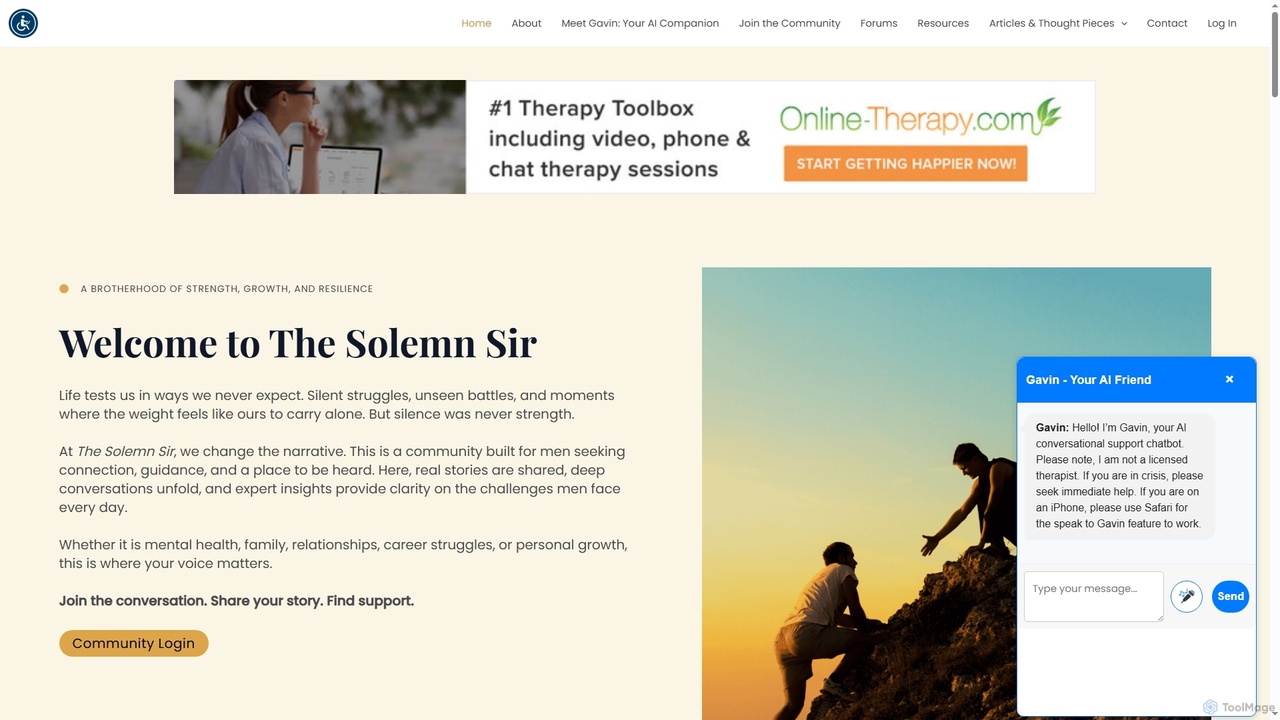
Solemnsir is a dedicated online community and resource hub for men, offering a supportive brotherhood, expert articles, and …
Solemnsir is a dedicated online community and resource hub for men, offering a supportive brotherhood, expert articles, and an AI conversational companion named Gavin. It provides guidance and connection for mental health, relationships, career, and personal growth, fostering resilience and self-improvement in a judgment-free space.
About Chatbot Assistant
Chatbot Assistants are AI-powered tools designed to simulate human-like conversations and provide automated assistance on websites, apps, and messaging platforms. They utilize Natural Language Processing (NLP) to understand user intent, answer questions, and execute specific tasks in real-time. This enables businesses to offer 24/7 customer support, automate lead generation, and guide users through various processes. Unlike broader conversational AI systems, Chatbot Assistants are specifically focused on goal-oriented interactions and task completion, acting as a direct extension of a company's service team.
Core Features
- Natural Language Understanding (NLU): Accurately interprets user queries, including slang and typos, to understand their true intent.
- Automated Task Execution: Books appointments, processes orders, or retrieves information from integrated databases without human intervention.
- Lead Generation & Qualification: Engages website visitors, collects contact information, and asks qualifying questions to identify potential customers.
- Multi-channel Integration: Deploys consistently across various platforms like websites, Facebook Messenger, WhatsApp, and Slack.
- Conversation Flow Builder: Provides visual, often no-code, interfaces to design, test, and modify conversational paths.
Applicable Scenarios
Chatbot Assistants are widely used across industries like e-commerce for order tracking and product recommendations, SaaS for user onboarding and feature support, and real estate for property inquiries and scheduling viewings. They serve as the first point of contact, handling a high volume of repetitive queries and freeing up human agents to focus on more complex issues.
Selection Criteria
When choosing a Chatbot Assistant, consider its integration capabilities with your existing CRM or helpdesk software. Evaluate the power and flexibility of its conversation builder—does it require coding? Assess the quality of its NLP engine for understanding user intent accurately. Also, review the analytics and reporting features to measure performance and identify areas for improvement.
Chatbot AssistantUse Cases
Automating E-commerce Customer Support
An e-commerce store manager implements a Chatbot Assistant on their website to handle common customer inquiries. When a customer asks, "Where is my order?", the chatbot authenticates the user, connects to the store's backend system via API, retrieves the real-time shipping status, and provides a direct tracking link. This process resolves hundreds of routine tickets daily, reducing the support team's workload by over 40% and providing instant answers to customers 24/7, which improves overall customer satisfaction.
Qualifying Leads for a B2B SaaS Company
A marketing manager for a SaaS company uses a Chatbot Assistant on their pricing page. The bot proactively engages visitors by asking about their team size, primary use case, and budget. Based on the responses, it qualifies them as a Marketing Qualified Lead (MQL). For high-value leads, the bot seamlessly integrates with a sales representative's calendar to schedule a demo. This automated process increases the number of qualified demos booked by 30% and ensures the sales team only spends time on promising prospects.
Streamlining Internal IT Helpdesk Requests
An IT manager in a large corporation deploys a Chatbot Assistant on the company's internal communication platform (e.g., Slack or Microsoft Teams). When an employee faces a common issue like a password reset or VPN connection problem, they can interact with the bot. The bot provides step-by-step instructions, links to knowledge base articles, and can even initiate automated reset procedures. This deflects over 50% of Level 1 support tickets, allowing the IT staff to concentrate on critical infrastructure and complex user issues.
Booking Appointments for a Dental Clinic
A dental clinic uses a Chatbot Assistant on its website and Facebook page to manage appointment bookings. A potential patient can ask for available slots for a check-up. The bot displays the dentist's real-time availability by integrating with the clinic's scheduling software. The user selects a time, provides their contact details, and receives an instant confirmation. The system also sends automated reminders before the appointment. This automates the entire booking process, reducing no-shows and freeing up reception staff from phone calls.
Guiding Users Through a SaaS Onboarding Process
A product manager for a new software tool implements an in-app Chatbot Assistant to improve user activation. When a new user signs up, the bot initiates a welcome sequence, highlighting key features one by one. It offers interactive tutorials, answers context-specific questions like "How do I create a new project?", and collects feedback on the onboarding experience. This guided approach helps users reach their "aha moment" faster, leading to a 25% increase in user retention after the first week.
Collecting Post-Purchase Customer Feedback
A customer experience manager uses a Chatbot Assistant via a messaging app like WhatsApp to gather feedback. A few days after a product is delivered, the chatbot automatically initiates a friendly conversation with the customer, asking about their satisfaction with the product and delivery process. It uses a conversational survey format, making it more engaging than a traditional email form. This method achieves a 60% higher response rate compared to email surveys, providing the company with valuable, real-time insights for service improvement.