Conversational Ai Best in category 1 results Custom Agents AI Tool

Popular AI tools in the Custom Agents field of Conversational Ai include OfficeBot, etc., helping you quickly improve efficiency.

OfficeBot

OfficeBot

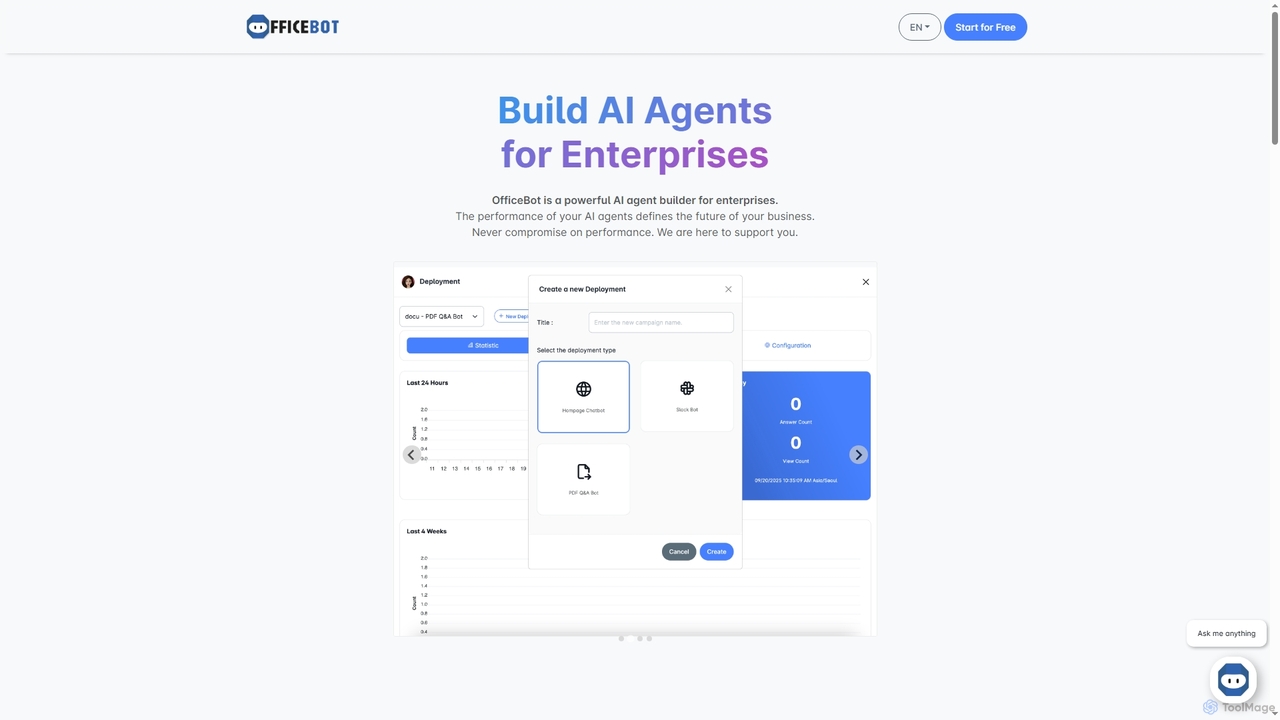
OfficeBot empowers enterprises to build custom AI agents for enhanced knowledge management and operational efficiency. It offers a …

3.2K

About Custom Agents

Custom Agents are a specialized type of conversational AI designed to perform complex, multi-step tasks autonomously. Unlike standard chatbots that primarily answer questions, these agents leverage large language models combined with access to external tools, APIs, and private knowledge bases to execute actions. They can understand a user's goal, create a plan, and use available tools to achieve it, such as booking appointments or analyzing data. This ability to act and reason makes Custom Agents powerful tools for automating sophisticated workflows and creating truly interactive digital assistants.

Core Features

  • Tool & API Integration: Connect to external services (e.g., calendars, CRMs, databases) to perform real-world actions.
  • Knowledge Base Grounding: Ingest and reason over private documents or data to provide context-aware, accurate responses.
  • Autonomous Planning & Execution: Independently devise and execute a sequence of steps to fulfill a complex request.
  • Customizable Instructions & Persona: Define the agent's specific goals, constraints, and communication style for tailored behavior.
  • Memory and Context Management: Maintain short-term and long-term memory to handle multi-turn conversations and learn from interactions.

Use Cases

Custom Agents are ideal for businesses and developers looking to automate complex internal processes or create advanced customer-facing experiences. For example, an e-commerce company can build an agent to handle returns by checking order history, generating a shipping label via an API, and updating the customer's account. In corporate environments, they can serve as IT support assistants that troubleshoot issues and create service tickets automatically.

How to Choose

When selecting a Custom Agent platform, consider the following: First, evaluate its integration capabilities—does it support the specific APIs and data sources you need? Second, assess the level of customization and control over the agent's logic and reasoning process. Third, consider the development experience, whether it's a no-code visual builder for business users or a code-first framework for developers. Finally, review the deployment options and scalability to ensure it fits your technical infrastructure.

Custom AgentsUse Cases

1

Automated IT Support and Ticket Management

An IT administrator configures a Custom Agent to handle common employee support requests. The agent is connected to the company's internal knowledge base and the IT ticketing system's API. When an employee reports an issue like 'Wi-Fi not working', the agent first searches the knowledge base for troubleshooting steps and provides them. If the issue persists, it asks for details like the user's location and device, then uses the API to create a formatted support ticket, assigning it to the correct team. This automates Level 1 support, reducing response times and freeing up IT staff for more complex problems.

2

Proactive Sales Lead Qualification and Scheduling

A marketing team deploys a Custom Agent on their website to engage potential leads. The agent is integrated with the company's CRM and the sales team's calendar APIs. When a visitor shows interest, the agent initiates a conversation, asking qualifying questions based on predefined criteria. If the lead is qualified, the agent accesses the CRM to create a new lead record. It then checks the calendar for an available sales representative and offers specific time slots to the lead for a demo, scheduling the meeting directly upon confirmation. This streamlines the lead qualification and booking process 24/7 without human intervention.

3

Intelligent Research and Data Synthesis Assistant

A market analyst uses a Custom Agent to gather and synthesize information for a competitive analysis report. The analyst provides the agent with a list of competitors and key topics to research. The agent is equipped with tools for web browsing, accessing financial news APIs, and reading PDF documents. It systematically browses competitor websites, pulls recent news articles, and extracts key data from annual reports. Finally, it synthesizes all the gathered information into a structured summary, complete with sources, saving the analyst dozens of hours of manual research and compilation work.

4

Automated Employee Onboarding Workflow

An HR manager designs a Custom Agent to streamline the new hire onboarding process. The agent is connected to the HRIS, IT service desk, and company calendar. Once a new hire is added to the HRIS, the agent triggers a workflow. It uses an API to order a laptop from IT, schedules introductory meetings with key team members by checking their calendars, and sends a welcome email to the new hire with a checklist of first-day tasks. The agent acts as a central coordinator, ensuring all necessary steps are completed consistently and on time for every new employee.

5

Personalized Travel Itinerary Planning

A user planning a vacation interacts with a travel-focused Custom Agent. The user specifies their destination, dates, budget, and interests (e.g., 'history museums' and 'local food'). The agent is equipped with tools to access flight booking APIs, hotel reservation systems, and local event databases. It first finds and presents flight and hotel options that fit the budget. Once confirmed, it searches for relevant museum opening times and popular local restaurants, then pieces together a day-by-day itinerary, booking tickets and reservations where possible. This creates a highly personalized and fully booked travel plan in minutes.

6

Code Generation and Debugging Assistant for Developers

A software developer uses a Custom Agent integrated into their IDE. The agent has tools to read files in the current project, execute code in a sandboxed environment, and search web documentation like Stack Overflow. When the developer needs a new function, they describe it in plain English. The agent analyzes the existing codebase for context, writes the function, and tests it. If the developer encounters a bug, they can ask the agent to debug it. The agent will read the error message, inspect the relevant code, and suggest a fix, significantly speeding up the development and debugging cycle.

Custom AgentsFrequently Asked Questions