Customer Research Best in category 1 results Voice Interviews AI Tool

Popular AI tools in the Voice Interviews field of Customer Research include ProductLoop, etc., helping you quickly improve efficiency.

ProductLoop

ProductLoop

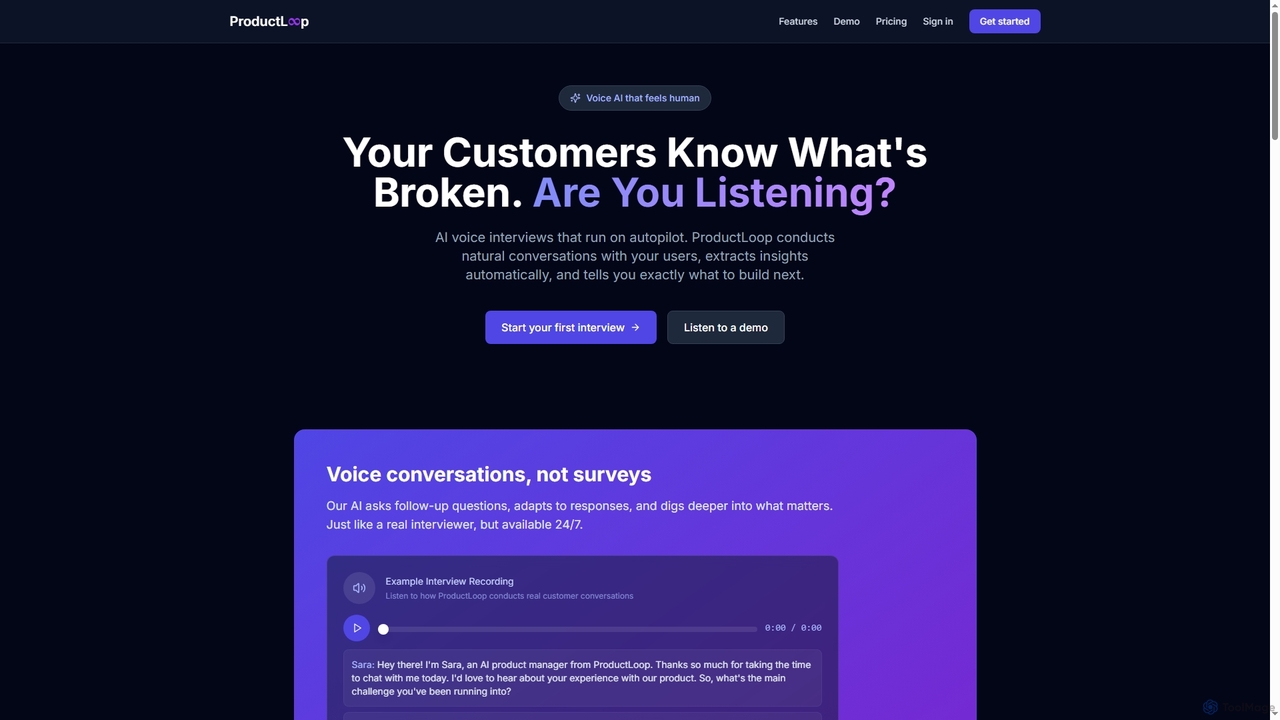
ProductLoop is an AI-powered platform that automates customer voice interviews to gather deep, actionable insights for product teams …

3.0K

About Voice Interviews

Voice Interviews are AI-powered tools designed to automate and enhance the process of conducting, transcribing, and analyzing spoken interactions for research purposes. Leveraging advanced speech-to-text and natural language processing, these platforms efficiently capture qualitative data from respondents. They streamline the collection of rich insights, making customer research more scalable and accessible. This technology significantly reduces manual effort in data gathering and analysis, accelerating the path to actionable intelligence.

Core Features

  • Automated Transcription: Converts spoken interviews into accurate text, often with speaker identification and timestamps.
  • Sentiment Analysis: Identifies emotional tone and sentiment within responses to gauge respondent feelings and attitudes.
  • Topic Extraction: Automatically uncovers key themes, recurring topics, and emerging patterns discussed across multiple interviews.
  • Interview Scheduling & Management: Provides tools for setting up, conducting, and organizing interview sessions efficiently.
  • Data Export & Integration: Allows exporting transcripts and analysis into other research, CRM, or data visualization platforms.

Use Cases

These tools are primarily used by market researchers, UX designers, product managers, and customer success teams. They enable efficient gathering of qualitative feedback from a large number of participants, understanding user pain points, and validating product hypotheses. For instance, a UX researcher can conduct dozens of user interviews in a fraction of the time, quickly identifying common usability issues and preferences.

How to Choose

When selecting a voice interview tool, consider the accuracy of its speech-to-text engine for your target languages and accents. Evaluate its natural language processing capabilities for sentiment and topic analysis, and ensure it offers robust data privacy and security features. Look for integration options with your existing research or CRM tools, and assess its scalability to handle your anticipated interview volume and team size.

Voice InterviewsUse Cases

1

Automating Initial Candidate Screening

HR professionals and recruiters use AI voice interview tools to pre-screen a large volume of job applicants. Candidates record their answers to a set of standardized questions, which the AI then transcribes, analyzes for keywords, and assesses for communication clarity and tone. This significantly reduces the time spent on manual first-round interviews, allowing recruiters to focus on more qualified candidates.

2

Conducting Large-Scale User Research

UX researchers can leverage voice interview tools to automate the collection of qualitative feedback from hundreds of users. By setting up structured voice prompts, they can efficiently gather insights on product usability, feature preferences, and pain points, identifying common themes and informing design iterations for a better user experience.

3

Conducting Large-Scale Customer Feedback

Product managers and market researchers deploy voice interview platforms to gather in-depth qualitative feedback from hundreds or thousands of customers. Users can respond to open-ended questions at their convenience, and the AI processes these responses to identify common pain points, feature requests, and overall sentiment, providing rich insights for product development and marketing strategies.

4

Automating Customer Feedback Collection

Customer success teams can set up automated voice surveys or post-interaction interviews to gather feedback at scale. This allows them to understand customer satisfaction, identify areas for service improvement, and proactively address common issues, leading to higher customer retention and loyalty without extensive manual outreach.

5

Streamlining User Experience (UX) Research

UX researchers leverage voice interview tools to conduct remote usability tests and gather feedback on prototypes or existing products. Participants describe their experiences and thoughts aloud, and the AI captures these verbal insights, transcribes them, and helps identify patterns in user behavior and sentiment, accelerating the iteration cycle for design improvements.

6

Market Research & Competitor Analysis

Market analysts can conduct structured voice interviews with target demographics or industry experts to gauge market sentiment, identify emerging trends, and analyze competitor strategies more efficiently. The automated transcription and topic extraction features allow for rapid synthesis of qualitative data, providing quicker insights into market dynamics.

7

Enhancing Employee Engagement Surveys

HR departments use voice interviews to collect more nuanced feedback than traditional written surveys. Employees can express their thoughts on company culture, management, and work-life balance verbally, allowing the AI to capture emotional context and identify underlying issues that might be missed in text-based responses, fostering a more engaged workforce.

8

Recruitment & Candidate Screening

HR professionals can utilize voice interviews for initial candidate screening, assessing communication skills, cultural fit, and basic qualifications through standardized questions. This saves significant time in the early stages of hiring by automating the review of numerous applicants, allowing recruiters to focus on more qualified candidates for in-depth interviews.

9

Facilitating Academic and Social Research

Academics and social scientists utilize voice interview tools to conduct qualitative research studies, especially when interviewing diverse populations across different geographies. The tools automate transcription and initial thematic analysis, making it easier to manage large datasets of spoken narratives and extract meaningful insights for scholarly publications and policy recommendations.

10

Product Feature Validation

Product managers can quickly gather spoken feedback on new features or prototypes from a diverse group of users. By conducting targeted voice interviews, they can validate assumptions, identify usability issues, and iterate designs based on direct user input, accelerating the product development lifecycle and ensuring features meet user needs effectively.

11

Gathering Sales Call Insights and Training

Sales managers employ voice interview analysis to review recorded sales calls, not just for compliance but also for identifying effective communication strategies and areas for improvement. The AI can highlight key moments, customer objections, and successful closing techniques, providing valuable data for sales training and performance coaching.

12

Academic & Social Science Research

Researchers in academia and social sciences can streamline the process of collecting and transcribing qualitative data from participants for studies. Voice interview tools enable faster analysis of interviews and focus group discussions, facilitating the identification of themes, patterns, and nuanced perspectives across large datasets, thereby accelerating research outcomes.

Voice InterviewsFrequently Asked Questions