Customer Support Best in category 1 results Customer Feedback Management AI Tool

Popular AI tools in the Customer Feedback Management field of Customer Support include Superorder, etc., helping you quickly improve efficiency.

Superorder

Superorder

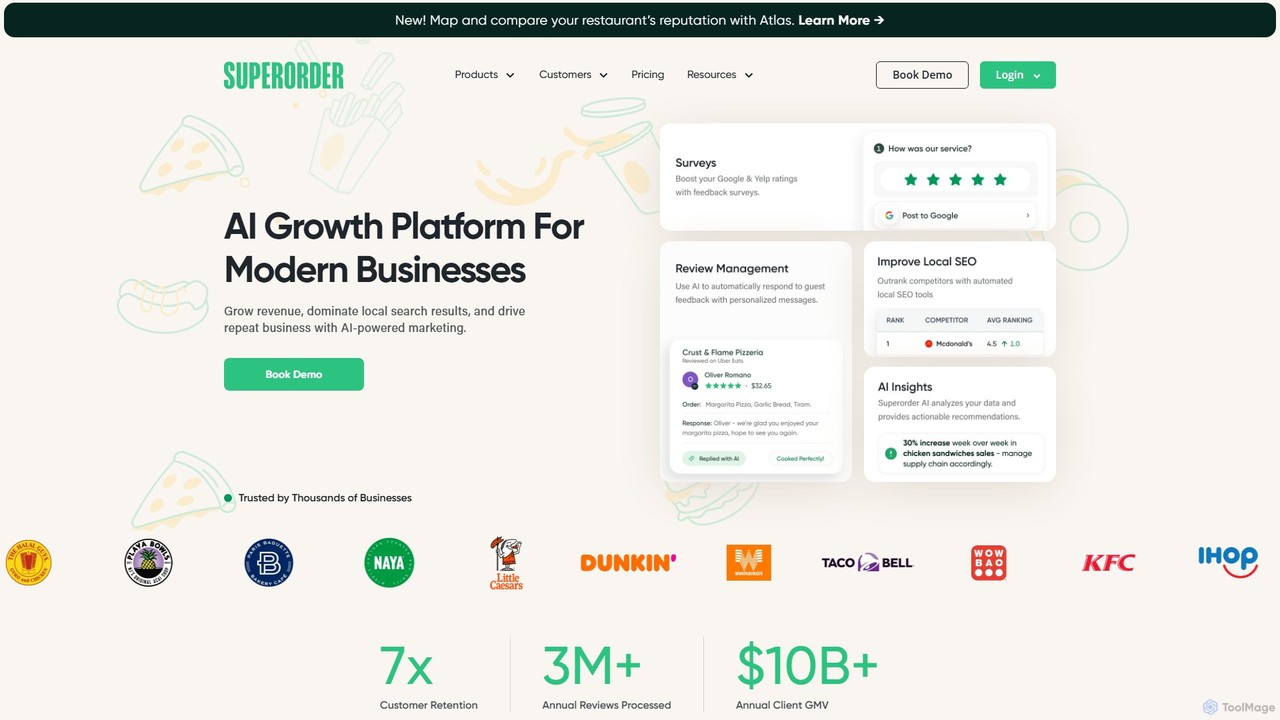
Superorder is an AI-powered growth platform for modern businesses, specializing in the restaurant industry. It helps increase revenue …

21.5K

About Customer Feedback Management

Customer Feedback Management tools are a specialized class of AI software designed to automatically collect, analyze, and act on user opinions from diverse channels. These platforms leverage Natural Language Processing (NLP) and sentiment analysis to interpret the intent and emotion behind text, audio, or survey responses. They empower businesses to move beyond manual analysis, quickly identifying product issues, understanding customer satisfaction drivers, and prioritizing improvements with data-driven insights. Unlike general survey tools, they focus on aggregating and structuring unstructured feedback into actionable intelligence for product and customer experience teams.

Core Features

  • Sentiment Analysis: Automatically determines if feedback is positive, negative, or neutral to gauge overall customer mood.
  • Topic & Keyword Extraction: Identifies and groups recurring themes, features, or problems mentioned by customers.
  • Multi-Channel Aggregation: Gathers feedback from sources like social media, review sites, surveys, and support tickets into a single dashboard.
  • Trend Identification: Tracks changes in feedback volume and sentiment over time to spot emerging issues or successes.
  • Automated Tagging & Routing: Categorizes feedback based on content and directs it to the relevant teams, such as product or engineering.

Use Cases

These tools are primarily used by product managers, customer experience (CX) teams, and marketing managers. They are essential for prioritizing product roadmaps based on user requests, proactively identifying churn risks by spotting negative trends, and monitoring brand reputation across public channels. For instance, an e-commerce company can analyze thousands of product reviews to find common complaints about shipping or quality.

How to Choose

When selecting a tool, consider its integration capabilities with your existing systems like CRM or helpdesk software. Evaluate the depth of its analytical features—does it offer basic sentiment analysis or advanced root cause identification? Also, assess its channel coverage to ensure it monitors where your customers are most active. Finally, consider its ability to turn insights into action, for example, by creating tasks in project management tools.

Customer Feedback ManagementUse Cases

1

Prioritizing Product Features with User Feedback

A product manager for a mobile app is planning the next development cycle. Instead of relying on assumptions, they use an AI feedback management tool to aggregate and analyze thousands of reviews from the App Store and Google Play, along with feature requests from support tickets. The tool's NLP automatically identifies and quantifies the most frequently requested features, such as 'dark mode' or 'offline access.' This data provides a clear, evidence-based roadmap, ensuring development efforts are focused on what users truly want, leading to higher user satisfaction and retention.

2

Prioritize Product Roadmap with User Feedback

A Product Manager for a SaaS application needs to decide which features to build next quarter. Instead of relying on intuition, they use a Customer Feedback Management tool to aggregate requests from support tickets, in-app surveys, and App Store reviews. The AI automatically groups similar requests, such as 'dark mode' or 'Google Calendar integration,' and analyzes the sentiment for each. The manager can quickly see that 'Google Calendar integration' is not only the most requested feature but also has the highest urgency based on negative sentiment from its absence. This data provides a clear, defensible rationale for prioritizing it on the product roadmap.

3

Monitoring Brand Sentiment During a Campaign

A marketing team launches a major advertising campaign for a new product. To measure its real-time impact on public perception, they use a customer feedback tool to monitor mentions across Twitter, Facebook, and news blogs. The platform's sentiment analysis provides a live dashboard showing the ratio of positive to negative comments. It also extracts key themes, revealing that while the ad's humor is well-received, many viewers are confused about the product's pricing. This immediate insight allows the team to quickly adjust their messaging and publish a clarifying FAQ.

4

Proactively Identify Customer Churn Risks

A Customer Success Manager for an enterprise software company monitors the health of high-value accounts. They configure their feedback management tool to track all communications (emails, support calls, surveys) from these clients. The AI is trained to flag keywords like 'frustrated,' 'unreliable,' 'switching,' or mentions of competitors. When the system detects a spike in negative sentiment or a cluster of these keywords from a specific account, it automatically creates an alert. This allows the manager to intervene proactively, address the client's issues, and potentially save a valuable account from churning.

5

Identifying Root Causes of Customer Churn

A customer success manager at a B2B SaaS company notices an increase in subscription cancellations. They use a feedback analysis tool to examine all communications from churned customers over the past six months, including support emails, exit surveys, and call transcripts. The AI identifies a recurring pattern: customers frequently mentioned 'difficult onboarding' and 'lack of integration with Salesforce.' Armed with this specific insight, the company can prioritize improving the onboarding process and developing a Salesforce integration to reduce future churn.

6

Monitor Brand Reputation after a Marketing Campaign

A marketing team launches a major rebranding campaign. To measure public reception, they use a feedback management tool to monitor brand mentions on Twitter, Reddit, and news sites. The tool's dashboard provides a real-time view of sentiment trends. The team notices a small but growing pocket of negative sentiment related to the new logo. By clicking into the topic, they can read the specific comments and understand the criticism. This allows them to quickly craft a public response addressing the concerns, controlling the narrative before the negative feedback spirals.

7

Improving Customer Support Agent Performance

A support manager wants to improve the quality of their team's service. They connect their helpdesk software (like Zendesk or Intercom) to a feedback management platform. The tool analyzes thousands of customer support conversations, automatically tagging them by topic (e.g., 'billing issue,' 'technical bug') and sentiment. The manager can then identify which topics generate the most negative customer sentiment and use these insights to provide targeted training for agents, improving resolution times and overall customer satisfaction (CSAT) scores.

8

Improve User Onboarding by Analyzing Early Feedback

A UX researcher wants to reduce the drop-off rate during the first week of a mobile app's use. They set up a feedback channel specifically for new users and connect it to their management tool. The AI analyzes all feedback from users in their first seven days, identifying common friction points. It discovers that many users mention being 'confused by the dashboard' or 'unable to find the settings menu.' Armed with this insight, the design team redesigns the initial dashboard layout and adds a tutorial highlight for the settings menu, leading to a measurable increase in user retention after the first week.

9

Analyzing Competitor Strengths and Weaknesses

A market research analyst is tasked with understanding a key competitor's market position. They configure a feedback management tool to scrape and analyze public reviews for the competitor's products from sites like G2, Capterra, and Amazon. The AI categorizes feedback into themes like 'Ease of Use,' 'Pricing,' and 'Customer Support.' The resulting report clearly visualizes that the competitor is praised for its user interface but frequently criticized for its high price and slow support, revealing strategic opportunities for product positioning and marketing.

10

Validate New Feature Launches with Real-time Data

A software company releases a highly anticipated new feature. The Product Marketing Manager uses a feedback tool to create a specific feed that only pulls in comments mentioning the new feature's name. Within hours of launch, they can see a real-time stream of feedback. The AI tags comments as 'bug reports,' 'usability issues,' or 'positive feedback.' This allows the team to quickly identify and patch a critical bug reported by multiple users and also gather positive testimonials for marketing materials, all without manually sifting through thousands of general comments.

11

Automating Feedback Triage for Faster Resolution

A large enterprise receives thousands of feedback submissions daily through its website contact form. Manually reading and routing each one is slow and inefficient. By implementing an AI feedback management tool, each submission is automatically analyzed. The system identifies the intent and topic: bug reports are automatically converted into Jira tickets for the engineering team, feature requests are added to a product board in Productboard, and urgent complaints with negative sentiment trigger a high-priority alert in the customer support team's Slack channel. This automation reduces response times from days to minutes.

12

Enhance Call Center Agent Training Programs

An operations manager for a large call center wants to improve first-call resolution rates. They use a feedback management tool with speech-to-text capabilities to analyze transcripts from thousands of support calls. The AI identifies topics that consistently lead to long calls or negative customer sentiment, such as 'billing disputes' or 'refund policy confusion.' It also flags calls where agents successfully de-escalated a frustrated customer. The manager uses these insights to create targeted training modules for agents on handling difficult topics and to share best-practice examples from successful calls, leading to more efficient and effective customer service.

Customer Feedback ManagementFrequently Asked Questions