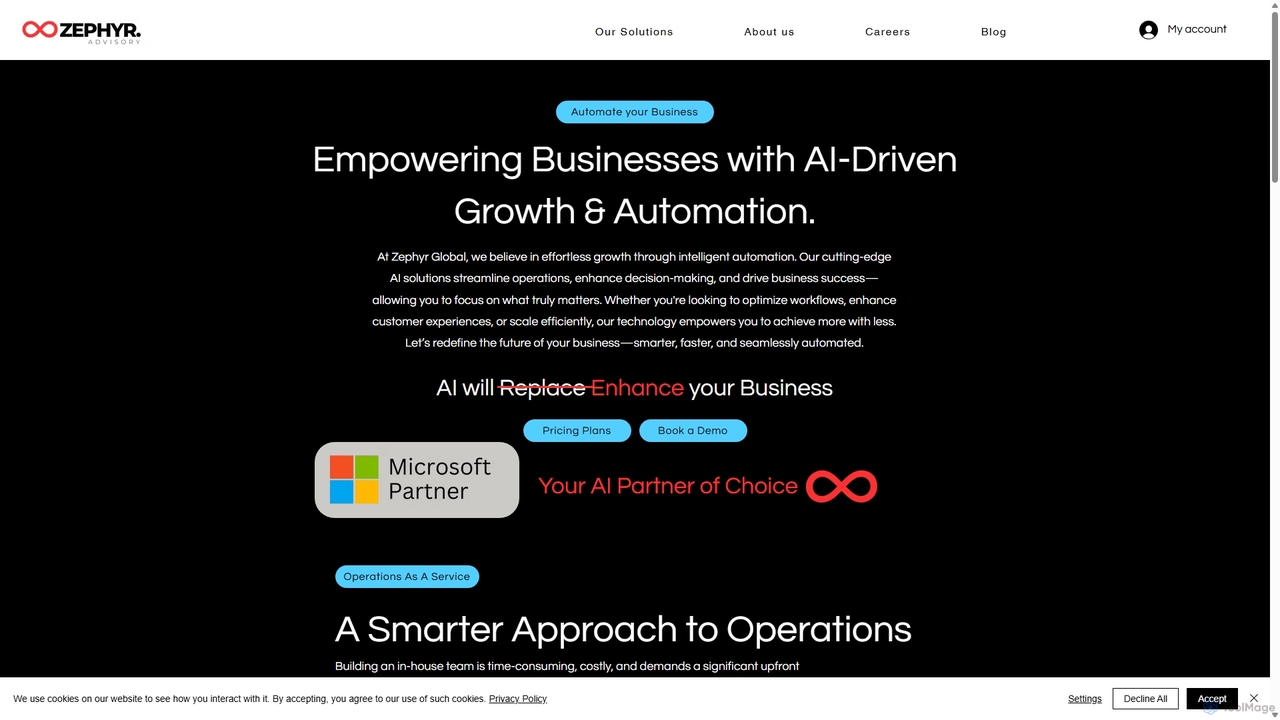
Zephyr Global
Zephyr Global offers 'Operations as a Service' powered by agentic AI, automating business processes like content creation, lead …
Zephyr Global offers 'Operations as a Service' powered by agentic AI, automating business processes like content creation, lead generation, and hiring. Their flagship AI assistant, Neo, provides 24/7, multilingual support for the entire Microsoft ecosystem, streamlining operations and reducing IT costs for businesses of all sizes.
About It Support
AI IT Support tools are a specialized class of solutions designed to automate the diagnosis and resolution of technical problems. They leverage natural language processing (NLP) to understand technical queries, integrate with knowledge bases for instant answers, and utilize automated workflows to guide users or agents through troubleshooting steps. This approach significantly reduces resolution times for technical incidents and frees up IT professionals to focus on more complex issues. These tools are distinct from general customer service bots by their deep integration with IT Service Management (ITSM) systems and their focus on technical problem-solving.
Core Features
- Automated Ticket Triage: Intelligently analyzes, categorizes, and routes incoming technical support tickets to the appropriate specialist or department.
- Diagnostic Workflows: Provides interactive, step-by-step guidance to help users and agents systematically troubleshoot and resolve technical issues.
- Technical Knowledge Base Integration: Instantly surfaces relevant articles, manuals, and past ticket solutions in response to user queries.
- User Self-Service Portals: Empowers users to resolve common issues like password resets or software access requests without agent intervention.
- ITSM Platform Integration: Seamlessly connects with systems like Jira Service Management, ServiceNow, or Zendesk to manage the entire ticket lifecycle.
Use Cases
AI IT Support tools are primarily used by corporate IT help desks to assist employees, Managed Service Providers (MSPs) supporting multiple clients, and technology companies offering technical support for their software or hardware products. They excel in environments with high volumes of repetitive technical requests, such as password resets, application troubleshooting, and network connectivity problems.
How to Choose
When selecting an AI IT Support tool, consider its integration capabilities with your existing ITSM and identity management systems. Evaluate the sophistication of its diagnostic engine and its ability to be trained on your specific technical documentation. Also, assess its security compliance (e.g., SOC 2, GDPR) and the scalability of its platform to handle your organization's ticket volume and complexity.
It SupportUse Cases
Automating Employee Password Resets
An employee is locked out of their account outside of standard business hours. Instead of waiting for the IT helpdesk to open, they interact with an AI IT support bot via a chat interface. The bot verifies their identity through multi-factor authentication, such as a code sent to their phone. Once verified, the AI automatically triggers a password reset process and guides the employee through creating a new, secure password, resolving the issue in minutes without any human intervention.
Triaging and Routing Software Bug Reports
A software development company receives hundreds of bug reports daily. An AI IT support tool integrated with their ticketing system automatically analyzes each new report. It extracts key information like error codes, software version, and operating system from the user's text and attached logs. Based on this data, the AI categorizes the bug's severity (e.g., critical, major, minor) and routes the ticket directly to the appropriate engineering team (e.g., UI team, backend team), significantly speeding up the bug-fixing lifecycle.
Guiding Users Through Network Troubleshooting
A remote employee reports a 'slow internet' issue. Instead of a support agent manually asking basic questions, an AI chatbot initiates a diagnostic workflow. It asks the user to run a speed test, check their router lights, and try restarting their modem. The AI analyzes the user's responses in real-time. If the issue persists, it collects system information (like IP address and DNS settings) and creates a detailed ticket for a network specialist, ensuring the specialist has all necessary data upfront to solve the problem efficiently.
Managing Software Access Requests
A new marketing team member needs access to several paid software tools. They submit a single request through a self-service portal powered by an AI IT support tool. The AI checks the employee's role against pre-approved software lists for the marketing department. For approved tools, it automatically provisions licenses and sends login details. For tools requiring manager approval, it automatically forwards the request to the correct manager and tracks the approval status, streamlining the entire onboarding process.
Resolving Common Printer and Peripheral Issues
An office employee can't connect to a network printer. They use a chat interface to report the problem. The AI IT support tool asks a series of targeted questions, such as 'Is the printer turned on?' and 'Have you checked the paper tray?'. It then provides a link to a specific knowledge base article with instructions on how to reinstall the printer driver for their operating system. This self-service approach resolves the majority of common peripheral issues, reducing the number of tickets that require hands-on support from an IT technician.
Proactive System Monitoring and Alerting
A Managed Service Provider (MSP) uses an AI IT support tool to monitor the server health of hundreds of clients. The AI continuously analyzes performance metrics like CPU usage, memory, and disk space. When it detects an anomaly that predicts a potential failure—such as disk space filling up rapidly—it automatically creates a high-priority ticket and assigns it to a technician. This proactive alert allows the MSP to resolve the issue before it impacts the client's business operations, shifting from a reactive to a preventative support model.