Vocareum
Vocareum is a comprehensive cloud-based learning platform designed for educational institutions. It provides secure, scalable, and budget-controlled access …
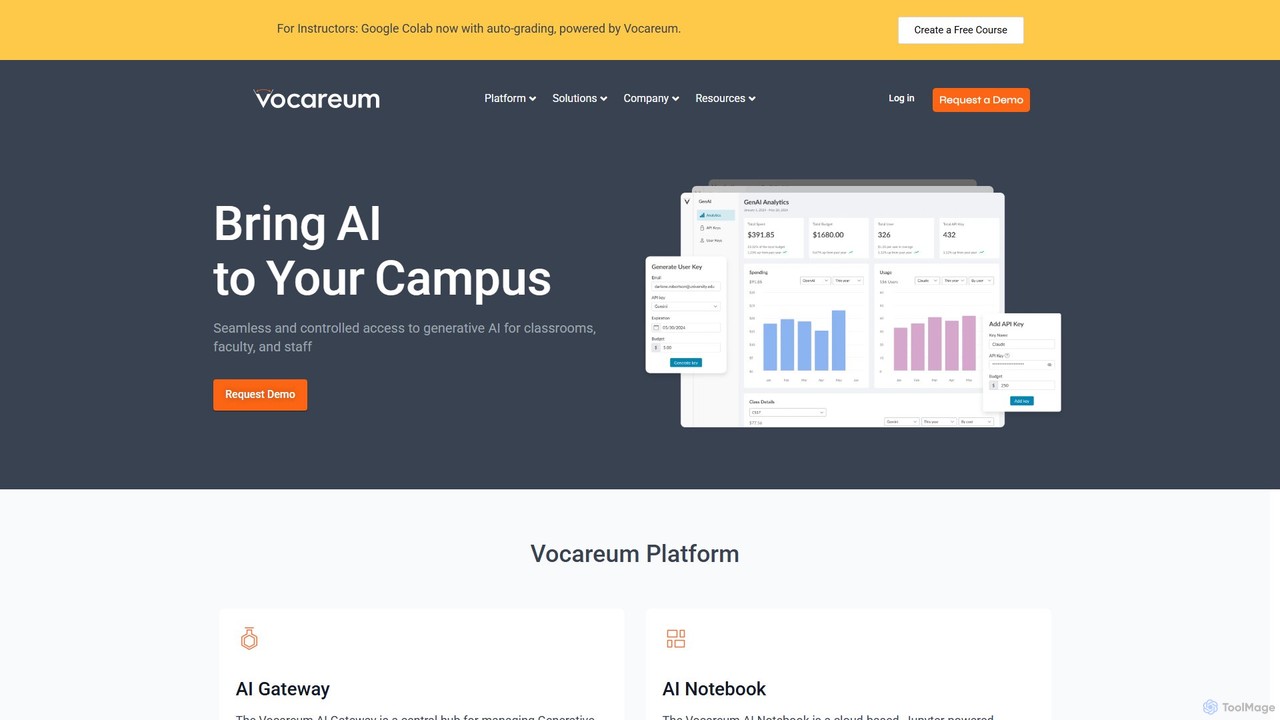
Vocareum is a comprehensive cloud-based learning platform designed for educational institutions. It provides secure, scalable, and budget-controlled access to AI tools, virtual computer labs, and cloud resources like AWS, Azure, and GCP. The platform facilitates hands-on learning in AI, data science, and computer science, integrating seamlessly with existing Learning Management Systems (LMS).
About Data Science
Data Science tools are integrated software platforms designed for the end-to-end process of extracting insights from data. They combine functionalities for data preparation, statistical analysis, machine learning model development, and visualization into a cohesive workflow. These platforms empower data scientists and analysts to build, train, and deploy predictive models, uncovering patterns and driving data-informed decisions. They are essential for transforming raw data into actionable business intelligence and predictive capabilities.
Core Features
- Interactive Notebooks: Provide environments like Jupyter or Zeppelin for exploratory data analysis, code iteration, and sharing results.
- Machine Learning Model Building: Offer frameworks and libraries for creating, training, and validating models for classification, regression, and clustering.
- Data Wrangling & Preprocessing: Include tools for cleaning, transforming, normalizing, and structuring raw data to make it suitable for analysis.
- Advanced Data Visualization: Enable the creation of complex charts, graphs, and interactive dashboards to communicate findings effectively.
- Model Deployment & MLOps: Facilitate the process of deploying trained models into production environments and monitoring their performance over time.
Use Cases
Data Science tools are widely used across industries like finance for fraud detection, e-commerce for building recommendation engines, and healthcare for predictive diagnostics. Roles such as Data Scientists, Machine Learning Engineers, and Business Analysts rely on these platforms to conduct complex analyses, forecast trends, and automate decision-making processes.
How to Choose
When selecting a Data Science tool, consider the technical skill level required (code-first vs. low-code GUI), its ability to scale with large datasets, and its integration capabilities with existing data sources like databases and cloud storage. Also, evaluate the breadth of its machine learning libraries and collaboration features for team-based projects.

Data ScienceUse Cases
Predicting Customer Churn for a Subscription Service
A data analyst at a telecom company is tasked with reducing customer churn. Using a data science platform, they import historical customer data, including usage patterns, subscription details, and support ticket history. They use the platform's data wrangling tools to clean and preprocess the data. Then, they build and train several classification models (like Logistic Regression and Gradient Boosting) to predict the likelihood of each customer churning. The model identifies key factors, such as decreased data usage and frequent service complaints, allowing the marketing team to launch targeted retention campaigns for at-risk customers, ultimately reducing churn by 15%.
Developing an E-commerce Product Recommendation Engine
A machine learning engineer at an online retail company aims to personalize the shopping experience. They use a data science tool to analyze user browsing history, purchase data, and product ratings. By applying collaborative filtering and content-based filtering algorithms within the tool's environment, they develop a recommendation model. This model is then deployed via an API. When a user visits the site, the model generates real-time personalized product suggestions like "Customers who bought this also bought" and "Recommended for you," leading to a 10% increase in average order value.
Real-Time Financial Fraud Detection
A data science team at a bank needs to build a system to detect fraudulent credit card transactions instantly. They use a data science platform to process millions of historical transaction records. The team trains a real-time anomaly detection model that learns normal spending behavior for each cardholder. The model is deployed into the bank's transaction processing pipeline. When a new transaction occurs, the model scores it for fraud potential in milliseconds. If a transaction is flagged as highly suspicious (e.g., a large purchase in a foreign country), it is automatically blocked, preventing financial loss and protecting customers.
Analyzing Sentiment in Customer Reviews
A product manager wants to understand public opinion about a newly launched app. They use a data science tool with Natural Language Processing (NLP) capabilities to collect and analyze thousands of reviews from app stores and social media. The tool automatically classifies each review as positive, negative, or neutral and identifies recurring themes or issues, such as 'buggy interface' or 'excellent customer support'. This provides the product team with structured, actionable feedback, helping them prioritize bug fixes and feature developments for the next update, improving user satisfaction.
Optimizing Supply Chain Logistics with Sales Forecasting
A retail chain's operations manager needs to optimize inventory levels to avoid stockouts and overstocking. Using a data science platform, they build a time-series forecasting model that analyzes historical sales data, seasonality, and promotional events. The model predicts future demand for thousands of products across different store locations. These forecasts are integrated into the inventory management system, which then automates reordering processes. This data-driven approach improves inventory accuracy, reduces storage costs, and ensures product availability, enhancing the overall customer experience.
Medical Image Analysis for Disease Detection
A medical researcher is developing a system to assist radiologists in detecting early-stage cancer from MRI scans. Using a specialized data science platform with computer vision capabilities, they upload a large dataset of labeled medical images. The researcher trains a convolutional neural network (CNN) model to identify subtle patterns indicative of tumors. The trained model can analyze new scans and highlight suspicious regions with high accuracy, serving as a second opinion for radiologists. This application helps improve diagnostic speed and accuracy, potentially leading to earlier treatment and better patient outcomes.