Health Pocket
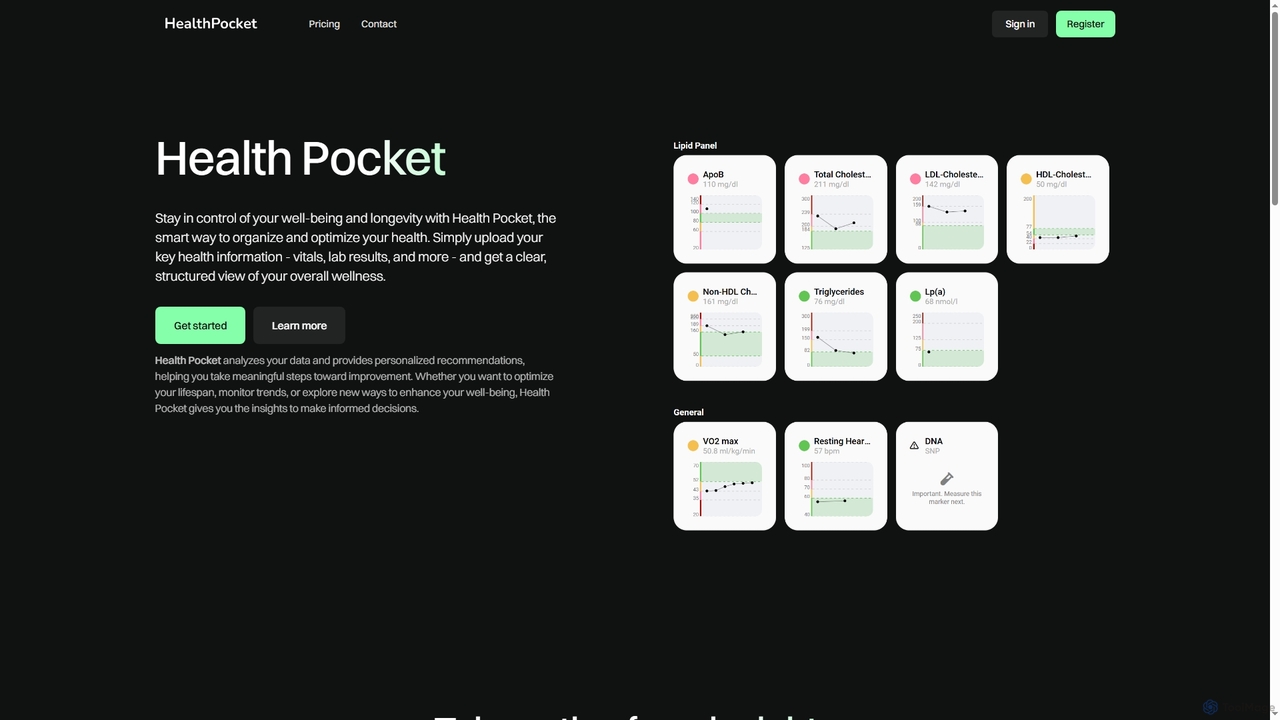
Health Pocket is a smart digital platform designed to help individuals organize, understand, and optimize their health data. …
Health Pocket is a smart digital platform designed to help individuals organize, understand, and optimize their health data. Users can upload vitals, lab results, and medical reports to receive personalized, science-backed recommendations, automated reports, and insights for proactive well-being management. It empowers users to take control of their health journey with an intuitive interface.
About Health Data
AI Health Data tools are a specialized category of data analysis platforms designed to process and interpret complex biomedical and healthcare information. They leverage machine learning, natural language processing (NLP), and computer vision to identify patterns, predict outcomes, and extract insights from sources like electronic health records (EHRs), medical images, and genomic sequences. These tools are crucial for accelerating clinical research, personalizing patient treatment, and improving operational efficiency in healthcare systems. Their ability to handle unstructured and high-dimensional data sets them apart from general-purpose analytics platforms.
Core Features
- EHR Data Processing: Automates the extraction and structuring of information from electronic health records.
- Medical Image Analysis: Uses computer vision to detect anomalies in X-rays, MRIs, and CT scans.
- Genomic Data Interpretation: Analyzes DNA/RNA sequences to identify genetic markers for diseases.
- Predictive Modeling: Builds models to forecast disease progression, patient risk, or treatment responses.
- Clinical NLP: Extracts key information from unstructured clinical notes and research papers.
Use Cases
These tools are primarily used by pharmaceutical companies for drug discovery, clinical research organizations for trial optimization, and hospitals for predictive diagnostics and operational management. They are also essential in the field of personalized medicine, where treatment plans are tailored to an individual's genetic makeup and health history.
How to Choose
When selecting an AI Health Data tool, prioritize regulatory compliance (e.g., HIPAA, GDPR) to ensure data privacy. Evaluate the clinical validation and accuracy of its algorithms. Assess its integration capabilities with existing systems like EHRs or PACS. Finally, consider the tool's specialization to ensure it aligns with your specific data type, whether it's genomics, radiology, or clinical text.

Health DataUse Cases
Accelerating Drug Discovery with Genomic Analysis
A bioinformatician at a pharmaceutical company needs to identify potential drug targets from thousands of genomic datasets. Using an AI Health Data tool, they perform a large-scale analysis of genomic sequences to pinpoint gene variants strongly associated with a specific disease. The platform's algorithms sift through terabytes of data, highlighting correlations that are impossible to spot manually. This process shortens the target identification phase from months to weeks, presenting the top 5 most promising genetic markers for further lab research and development.
Predicting Patient Readmission Risk in Hospitals
A hospital administrator aims to reduce costly patient readmissions. They use an AI platform to analyze historical EHR data, including diagnoses, procedures, lab results, and demographics. The tool's predictive model processes this information to assign a real-time readmission risk score to each discharged patient. This allows care teams to proactively provide targeted follow-up support, such as home visits or telehealth check-ins, for high-risk individuals, aiming to reduce overall readmission rates by 15-20%.
Automating Anomaly Detection in Medical Imaging
A radiologist is tasked with reviewing hundreds of CT scans daily, a process that is time-consuming and prone to fatigue-related errors. By integrating an AI medical image analysis tool, each scan is pre-processed to highlight potential anomalies, such as nodules or lesions. The AI acts as a second reader, flagging areas of concern for the radiologist's final review and diagnosis. This workflow doesn't replace the expert but augments their capabilities, reducing review time per scan by up to 40% and improving the detection rate of subtle abnormalities.
Personalizing Cancer Treatment Plans
An oncologist needs to devise the most effective treatment plan for a patient with a rare form of cancer. They use an AI health data platform to integrate the patient's genomic data, pathology reports, and clinical history. The tool compares this comprehensive profile against a vast database of clinical trials, treatment outcomes, and published research. It then provides evidence-based recommendations for targeted therapies that are most likely to be effective for the patient's specific cancer subtype, empowering the oncologist to make a more informed and personalized treatment decision.
Analyzing Real-World Evidence from Wearable Devices
A clinical researcher is studying the long-term effects of a new medication for a chronic condition. Instead of relying solely on periodic clinic visits, they use an AI platform to analyze continuous data streams from patients' wearable devices (e.g., smartwatches). The tool processes metrics like heart rate variability, sleep patterns, and activity levels to identify trends and flag significant deviations from a patient's baseline. This provides objective, real-world evidence of the drug's efficacy and side effects, offering deeper insights than traditional study methods.
Optimizing Clinical Trial Recruitment
A clinical trial coordinator is struggling to find eligible patients for a study with complex inclusion/exclusion criteria. They deploy an AI tool that uses Natural Language Processing (NLP) to scan millions of unstructured EHR notes and records across a hospital network. The system understands clinical terminology and context to accurately match patient profiles against the trial's specific requirements. This automates a previously manual process, identifying a pool of qualified candidates in hours instead of weeks, significantly accelerating the trial enrollment phase.