ToolMage
Sign in

Best 1 Data & Content AI tools

Popular Data & Content AI tools include Mcplist, helping you work more efficiently.

Mcplist
Free

Mcplist

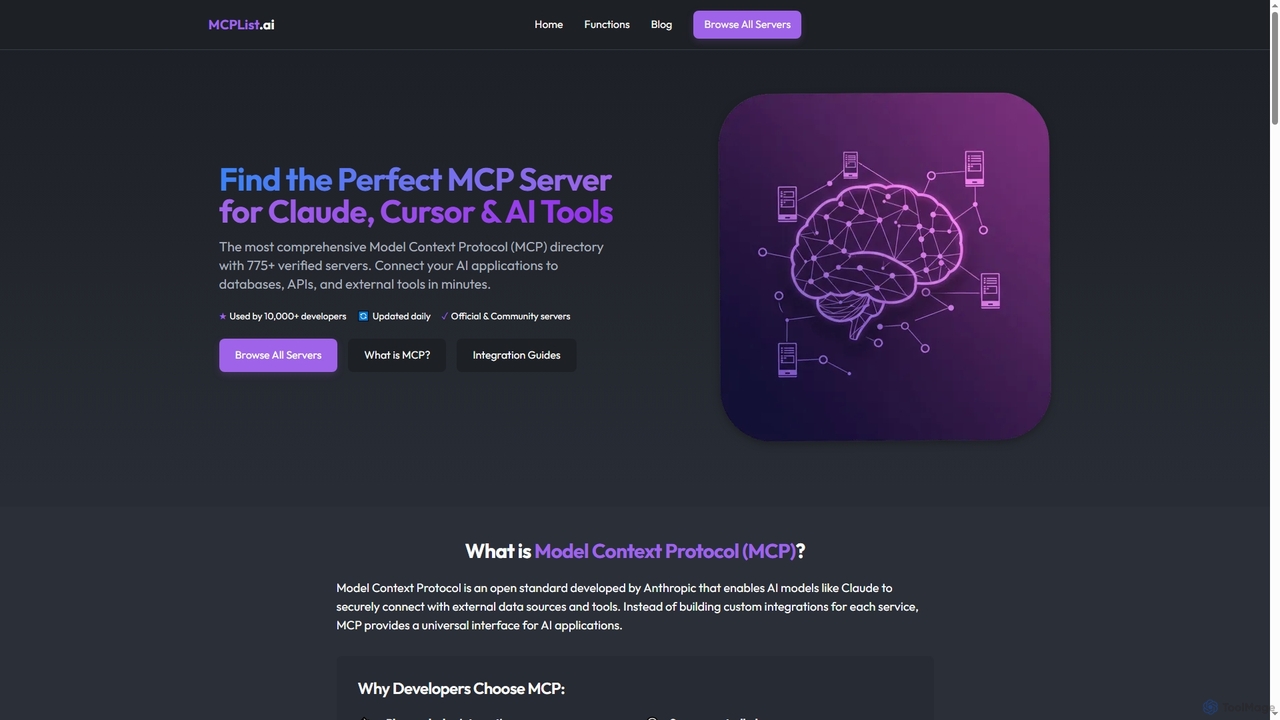
Mcplist is the most comprehensive directory of Model Context Protocol (MCP) servers, designed for developers. It features over 775 verified official and community servers, enabling AI applications like Claude and Cursor to seamlessly connect with external databases, APIs, and tools. The platform offers powerful search, filtering, and step-by-step integration guides to accelerate AI development.

3D
Visits 3.4KFavorites 130Likes 134

About Data & Content

AI Data & Content tools are a class of applications that leverage artificial intelligence to process, analyze, generate, and manage digital information. These tools utilize technologies like machine learning, natural language processing (NLP), and computer vision to automate complex tasks. They are designed to transform raw data into actionable insights and scale the creation of various content formats, from text and images to code. This enables businesses and individuals to make data-driven decisions and enhance their content strategy efficiently.

Core Features

  • Data Processing & Analysis: Automates the extraction, cleaning, and interpretation of structured and unstructured data to uncover trends and patterns.
  • Content Generation: Creates original text, images, audio, or code based on user prompts and specified parameters.
  • Content Optimization: Analyzes and refines content for specific audiences, platforms, or SEO goals to improve performance and engagement.
  • Information Synthesis: Organizes, categorizes, and summarizes large volumes of information into concise and understandable formats.

Use Cases

These tools are widely used by marketing teams for campaign personalization, data scientists for predictive modeling, and content creators for scaling production. Common applications include automated market research reporting, intelligent document processing in finance and legal sectors, and generating personalized product descriptions for e-commerce platforms.

How to Choose

When selecting a tool, consider the specific data or content types you work with (e.g., text, PDF, images). Evaluate its integration capabilities with your existing software stack, such as CRM or CMS. Assess its scalability to handle your data volume and the accuracy of its AI models. Finally, consider the user interface and the level of technical expertise required to operate it effectively.

Featured tool rankings

Data & Content use cases

1

Automated Market Research Reporting

A market analyst needs to understand emerging consumer trends by analyzing thousands of online reviews and social media posts. Instead of manual reading, they use an AI data analysis tool. The tool ingests unstructured text, performs sentiment analysis, identifies key topics like 'sustainability' or 'user-friendly interface', and generates a visual dashboard with key insights. This process reduces research time from weeks to a few hours, enabling faster strategic responses to market shifts.

2

Scalable Content Creation for Marketing

A content marketing team is tasked with producing 20 blog posts and 100 social media updates per month. To meet this demand without sacrificing quality, they use an AI content generator. They provide the tool with keywords, target audience information, and a desired tone of voice. The AI generates multiple drafts for blog posts and creative captions for social media. This allows the team to increase their output by over 300%, focusing their time on editing, strategy, and adding unique human insights rather than writing from scratch.

3

Intelligent Document Processing for Enterprises

An accounting department processes thousands of invoices monthly, a task that involves manual data entry from PDFs into an ERP system. They implement an AI document processing tool that uses Optical Character Recognition (OCR) and Natural Language Processing (NLP). The tool automatically extracts key fields like invoice number, date, and total amount with over 98% accuracy. It then validates the data and exports it directly to the ERP. This automation reduces processing costs by 70% and minimizes human error.

4

Personalized Customer Communication

An e-commerce manager wants to increase engagement by sending personalized weekly newsletters. Using an AI personalization engine, they connect their customer data platform (CDP). The AI analyzes each customer's browsing history and past purchases to generate unique product recommendations and tailor promotional content. The result is a highly relevant newsletter for each subscriber, leading to a 40% increase in click-through rates and a significant uplift in sales from email campaigns.

5

Data Cleaning for Machine Learning Projects

A data scientist spends nearly 80% of their project time cleaning and preparing large, messy datasets for model training. They adopt an AI-powered data preparation tool. The tool automatically scans datasets to identify and suggest fixes for missing values, duplicates, and inconsistent formatting. It also provides features for data transformation and feature engineering. This automation accelerates the data preparation phase significantly, allowing the data scientist to focus more on model development and experimentation, leading to faster project completion.

6

Academic Research and Literature Review

A PhD student is conducting a literature review and needs to synthesize information from hundreds of academic papers. They use an AI research assistant tool. The student inputs their research topic, and the tool scans multiple databases to find relevant papers. It then generates summaries for each paper, identifies common themes and research gaps across the literature, and helps create a structured outline for the review. This transforms a months-long process into a matter of days, accelerating the research timeline.

Data & Content FAQ

What are AI Data & Content tools?

AI Data & Content tools are applications that use artificial intelligence to automate tasks related to digital information. They leverage technologies like machine learning and natural language processing to analyze data, generate text or images, and manage content workflows. Essentially, they help turn raw data into valuable insights and scale content creation far beyond manual capabilities.

How to choose the right AI Data & Content tool?

To choose the right tool, first define your primary goal: are you analyzing data, generating content, or processing documents? Then, consider these factors:

  • Data/Content Type: Ensure the tool supports the formats you use (e.g., text, CSV, PDF, images).
  • Integration: Check if it connects with your existing software like CRM, CMS, or databases.
  • Scalability: Evaluate its ability to handle your expected volume of data or content requests.
  • Accuracy & Control: Assess the quality of the output and whether you can fine-tune the AI models for better results.
What's the difference between Data tools and Content tools in this category?

While often overlapping, the main difference lies in their primary focus. AI Data tools concentrate on processing and analyzing existing information to extract insights (e.g., analyzing customer feedback, processing invoices). AI Content tools focus on generating new, original information or media (e.g., writing blog posts, creating images). Many modern platforms blend both, using data analysis to inform and personalize content generation.

What are the main functions of AI Data & Content tools?

The core functions revolve around manipulating digital information. Key capabilities include:

  • Data Extraction: Automatically pulling specific information from documents, websites, or databases.
  • Natural Language Processing (NLP): Understanding, interpreting, and generating human language for tasks like summarization and sentiment analysis.
  • Generative AI: Creating new content, such as text, images, code, or audio, from user prompts.
  • Pattern Recognition: Identifying trends, anomalies, and correlations within large datasets for analysis and prediction.
Who can benefit from using AI Data & Content tools?

A wide range of professionals can benefit. Marketers use them to personalize campaigns and create content at scale. Data analysts automate reporting and uncover insights faster. Content creators overcome writer's block and increase output. Business operations teams streamline document processing, and researchers accelerate literature reviews. Essentially, anyone who works with large amounts of digital information can find value in these tools.