Kaipsul
Kaipsul is an innovative macOS application that leverages Apple Intelligence to pre-process large text datasets, compressing them by …
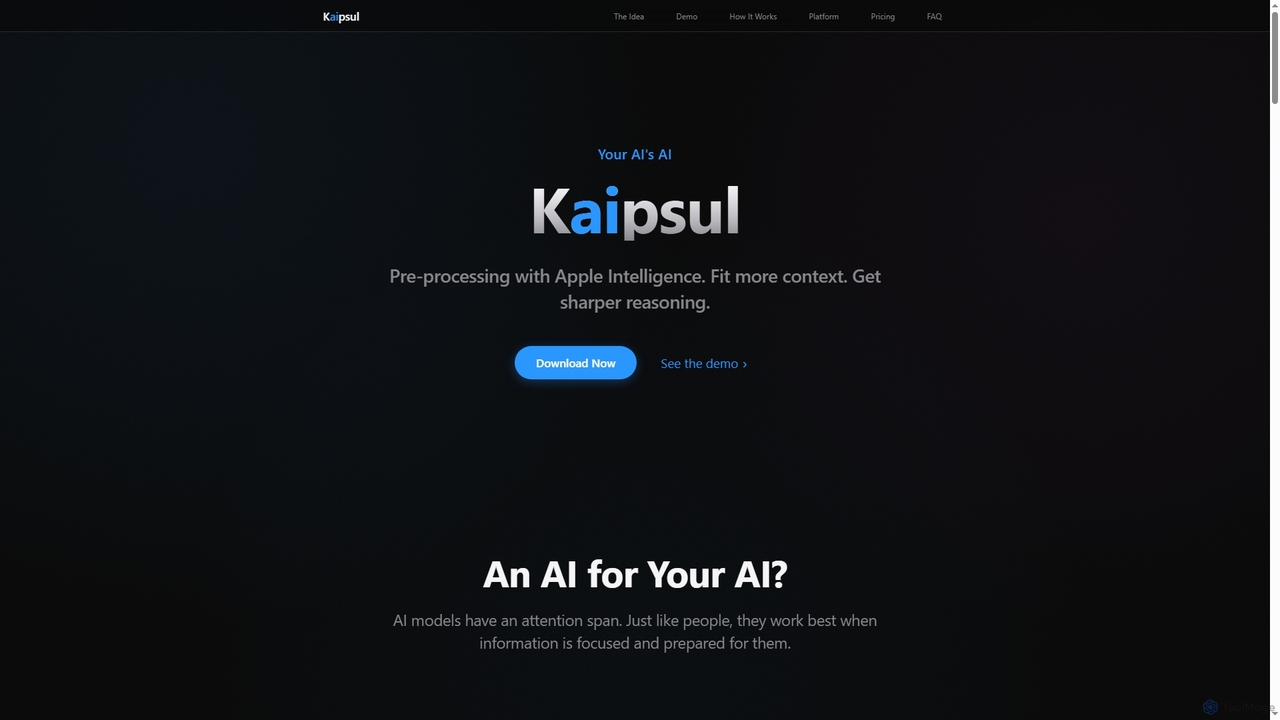
Kaipsul is an innovative macOS application that leverages Apple Intelligence to pre-process large text datasets, compressing them by up to 90% while preserving semantic meaning. It enables AI models to handle more context, overcome "context window exceeded" errors, and achieve sharper reasoning, all through 100% local, on-device processing.
About Data Compression
Data Compression tools are AI-powered solutions designed to reduce the size of digital data while maintaining its integrity or an acceptable level of quality. As a vital component of data management, these tools leverage advanced algorithms, often enhanced by machine learning, to identify redundancies and encode information more efficiently. Their primary value lies in optimizing storage utilization, accelerating data transmission, and minimizing bandwidth consumption across various applications.
Core Features
- Intelligent Redundancy Detection: AI algorithms analyze data patterns to identify and eliminate redundant information more effectively than traditional methods.
- Adaptive Compression Ratios: Tools can dynamically adjust compression levels based on data type, content, and user-defined quality thresholds, balancing size reduction with fidelity.
- Lossless & Lossy Optimization: Support for both lossless compression (for perfect data reconstruction) and lossy compression (for media files where some data loss is acceptable for greater size reduction), often with AI-driven quality control.
- Format Agnostic Processing: Ability to compress various data types, including text, images, audio, video, and structured datasets, with specialized algorithms for each.
Applicable Scenarios
Data Compression tools are essential for organizations and individuals dealing with large volumes of digital information. They are widely used by cloud service providers to optimize storage and network traffic, by media companies for efficient content delivery, and by data scientists to manage massive datasets for analysis and machine learning model training. Developers also utilize these tools to reduce application sizes and improve loading times.
How to Choose
When selecting a Data Compression tool, consider the type of data you need to compress (e.g., text, images, video), whether lossless or lossy compression is required, and the desired compression ratio versus quality trade-off. Evaluate the tool's integration capabilities with existing data pipelines or cloud storage, its processing speed, and the security features for sensitive data. Also, assess the cost-effectiveness based on your data volume and infrastructure.
Data CompressionUse Cases
Optimizing Cloud Storage Costs
Cloud administrators use data compression tools to significantly reduce the storage footprint of backups, archives, and large datasets stored in cloud environments. By automatically compressing files before upload and decompressing on demand, organizations can lower monthly storage bills and improve data retrieval speeds, making cloud resources more cost-efficient for long-term data retention and active workloads.
Accelerating Website & Application Loading
Web developers and application engineers employ compression to minimize the size of static assets like images, CSS, and JavaScript files. This reduces the amount of data transferred over the network, leading to faster page load times for websites and quicker application startup for users, enhancing overall user experience and improving SEO rankings.
Efficient Media Content Delivery
Media companies and streaming services utilize advanced data compression for video and audio files to deliver high-quality content over varying network conditions. AI-powered codecs can adaptively compress streams, ensuring smooth playback even with limited bandwidth, while minimizing data usage for viewers and reducing content delivery network (CDN) costs for providers.
Managing Large Scientific Datasets
Researchers and data scientists working with massive datasets from simulations, sensor readings, or genomic sequencing apply data compression to make these files more manageable. Compressing these datasets reduces storage requirements on local machines and high-performance computing clusters, and speeds up data transfer for collaborative analysis and model training, without compromising data integrity for critical research.
Reducing Bandwidth for Remote Work
Enterprises with a distributed workforce use data compression to optimize data transfer for remote access to shared files and applications. By compressing documents, presentations, and other work-related files, the amount of data sent over potentially slower home internet connections is reduced, leading to faster file synchronization, smoother virtual desktop experiences, and improved productivity for remote employees.
Archiving Historical Data for Compliance
Financial institutions and healthcare providers leverage data compression to efficiently store vast amounts of historical data required for regulatory compliance and auditing. Compressing these long-term archives reduces the physical or cloud storage space needed, making it more economical to retain data for decades, while ensuring data integrity and accessibility for future audits or legal requirements.