BrowserBook
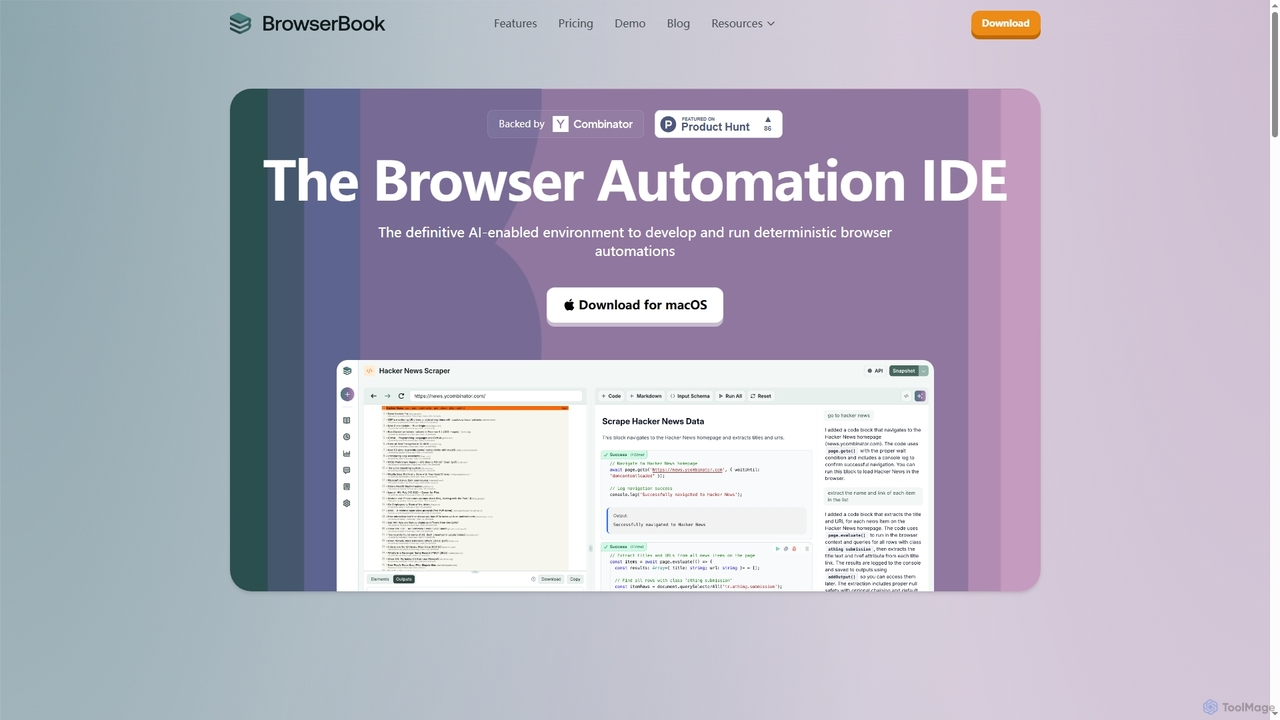
BrowserBook is an AI-powered integrated development environment (IDE) designed for building, deploying, and scaling deterministic browser automations. It …
BrowserBook is an AI-powered integrated development environment (IDE) designed for building, deploying, and scaling deterministic browser automations. It simplifies complex web automation tasks, offering speed, stability, and cost savings by combining AI code generation with reliable scripted execution. Ideal for AI agents, web scraping, UI testing, and industry-specific workflows in healthcare and finance.
Kaipsul
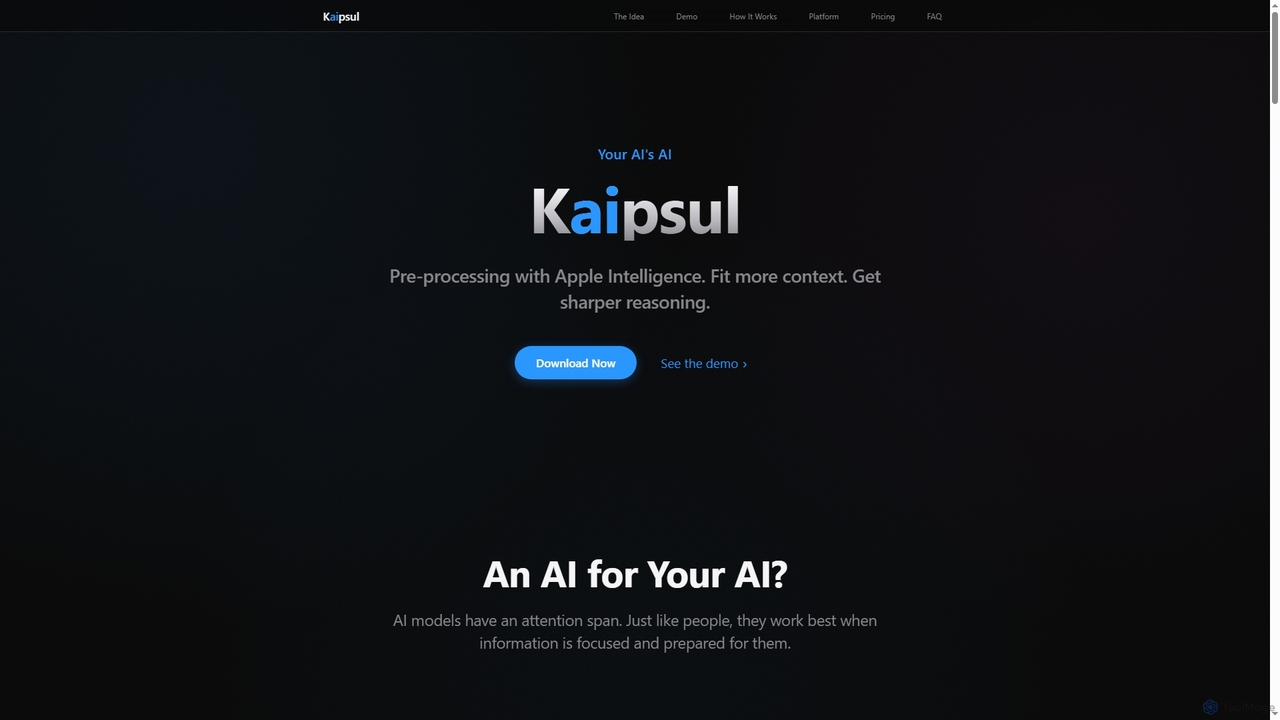
Kaipsul is an innovative macOS application that leverages Apple Intelligence to pre-process large text datasets, compressing them by …
Kaipsul is an innovative macOS application that leverages Apple Intelligence to pre-process large text datasets, compressing them by up to 90% while preserving semantic meaning. It enables AI models to handle more context, overcome "context window exceeded" errors, and achieve sharper reasoning, all through 100% local, on-device processing.
About Data Management
AI Data Management tools are a class of software that leverages artificial intelligence and machine learning to automate and optimize the entire data lifecycle. These tools intelligently handle tasks like data ingestion, cleaning, integration, and governance, often using algorithms to detect patterns, anomalies, and relationships within datasets. This enables organizations to maintain high-quality, reliable data pipelines with minimal manual intervention, accelerating analytics and decision-making. They transform complex data operations into efficient, scalable, and proactive processes.
Core Features
- Automated Data Cleansing: Uses AI to identify and correct errors, duplicates, and inconsistencies in data automatically.
- Intelligent Data Cataloging: Automatically discovers, classifies, and tags data assets, creating a searchable inventory of all data.
- AI-Powered Data Integration: Simplifies the process of mapping and merging data from various disparate sources without manual coding.
- Anomaly Detection: Proactively monitors data streams to identify unusual patterns or outliers that could indicate quality issues or business risks.
- Natural Language Querying: Allows users to retrieve data and insights by asking questions in plain language, removing the need for complex SQL.
Use Cases
These tools are essential for data engineers, data analysts, governance officers, and business intelligence teams. In industries like finance, healthcare, and e-commerce, they are used to manage customer data platforms, ensure regulatory compliance (like GDPR), and prepare high-quality datasets for machine learning models. For example, a retail company can use them to unify customer data from online and offline stores for a single customer view.
How to Choose
When selecting an AI Data Management tool, consider its compatibility with your existing data sources and infrastructure. Evaluate the sophistication of its AI models for tasks like cleansing and anomaly detection. Assess its scalability to handle your data volume and velocity. Also, consider the user interface—whether it supports both technical data teams and less-technical business users—and its integration capabilities with your analytics and BI platforms.
Data ManagementUse Cases
Automating Data Quality for E-commerce
An e-commerce data analyst is tasked with creating accurate customer segments for a personalized marketing campaign. They use an AI Data Management tool to ingest customer data from multiple sources like the website, mobile app, and POS systems. The tool automatically identifies and merges duplicate customer profiles, standardizes mailing addresses to a unified format, and flags incomplete records for review. This process ensures the marketing team works with a clean, reliable single view of each customer, improving campaign targeting accuracy and ROI.
Building a Smart Data Catalog for Compliance
A data governance officer at a financial institution needs to ensure compliance with regulations like GDPR. They deploy an AI Data Management tool to scan all organizational data sources, including databases and cloud storage. The AI automatically identifies and classifies Personally Identifiable Information (PII), tracks data lineage to show how data moves and is transformed, and builds a centralized, searchable catalog. This allows compliance teams to quickly respond to data subject access requests and demonstrate a clear data governance framework to auditors.
Streamlining Data Prep for Machine Learning
A data scientist is building a predictive model to forecast customer churn. The initial dataset is large and contains missing values, outliers, and inconsistent formatting. Instead of spending weeks on manual data preparation, they use an AI Data Management tool. The tool suggests optimal strategies for handling missing data, automatically detects and flags outliers based on statistical models, and streamlines feature engineering. This reduces the data preparation phase from weeks to days, allowing the data scientist to focus on model development and iteration, leading to a more accurate final model.
Natural Language Database Querying for Business Teams
A marketing manager, who does not have SQL skills, needs to quickly understand last quarter's sales performance. Using an AI Data Management tool with a natural language interface, they simply type: "Show me top 5 products by revenue in North America for Q3". The AI translates this request into a complex SQL query, executes it against the sales database, and returns a visualized chart and data table. This empowers non-technical users to perform self-service analytics, reducing their dependency on the data team and enabling faster, data-informed decisions.
Real-time Anomaly Detection in IoT Data Streams
An operations manager at a manufacturing plant monitors thousands of IoT sensors on the production line. An AI Data Management tool continuously ingests and analyzes this high-velocity data stream in real-time. Its machine learning models, trained on historical data, can instantly detect anomalies such as a sudden temperature spike or unusual vibration patterns that deviate from the norm. The system automatically sends an alert to the maintenance team, enabling them to perform predictive maintenance and prevent costly equipment failure and production downtime.
Accelerating Data Migration to the Cloud
An IT team is migrating a legacy on-premise database to a cloud data warehouse. This complex project involves mapping hundreds of tables and transforming data formats. They use an AI Data Management tool that automatically scans the source and target schemas, intelligently suggests column mappings, and generates the necessary transformation code. The tool also performs automated data validation post-migration to ensure data integrity. This AI-assisted approach significantly reduces manual effort, minimizes the risk of human error, and cuts the overall project timeline by more than 40%.