Granica
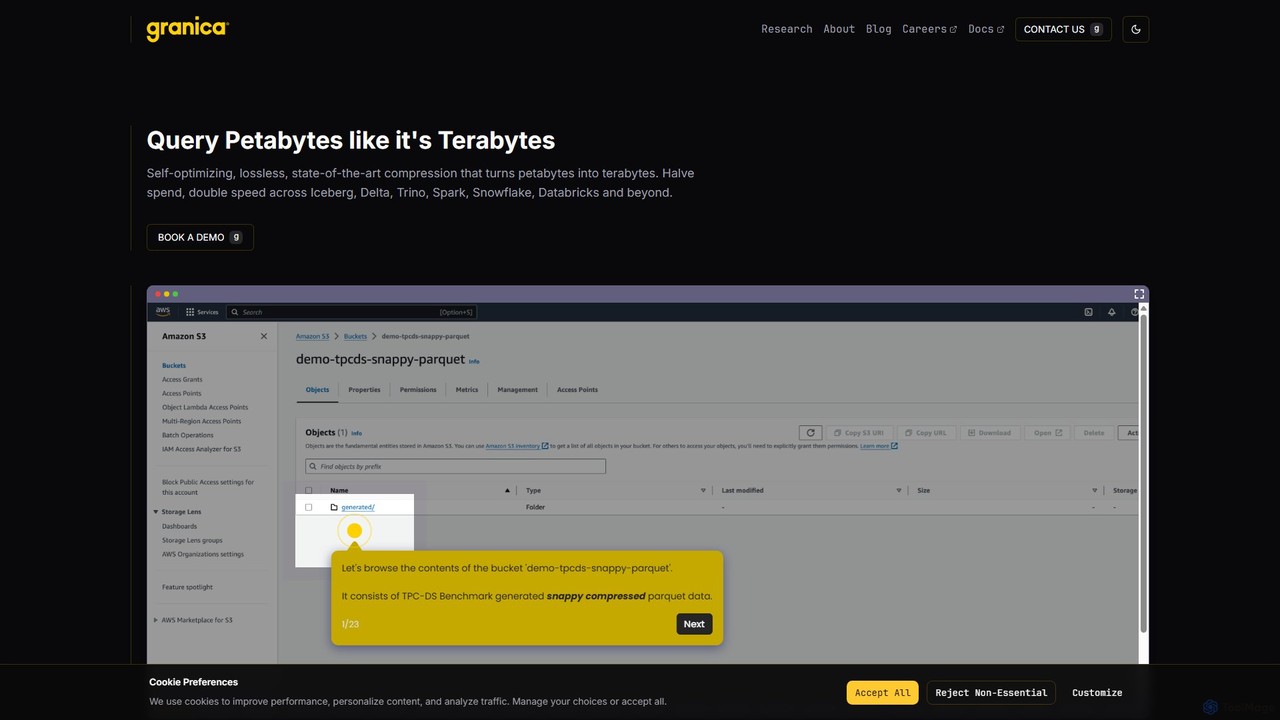
Granica is an AI-powered data infrastructure platform that provides self-optimizing, lossless compression for petabyte-scale data lakes. It dramatically …
Granica is an AI-powered data infrastructure platform that provides self-optimizing, lossless compression for petabyte-scale data lakes. It dramatically reduces cloud storage and compute costs while accelerating query performance across platforms like Snowflake, Databricks, Spark, and more.
About Optimization
AI Optimization tools are a class of software that uses algorithms to find the best possible solution from a vast set of alternatives under specific constraints. These tools employ techniques from machine learning and operations research to model complex systems, simulate outcomes, and identify optimal parameters. Their primary value lies in transforming data analysis into actionable decisions, helping businesses maximize efficiency, profit, or other key metrics. Unlike standard data tools that describe past events, optimization tools prescribe the best course of action for the future.
Core Features
- Constraint Modeling: Define the rules, limits, and variables of a complex problem to create a realistic model.
- Scenario Simulation: Run thousands of 'what-if' scenarios to test the impact of different decisions before implementation.
- Algorithmic Solvers: Apply specialized algorithms (e.g., linear programming, genetic algorithms) to find the mathematically best solution.
- Resource Allocation: Recommend the most effective distribution of limited resources like budget, personnel, or materials.
- Prescriptive Analytics: Provide clear recommendations on the actions to take to achieve a specific business goal.
Use Cases
These tools are widely used in industries with complex operational challenges, such as supply chain management for route planning, finance for portfolio optimization, and manufacturing for production scheduling. Roles like operations managers, financial analysts, and data scientists leverage them to solve resource allocation and strategic planning problems.
How to Choose
When selecting an AI Optimization tool, consider the specific types of problems it can solve (e.g., routing, scheduling, pricing). Evaluate its integration capabilities with your existing data sources, its scalability to handle the complexity of your operations, and whether its interface is suited for your team's technical skills (e.g., code-based vs. low-code visual interface).
OptimizationUse Cases
Optimizing Supply Chain Logistics
A logistics manager for a national retail chain needs to minimize transportation costs while ensuring timely deliveries. Using an AI Optimization tool, they model their entire distribution network, including warehouse locations, vehicle capacities, fuel costs, and delivery windows. The tool processes this data and simulates thousands of possible routing combinations. It then generates an optimal daily routing plan for the entire fleet, resulting in a 15% reduction in fuel costs and a significant improvement in on-time delivery rates.
Dynamic Pricing for E-commerce
An e-commerce pricing analyst is tasked with maximizing revenue for thousands of products. An AI Optimization tool is used to analyze real-time data on competitor prices, inventory levels, demand forecasts, and customer behavior. The tool's algorithm continuously calculates the optimal price for each product to balance sales volume and profit margin. This dynamic pricing strategy allows the business to react instantly to market changes, leading to an 8% increase in overall profit margins without sacrificing market share.
Allocating Marketing Campaign Budgets
A digital marketing manager needs to allocate a fixed quarterly budget across various channels like Google Ads, social media, and email marketing for maximum return on investment (ROI). An AI Optimization tool models the expected performance of each channel based on historical data and conversion rates. It then recommends the optimal budget split to achieve the highest number of leads or sales. By reallocating funds from underperforming channels to more effective ones, the manager achieves a 20% improvement in overall campaign ROI.
Manufacturing Production Scheduling
A production planner in a factory aims to create a schedule that maximizes output while minimizing machine downtime and labor costs. They use an AI Optimization tool to input all constraints, including machine availability, maintenance schedules, raw material inventory, and order deadlines. The tool's algorithm generates an optimized production schedule that perfectly balances these competing factors. This leads to a 10% increase in overall production efficiency and a significant reduction in costly overtime hours.
Financial Portfolio Optimization
An investment analyst needs to construct a portfolio that maximizes expected returns for a client's specific risk tolerance. Using an AI Optimization tool, the analyst inputs data on thousands of assets, including their historical returns, volatility, and correlations. The tool applies modern portfolio theory algorithms to identify the ideal asset allocation that offers the highest possible return for the given level of risk. The result is a well-diversified portfolio that is mathematically optimized to meet the client's financial goals.
Workforce Shift Scheduling
An operations manager for a 24/7 call center must create weekly schedules that meet fluctuating call volumes while adhering to labor laws and employee preferences. They use an AI Optimization tool to input demand forecasts, employee availability, skill sets, and union rules. The tool automatically generates a fair and efficient schedule that minimizes labor costs by preventing overstaffing and understaffing. This reduces scheduling time from hours to minutes and improves employee satisfaction by creating more balanced workloads.