
Xano
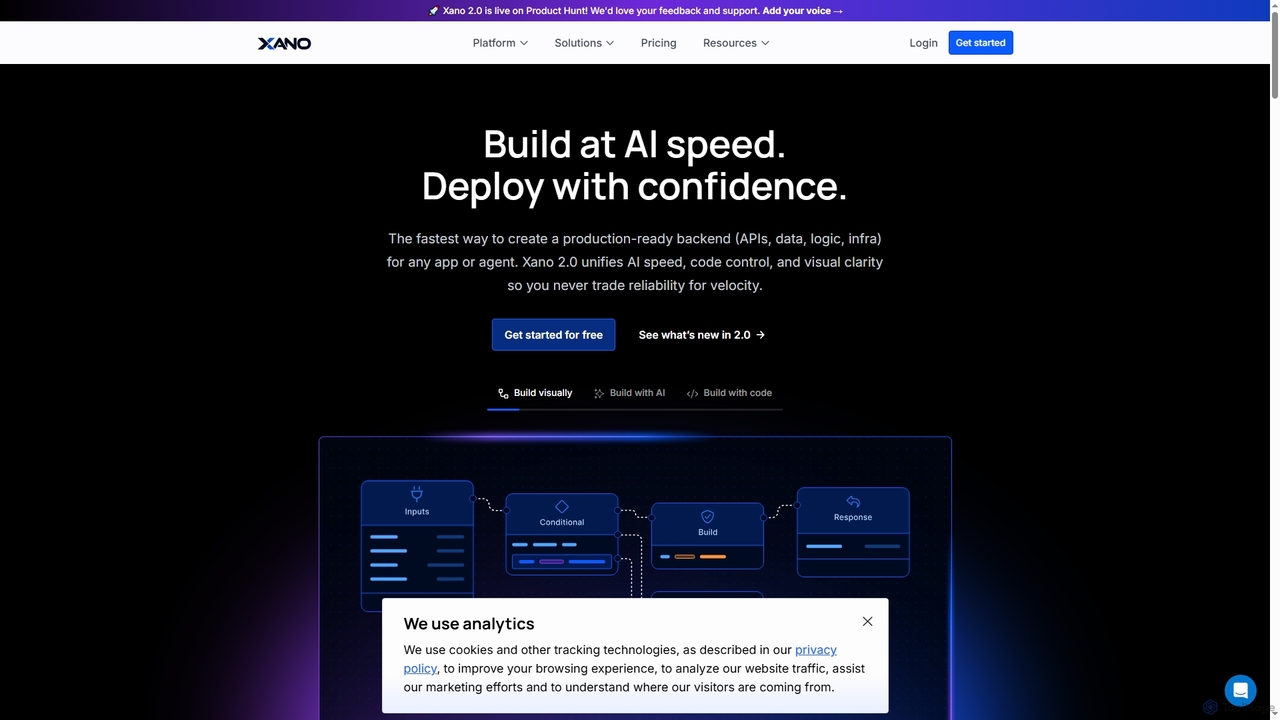
Xano is a scalable no-code backend platform that empowers developers and teams to build production-ready applications and AI …
Xano is a scalable no-code backend platform that empowers developers and teams to build production-ready applications and AI agents at speed. It provides a unified solution for APIs, a managed Postgres database, visual logic, and auto-scaling infrastructure, eliminating the need for complex DevOps.
About Postgres
AI Postgres tools are solutions designed to enhance or leverage the PostgreSQL object-relational database system for artificial intelligence applications. They utilize Postgres's advanced capabilities, such as extensibility and support for complex data types, to manage, process, and query data for machine learning models. These tools enable developers to build sophisticated, data-intensive applications by integrating AI functionalities like vector similarity search directly within a robust, ACID-compliant database environment. This approach simplifies the tech stack and ensures data consistency for critical AI workloads.
Core Features
- Vector Similarity Search: Integrates extensions like pgvector to store and query high-dimensional vector embeddings for tasks like semantic search or recommendation systems.
- Advanced Data Type Support: Natively handles complex data structures such as JSONB, arrays, and geospatial data (via PostGIS), crucial for diverse AI models.
- In-Database Machine Learning: Allows for the creation and execution of custom functions and models directly within the database, reducing data movement.
- AI-Powered Query Optimization: Employs machine learning to analyze query patterns and suggest performance improvements, such as optimal indexing or query rewriting.
- Transactional Integrity: Ensures ACID compliance, providing a reliable and consistent data foundation for mission-critical AI systems.
Use Cases
These tools are widely used by AI engineers, data scientists, and backend developers. Common applications include building Retrieval-Augmented Generation (RAG) systems for LLMs, creating real-time recommendation engines for e-commerce, and performing complex geospatial analysis for urban planning or logistics optimization.
How to Choose
When selecting an AI Postgres tool, consider its primary function: is it for database optimization or for enabling AI features? Evaluate its support for essential extensions like pgvector and PostGIS. Assess its scalability, integration capabilities with your existing MLOps pipeline, and whether its pricing model aligns with your data volume and query load.
PostgresUse Cases
Build a RAG System for an AI Chatbot
An AI engineer is tasked with creating a knowledgeable chatbot for customer support. They use a Postgres database with the pgvector extension to store vector embeddings of their entire knowledge base. When a user asks a question, the system first converts the query into a vector, then uses Postgres to perform a similarity search to find the most relevant document chunks. These chunks are then fed to a Large Language Model (LLM) as context, allowing the chatbot to provide accurate, context-aware answers based on internal documentation, significantly reducing hallucinations.
Optimize Database Performance with AI Analysis
A Database Administrator (DBA) manages a large, high-traffic Postgres database for a SaaS application. To prevent performance bottlenecks, they use an AI-powered monitoring tool. The tool continuously analyzes query logs, execution plans, and system metrics. It uses machine learning to identify inefficient queries, recommend new indexes, and suggest configuration changes (like adjusting `work_mem`). This proactive approach helps the DBA maintain optimal performance and scalability, reducing manual tuning efforts and preventing service disruptions before they impact users.
Geospatial Analysis for Logistics Optimization
A data scientist at a logistics company uses Postgres with the PostGIS extension as the backend for an AI-powered route optimization platform. The database stores vast amounts of geospatial data, including delivery locations, road networks, and real-time traffic information. They run complex spatial queries to calculate optimal delivery routes, identify service coverage gaps, and predict delivery times. AI models trained on this data help automate routing decisions, reducing fuel costs and improving delivery efficiency by over 15%.
Powering a Real-Time Recommendation Engine
An e-commerce platform developer needs to build a personalized recommendation engine. They choose Postgres to store user profiles, product catalogs with complex attributes in JSONB format, and real-time user interaction data. An AI tool connected to Postgres processes this data to train a recommendation model. When a user browses the site, the system queries Postgres for the user's recent activity and product features, feeds this to the AI model, and receives a list of personalized recommendations in milliseconds, all managed within a single, reliable database system.
Natural Language to SQL Query Generation
A business analyst needs to extract insights from a large Postgres data warehouse but lacks advanced SQL skills. They use an AI tool that provides a natural language interface. The analyst types a question like, "Show me the total sales for the top 5 products in the last quarter." The AI model interprets the request, understands the database schema, and generates an optimized SQL query for Postgres. This empowers non-technical users to perform complex data analysis independently, accelerating decision-making without needing to rely on the data engineering team.
Automating Data Anonymization for Compliance
A healthcare technology company must comply with strict data privacy regulations like HIPAA. Before using patient data for research, it needs to be anonymized. They deploy an AI-powered tool that connects to their Postgres database. The tool uses named entity recognition (NER) models to automatically identify and mask personally identifiable information (PII) such as names, addresses, and social security numbers directly within database copies. This automates a critical compliance step, reduces the risk of human error, and allows researchers to work with safe, anonymized datasets.