Eco-AI
Eco-AI is a pioneering decentralized artificial intelligence platform designed for sustainability, significantly reducing energy and water consumption compared …
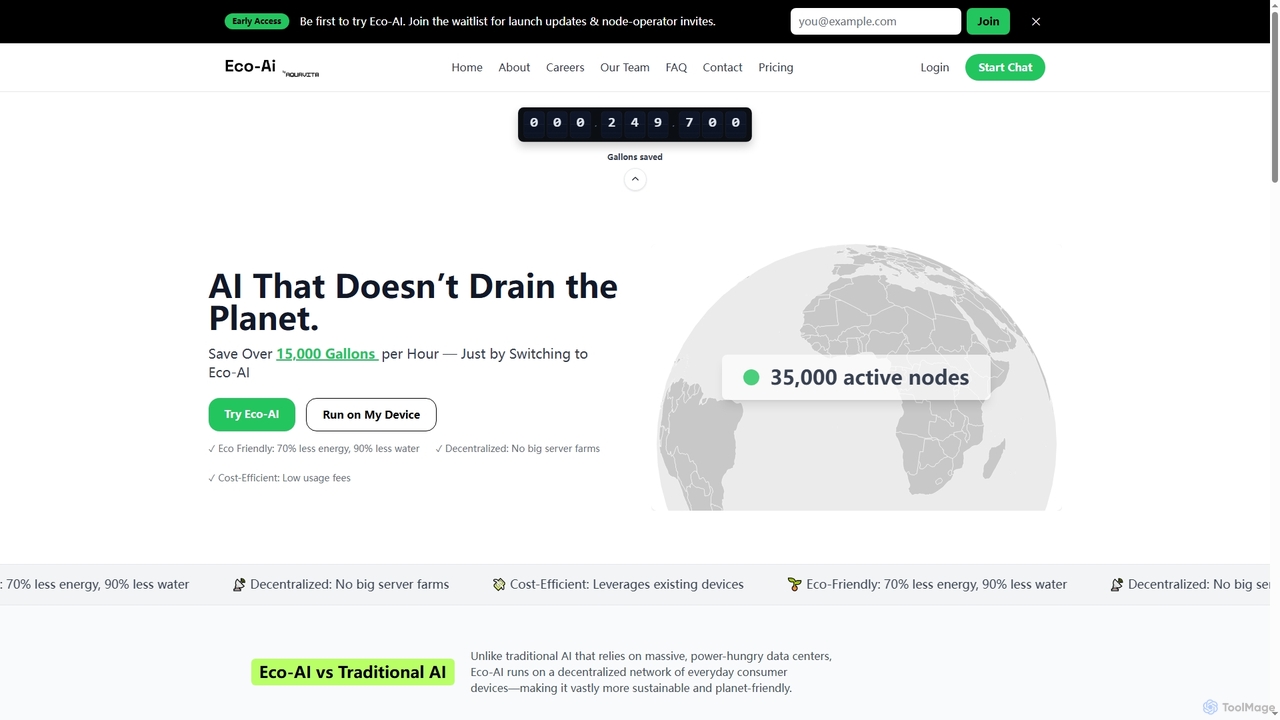
Eco-AI is a pioneering decentralized artificial intelligence platform designed for sustainability, significantly reducing energy and water consumption compared to traditional AI. It leverages a network of consumer-owned devices, promoting an eco-friendly and cost-efficient approach to AI processing while enhancing privacy.
About Edge Ai
Edge AI is a category of artificial intelligence that processes data directly on local devices, known as edge devices, rather than relying on centralized cloud servers. This approach enables real-time inference and decision-making at the source of data generation, making it a crucial component of decentralized computing paradigms. By bringing AI capabilities closer to the data, Edge AI significantly reduces latency, conserves bandwidth, and enhances data privacy and operational reliability.
Core Features
- On-device Processing: Executes AI models directly on local hardware, minimizing reliance on cloud connectivity.
- Low Latency: Enables immediate responses and real-time decision-making by eliminating network delays.
- Offline Capability: Allows AI applications to function effectively even without continuous internet access.
- Enhanced Data Privacy: Processes sensitive data locally, reducing the need to transmit it to external servers.
- Reduced Bandwidth Usage: Only sends aggregated insights or critical alerts to the cloud, rather than raw data.
Applicable Scenarios
Edge AI tools are vital for industries requiring immediate data processing and robust local operations. They are widely adopted in smart manufacturing for predictive maintenance, autonomous vehicles for real-time object detection, and IoT devices for local sensor data analysis. Healthcare monitoring devices also leverage Edge AI for on-device anomaly detection, ensuring timely alerts without compromising patient data privacy.
How to Choose
When selecting an Edge AI solution, prioritize hardware compatibility with your existing infrastructure and the specific computational resources available on your edge devices. Evaluate the model optimization capabilities to ensure efficient performance on constrained hardware. Consider the security features for local data protection and the scalability of the solution to accommodate future growth and deployment across multiple devices. Finally, assess the ease of integration with your current data pipelines and application ecosystem.
Edge AiUse Cases
Autonomous Vehicle Navigation
Automotive engineers deploy Edge AI models directly onto self-driving cars to perform real-time object detection, lane keeping, and pedestrian recognition. This on-device processing ensures immediate decision-making critical for safety, even in areas with poor network connectivity, allowing vehicles to react instantly to changing road conditions and avoid hazards.
Smart Factory Predictive Maintenance
Manufacturing plant managers utilize Edge AI sensors on machinery to continuously monitor operational parameters like vibration, temperature, and sound. The AI models analyze this data locally to predict equipment failures before they occur, triggering maintenance alerts. This reduces downtime by up to 30% and optimizes maintenance schedules without sending sensitive operational data to the cloud.
Retail Store Customer Analytics
Retail operations teams use Edge AI cameras and sensors within physical stores to analyze customer traffic patterns, dwell times, and product interactions. All video and sensor data is processed locally to generate anonymous insights into customer behavior, enhancing store layout and product placement strategies while ensuring customer privacy by not transmitting raw footage off-site.
Remote Infrastructure Monitoring
Utility companies deploy Edge AI devices at remote power grids, pipelines, or communication towers to monitor their status and detect anomalies. These devices process sensor data locally to identify potential faults or security breaches in real-time, sending only critical alerts to a central control room. This ensures rapid response times and reduces the need for constant high-bandwidth data transmission from remote locations.
Personalized Healthcare Wearables
Individuals use Edge AI-powered wearable health devices to continuously monitor vital signs, activity levels, and sleep patterns. The AI models on the device analyze this personal health data locally to detect anomalies or potential health issues, providing immediate feedback or alerts. This approach ensures high data privacy for sensitive health information and allows for continuous monitoring even when offline.
Agricultural Crop Health Analysis
Farmers employ drones or ground-based sensors equipped with Edge AI to analyze crop health in real-time. The AI models process images and sensor data directly on the device to identify signs of disease, pest infestations, or nutrient deficiencies. This enables immediate, targeted intervention, optimizing resource use and improving yields, without requiring large amounts of data to be uploaded to the cloud for processing.