
ToolMage
Sign in

Best 1 Sustainable Ai AI tools for Artificial Intelligence

Popular Sustainable Ai AI tools in Artificial Intelligence include Eco-AI, helping you work more efficiently.

Eco-AI
Freemium

Eco-AI

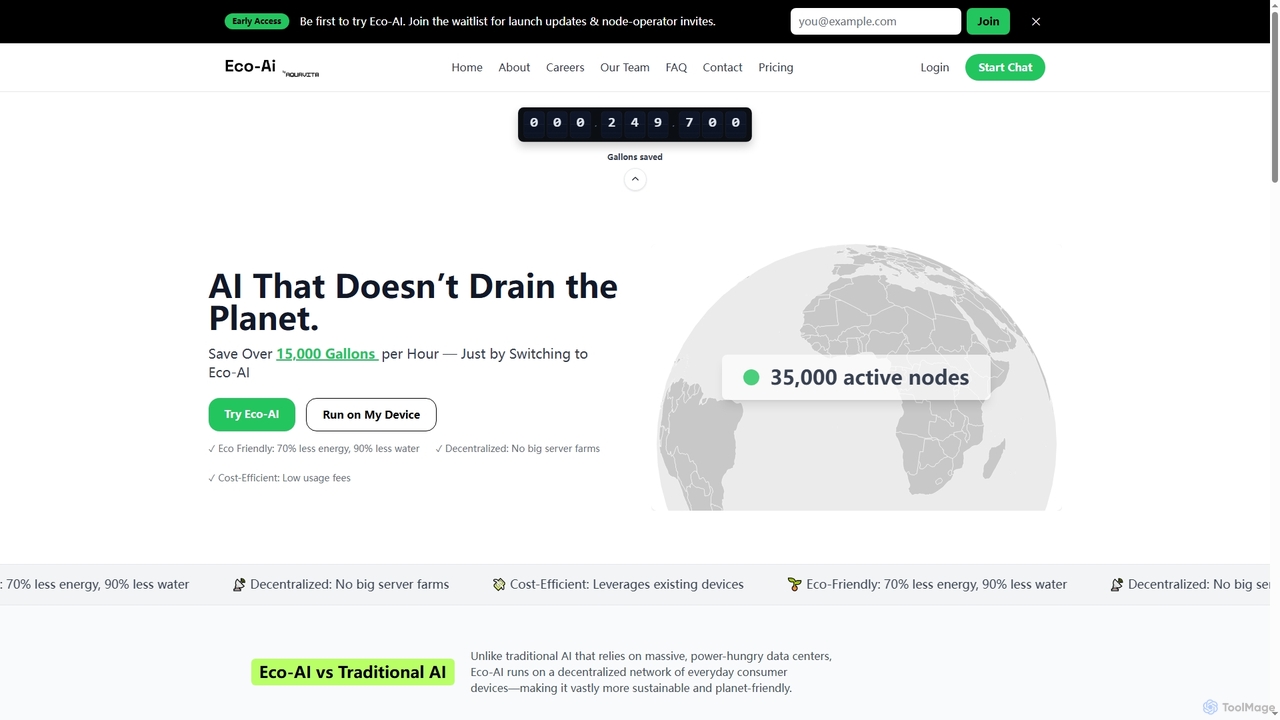
Eco-AI is a pioneering decentralized artificial intelligence platform designed for sustainability, significantly reducing energy and water consumption compared to traditional AI. It leverages a network of consumer-owned devices, promoting an eco-friendly and cost-efficient approach to AI processing while enhancing privacy.

Sustainable Ai
Visits 5.8KFavorites 130Likes 152

About Sustainable Ai

Sustainable AI refers to the development, deployment, and use of artificial intelligence systems with a focus on minimizing their environmental impact and maximizing their social and ethical benefits. These tools leverage advanced algorithms and data analysis to optimize resource consumption, reduce energy footprints, and promote responsible AI practices throughout their lifecycle. By integrating principles of efficiency and ethics, Sustainable AI aims to create intelligent systems that are not only powerful but also environmentally friendly and socially equitable.

Core Features

  • Energy Efficiency Monitoring: Tools to track and optimize the energy consumption of AI models and infrastructure.
  • Resource Optimization: Algorithms designed to reduce computational resources, data storage, and network bandwidth required for AI operations.
  • Ethical AI Governance: Features for detecting and mitigating biases, ensuring fairness, transparency, and accountability in AI systems.
  • Lifecycle Impact Assessment: Capabilities to evaluate the environmental and social footprint of AI from development to deployment and decommissioning.

Use Cases

Sustainable AI is crucial for organizations aiming to reduce their carbon footprint and adhere to ethical guidelines. It is applied in data centers to optimize cooling and power usage for AI servers, in model development to select less resource-intensive architectures, and in business operations to ensure AI decisions are fair and transparent. This approach helps companies meet sustainability goals while leveraging AI's power.

How to Choose

When selecting Sustainable AI tools, prioritize solutions that offer comprehensive energy consumption reporting and optimization features. Look for capabilities in bias detection and ethical AI governance to ensure responsible deployment. Consider the tool's integration with existing MLOps pipelines and its ability to support various AI model types. Scalability, compliance with sustainability standards, and transparent impact assessment metrics are also vital for long-term value.

Sustainable Ai use cases

1

Optimizing Data Center Energy for AI Workloads

Data center managers can utilize Sustainable AI tools to monitor and dynamically adjust power consumption for AI training and inference servers. By analyzing real-time workload demands and environmental conditions, these tools can intelligently manage cooling systems and server utilization, significantly reducing the overall energy footprint and operational costs associated with large-scale AI deployments.

2

Developing Resource-Efficient AI Models

AI researchers and developers employ Sustainable AI methodologies to design and train models that require fewer computational resources. This involves techniques like model compression, quantization, and efficient neural architecture search, leading to smaller, faster, and less energy-intensive models that can be deployed on edge devices or in environments with limited power.

3

Ensuring Ethical Bias Detection in AI Applications

Ethical AI specialists use Sustainable AI platforms to continuously monitor and detect potential biases in AI models used for critical applications like loan approvals or hiring. These tools provide metrics and visualizations to identify unfair outcomes based on demographic data, allowing developers to retrain or adjust models to promote fairness and prevent discriminatory practices.

4

Implementing Green Computing Practices for AI

IT departments can integrate Sustainable AI solutions to implement broader green computing strategies. This includes optimizing data storage for AI datasets, managing network traffic efficiently, and virtualizing AI infrastructure to maximize hardware utilization. The goal is to minimize the environmental impact of the entire AI ecosystem, from hardware to software.

5

Sustainable Supply Chain Optimization with AI

Logistics and supply chain managers leverage Sustainable AI to optimize routes, manage inventory, and predict demand with a focus on environmental impact. AI models can analyze factors like fuel consumption, emissions, and waste generation, suggesting more sustainable operational choices that reduce the carbon footprint of the supply chain while maintaining efficiency.

6

Assessing and Reporting AI's Environmental Impact

Environmental compliance officers and sustainability teams use Sustainable AI tools to measure, track, and report the environmental impact of their AI initiatives. These tools can quantify carbon emissions, energy usage, and resource consumption associated with specific AI projects, providing data for sustainability reports and helping organizations meet regulatory requirements and ESG goals.

Sustainable Ai FAQ

What is Sustainable AI?

Sustainable AI is an approach to developing and deploying artificial intelligence systems that prioritizes minimizing environmental harm, such as energy consumption and carbon emissions, while also ensuring social equity, transparency, and ethical considerations. It aims to create AI that is not only powerful and effective but also responsible and beneficial for the planet and society in the long term.

How does Sustainable AI differ from general AI?

While general AI focuses primarily on performance, accuracy, and efficiency in achieving specific tasks, Sustainable AI adds critical dimensions of environmental and social responsibility. It specifically considers the energy footprint of AI models, the ethical implications of their decisions, and their overall impact on resources and society throughout their lifecycle, moving beyond just computational power.

What are the key benefits of implementing Sustainable AI?

Implementing Sustainable AI offers multiple benefits, including reduced operational costs through optimized energy and resource consumption, improved brand reputation by demonstrating commitment to environmental and ethical practices, and enhanced compliance with emerging sustainability regulations. It also leads to more robust, fair, and trustworthy AI systems that mitigate risks like bias and discrimination.

How can organizations measure the sustainability of their AI systems?

Organizations can measure AI sustainability by tracking metrics such as energy consumption (e.g., kilowatt-hours per model training), carbon emissions (e.g., CO2 equivalent), resource utilization (e.g., CPU/GPU hours, data storage), and the fairness and transparency of AI decisions. Specialized Sustainable AI tools often provide dashboards and reporting features to monitor these indicators across the AI lifecycle.

What are some challenges in adopting Sustainable AI?

Adopting Sustainable AI can present challenges such as the initial investment in new tools and methodologies, the complexity of measuring and optimizing AI's environmental impact, and the need for specialized expertise in both AI and sustainability. Additionally, balancing the trade-offs between model performance and resource efficiency, and navigating evolving ethical guidelines, can be difficult for organizations.