
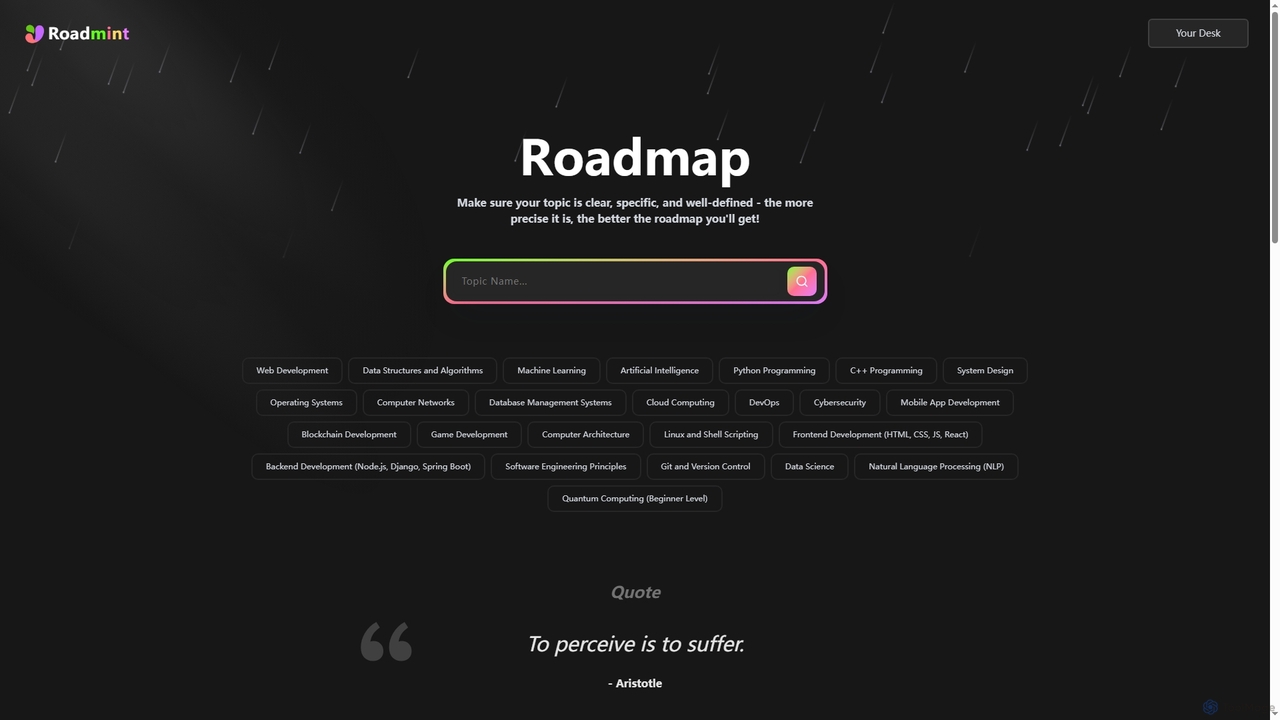
Roadmint
Roadmint is a free, AI-powered online tool that generates personalized learning roadmaps for any specified topic. It breaks …
Roadmint is a free, AI-powered online tool that generates personalized learning roadmaps for any specified topic. It breaks down complex subjects into clear, daily steps, enabling users to track their progress without needing to sign up or pay. Ideal for self-learners and developers.
About Learning Resources
AI Learning Resources are tools that use artificial intelligence to deliver personalized and interactive educational experiences for developers. These platforms go beyond static tutorials by employing AI models to understand a user's code, answer complex technical questions, and adapt learning paths in real time. They are designed to accelerate the mastery of new programming languages, frameworks, and APIs by providing instant feedback and context-aware examples. This approach transforms learning from a passive activity into an engaging, hands-on development process.
Core Features
- Interactive Coding Environments: AI-powered sandboxes that offer real-time code analysis, intelligent suggestions, and automated debugging assistance.
- Personalized Learning Paths: Algorithms that dynamically adjust course content and difficulty based on a developer's progress, strengths, and weaknesses.
- AI-Powered Q&A: Natural language interfaces that can interpret technical questions and provide precise answers with code examples from documentation or knowledge bases.
- Code Explanation and Refactoring: Tools that analyze code snippets to explain their functionality in plain language or suggest performance and style improvements.
- Concept Visualization: AI-driven generation of diagrams, flowcharts, and simulations to clarify abstract software engineering concepts.
Applicable Scenarios
These resources are widely used by individual developers aiming to upskill, tech companies for onboarding new engineers, and educational institutions for modernizing their computer science curriculum. They are particularly effective for learning complex domains like machine learning, blockchain, or a new programming language where hands-on practice and immediate feedback are crucial.
Selection Criteria
When choosing an AI Learning Resource, consider the breadth and depth of the technology stacks covered (e.g., Python, JavaScript, specific cloud platforms). Evaluate the level of interactivity and the quality of the AI feedback. Also, assess its integration capabilities with standard developer tools like VS Code or GitHub and review the pricing model to ensure it aligns with your learning goals and budget.
Learning ResourcesUse Cases
Accelerate Onboarding for Junior Developers
A tech lead is tasked with onboarding a new junior developer onto a team that uses a complex stack including Go, Kubernetes, and a proprietary microservices framework. Instead of relying solely on senior developer time for mentoring, they use an AI Learning Resource. The platform generates a personalized learning path that starts with Go fundamentals and progresses to interactive Kubernetes exercises within a simulated cloud environment. The junior developer can ask the AI assistant specific questions about the company's internal libraries, receiving instant, context-aware answers and code snippets. This reduces the onboarding time by an estimated 40% and frees up senior engineers to focus on critical tasks.
Master a New Machine Learning Library
A data scientist with expertise in Scikit-learn needs to quickly become proficient in PyTorch for a deep learning project. They use an AI-powered learning tool that specializes in ML frameworks. The tool allows them to write code in an interactive notebook and provides real-time feedback on PyTorch tensor operations and neural network architectures. When they encounter a complex function, they can highlight it and ask the AI to explain it with a simplified analogy and a practical code example. This hands-on, query-based approach helps them build and debug complex models much faster than by reading static documentation alone.
Prepare for Technical Coding Interviews
A software engineer is preparing for interviews at top tech companies. They subscribe to an AI learning platform focused on algorithms and data structures. The platform presents a curated list of problems based on their target role and skill level. As they write a solution, the AI provides real-time hints and efficiency analysis (Big O notation). After submitting a solution, the AI not only validates its correctness but also explains alternative, more optimal approaches. This simulates the feedback loop of a real interview, helping the engineer identify and fix weaknesses in their problem-solving process.
Rapidly Prototype with an Unfamiliar API
A full-stack developer needs to integrate the Stripe payment API into an e-commerce application for the first time. To avoid spending hours reading dense documentation, they use an AI learning resource with an API sandbox. They describe their goal in natural language, such as "create a subscription for a customer." The AI generates the necessary API call sequence in their preferred language (e.g., Node.js), complete with explanations for each parameter. They can immediately run and modify this code in the sandbox, allowing them to build a functional prototype in a fraction of the time.
Learn a New Programming Paradigm
An object-oriented programmer with years of experience in Java decides to learn a functional programming language like Haskell to broaden their skills. They find the paradigm shift challenging. They use an AI tutor that specializes in explaining programming concepts. The tool visualizes concepts like monads and immutability and provides exercises that directly contrast Haskell's functional approach with familiar Java patterns. The AI can analyze their code and explain why a particular functional approach is more idiomatic or efficient, bridging the conceptual gap effectively.
Understand and Refactor Legacy Codebases
A developer joins a team maintaining a large, poorly documented legacy application written in C++. To get up to speed, they use an AI tool that can analyze codebases. They can point the tool to a complex function, and the AI generates a detailed, natural-language explanation of its purpose, inputs, outputs, and side effects. It also identifies potential bugs, security vulnerabilities, or areas that could be refactored for better performance. This tool acts as an expert system, making the daunting task of understanding legacy code manageable and systematic.