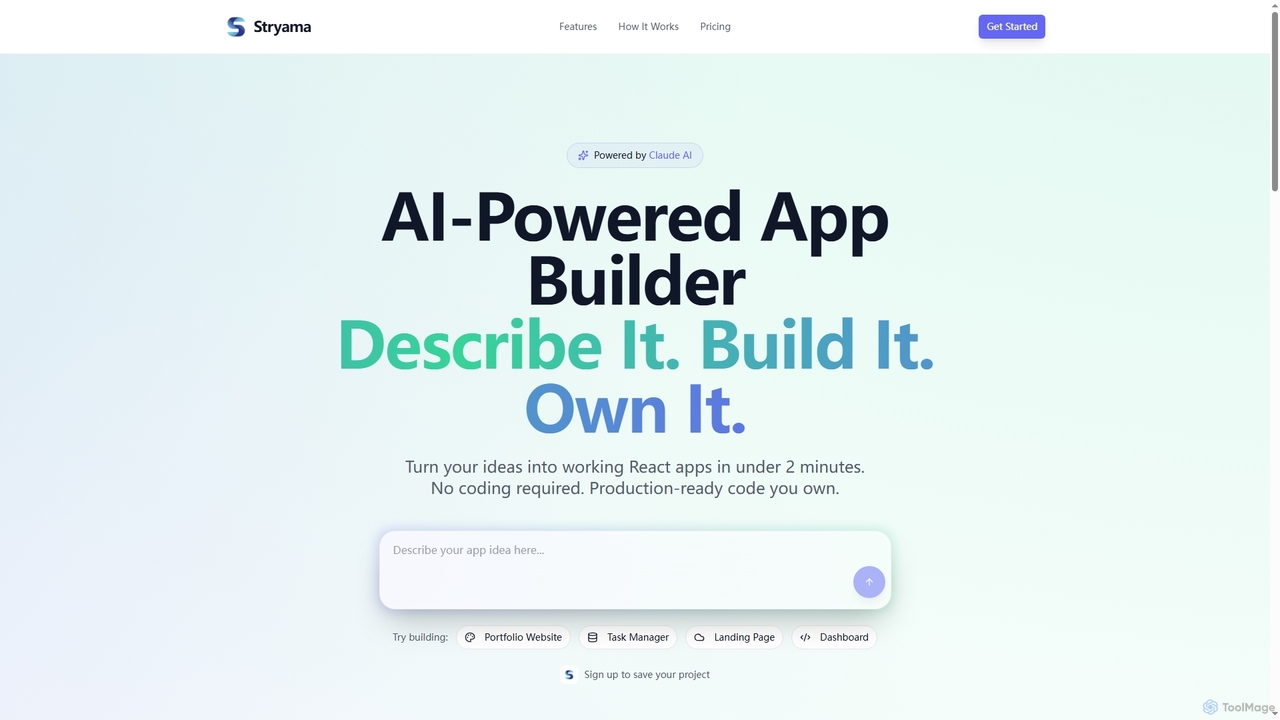
Stryama
Stryama is an AI-powered app builder that transforms your ideas into functional React applications in minutes, requiring no …
Stryama is an AI-powered app builder that transforms your ideas into functional React applications in minutes, requiring no coding. It generates production-ready code that you fully own, enabling rapid development and deployment for various web projects.
About Frontend Development
Frontend Development tools are AI-powered solutions designed to streamline and automate various aspects of building user interfaces and experiences for web and mobile applications. These tools leverage machine learning to assist with tasks ranging from design conversion to code generation, significantly enhancing developer productivity. They aim to accelerate the creation of responsive, accessible, and performant frontend applications, allowing developers to focus on complex logic and innovation.
Core Features
- Design-to-Code Conversion: Automatically transforms UI/UX designs (e.g., from Figma, Sketch) into clean, functional HTML, CSS, and JavaScript code.
- Intelligent Code Generation: Generates boilerplate code, UI components, or even entire page sections based on natural language prompts or visual inputs.
- Responsive Design Assistance: Provides AI-driven suggestions and automated adjustments to ensure layouts adapt seamlessly across various devices and screen sizes.
- Accessibility Auditing & Correction: Identifies potential accessibility issues (WCAG compliance) in UI code and suggests automated fixes or improvements.
- Performance Optimization: Analyzes frontend code for bottlenecks and suggests optimizations for faster loading times and smoother user interactions.
Applicable Scenarios
Web development teams use these tools to rapidly prototype new features and convert designer mockups into functional code, reducing manual coding effort. Freelance developers leverage AI for quick component generation and boilerplate setup, accelerating project kick-off. Large enterprises integrate these solutions to maintain consistent design systems and ensure high code quality across multiple frontend projects.
How to Choose
When selecting Frontend Development AI tools, consider their compatibility with your existing design tools and tech stack (e.g., React, Vue). Evaluate the quality and maintainability of the generated code, as well as the level of customization offered. Assess the tool's ability to handle complex UI patterns and its support for accessibility standards. Finally, review pricing models and community support for long-term viability.
Frontend DevelopmentUse Cases
Accelerating UI Component Generation from Mockups
UI/UX designers can use AI frontend development tools to rapidly convert static design mockups (e.g., Figma, Sketch files) into functional, production-ready code components. By simply importing designs, the AI analyzes visual elements and generates corresponding HTML, CSS, and JavaScript/TypeScript, significantly reducing the manual coding effort and ensuring pixel-perfect implementation. This allows design teams to quickly iterate on concepts and hand off clean code to developers, saving weeks on front-end build times.
Converting UI/UX Designs to Code
For UI/UX designers and frontend developers, AI tools can automatically transform high-fidelity design mockups from platforms like Figma or Sketch into production-ready HTML, CSS, and JavaScript. This eliminates the tedious manual coding of visual elements, allowing developers to focus on interactivity and backend integration, significantly speeding up the design-to-development handover process and reducing errors.
Automating Responsive Layout Adjustments
Web developers often spend considerable time ensuring applications look and function correctly across diverse devices. AI frontend tools can automate this process by analyzing the initial design and intelligently generating responsive CSS and media queries. This ensures optimal display on desktops, tablets, and mobile phones without manual tweaking, drastically cutting down on cross-browser and cross-device testing, and allowing developers to focus on core application logic rather than layout adjustments.
Generating Boilerplate and UI Components
Frontend developers often spend considerable time writing repetitive boilerplate code or common UI components. AI tools can generate these elements—such as navigation bars, forms, or cards—based on simple text prompts or visual cues. This accelerates initial project setup, ensures consistency with design systems, and frees developers to concentrate on unique application logic rather than foundational structures.
Enhancing Code Quality and Accessibility Compliance
For development teams, maintaining high code quality and accessibility standards is crucial. AI tools can integrate directly into the development workflow to perform real-time code reviews, identifying potential bugs, performance bottlenecks, and violations of WCAG (Web Content Accessibility Guidelines). They provide actionable suggestions for refactoring code, optimizing assets, and adding ARIA attributes, helping teams deliver more robust, performant, and inclusive web applications with less manual auditing.
Automating Responsive Layout Adjustments
Ensuring a website or application looks good and functions correctly on all devices is crucial. AI-powered frontend tools can analyze existing layouts and automatically suggest or implement responsive adjustments for different screen sizes (desktop, tablet, mobile). This saves developers from manually writing extensive media queries and testing across numerous breakpoints, ensuring a consistent user experience.
Generating Boilerplate Code for New Projects
Startups and individual developers can leverage AI frontend development tools to quickly scaffold new projects or add new features. By providing high-level descriptions or selecting common patterns, the AI can generate entire project structures, essential components, and routing configurations. This eliminates the tedious setup phase, allowing developers to jump straight into building unique features and accelerating time-to-market for new applications or prototypes.
Enhancing Web Accessibility Compliance
Accessibility is a critical but often overlooked aspect of web development. AI tools can scan frontend code and identify violations of Web Content Accessibility Guidelines (WCAG), such as missing alt text, insufficient color contrast, or improper semantic HTML. They can then suggest or automatically apply fixes, helping developers build more inclusive applications without extensive manual auditing.
Optimizing Frontend Performance Automatically
Performance is critical for user experience and SEO. AI-powered frontend tools can analyze an application's codebase and assets to identify areas for optimization. This includes suggesting efficient image formats, automatically compressing assets, implementing code splitting, and recommending lazy loading strategies. By automating these complex optimizations, developers can achieve faster load times and smoother user interactions without deep manual analysis, improving overall application responsiveness.
Optimizing Frontend Performance
Slow loading times can significantly impact user experience and SEO. Frontend Development AI tools can analyze JavaScript, CSS, and image assets to identify performance bottlenecks. They can suggest or automatically apply optimizations like code splitting, lazy loading, image compression, and critical CSS extraction, leading to faster page loads and improved overall application responsiveness.
Creating Interactive Prototypes from Text Prompts
Product managers and designers can utilize AI frontend tools to generate interactive prototypes directly from textual descriptions or user stories. Instead of manually designing every screen, they can describe desired functionalities and layouts, and the AI will generate clickable prototypes. This significantly speeds up the ideation and validation phases, enabling quicker feedback loops with stakeholders and users before committing extensive resources to full development.
Rapid Prototyping and Iteration
Product managers and development teams can use AI frontend tools for rapid prototyping. By inputting basic requirements or wireframes, these tools can quickly generate functional prototypes, allowing for faster user testing and design iteration. This accelerates the feedback loop, enables quicker validation of ideas, and reduces the time and resources spent on early-stage development.