Adviseful.ai
Adviseful.ai is an AI-native platform designed for IT consultancies and digital agencies to accelerate sales and lead generation. …
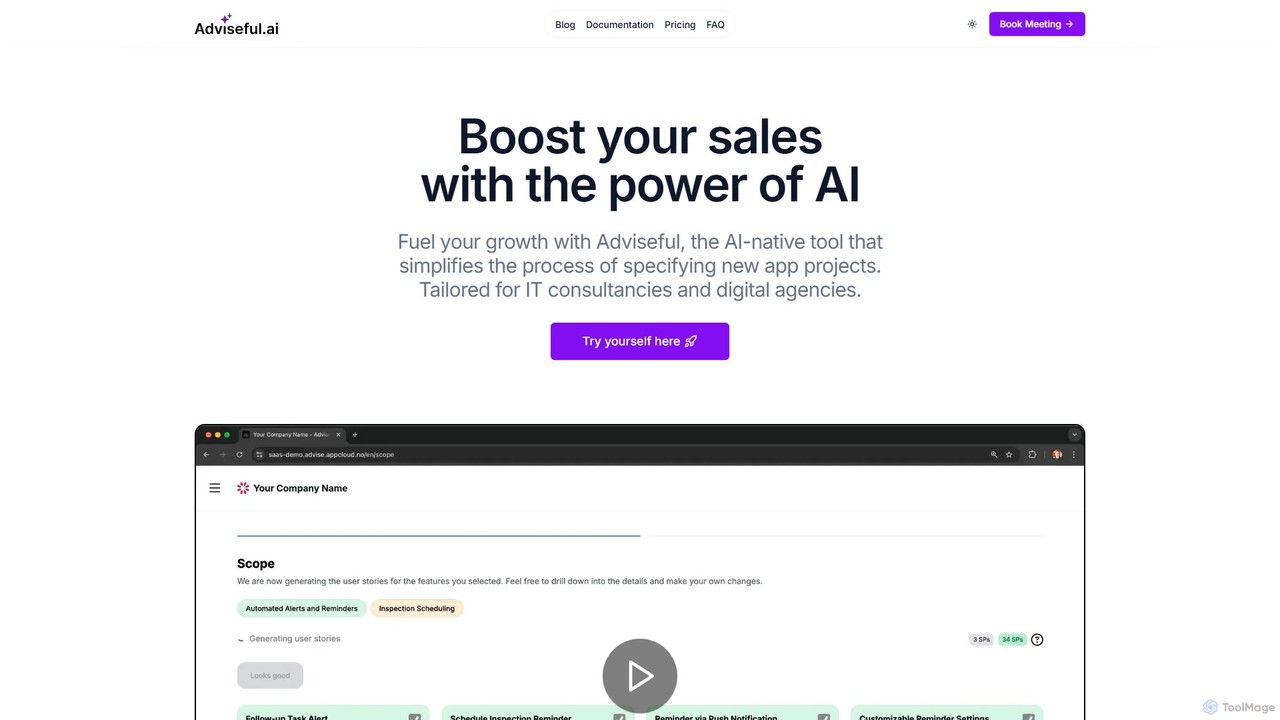
Adviseful.ai is an AI-native platform designed for IT consultancies and digital agencies to accelerate sales and lead generation. It transforms a client's initial app idea into a detailed, actionable project concept, complete with features, user stories, and a professional pitch deck in minutes. This streamlines the specification process, qualifies leads efficiently, and integrates seamlessly with major CRM systems.
About Specification
AI Specification tools are a specialized class of development software that automates the creation of detailed technical and functional requirement documents. Leveraging natural language processing (NLP), these tools analyze high-level ideas or user stories to generate structured specifications, such as SRS documents or API schemas. This process significantly reduces ambiguity, ensures consistency, and accelerates the pre-coding phase of the software development lifecycle. They act as a crucial bridge between product vision and engineering execution.
Core Features
- Requirement Elicitation: Automatically extracts and structures functional and non-functional requirements from unstructured text or conversations.
- User Story Generation: Converts feature ideas into well-formed user stories with corresponding acceptance criteria for agile development.
- API Schema Creation: Generates formal API documentation, such as OpenAPI (Swagger) specifications, from natural language descriptions.
- Consistency Analysis: Scans requirement documents to identify conflicting statements, ambiguities, or logical gaps.
- Diagram Generation: Creates visual models like UML diagrams or flowcharts based on textual descriptions of processes.
Use Cases
These tools are primarily used by product managers, business analysts, and software architects in agile environments. They are valuable for rapidly translating client briefs into detailed project scopes, formalizing feature requests into actionable user stories for sprint planning, and automating the documentation for complex APIs and microservices, ensuring clarity before development begins.
How to Choose
When selecting an AI Specification tool, consider its integration capabilities with your project management software (e.g., Jira, Trello). Evaluate the supported output formats (e.g., Markdown, PDF, Confluence) and the sophistication of its NLP model for understanding your specific domain's terminology. Also, assess its collaboration features for team reviews and feedback cycles.
SpecificationUse Cases
Automating User Story and Acceptance Criteria Generation
For agile development teams, a product owner can input a high-level feature concept, such as 'a user profile page with editable fields.' The AI Specification tool processes this request and generates a set of well-formed user stories ('As a user, I want to edit my profile information so that I can keep it up-to-date') and corresponding acceptance criteria. This automates a time-consuming task, ensures consistency, and frees up the product owner to focus on strategy.
Translating Business Requirements into Technical Specs
A business analyst receives a document outlining a new business process. Instead of manually translating this into a formal Software Requirements Specification (SRS), they feed the document into an AI tool. The tool identifies key entities, processes, and rules, then structures them into a formal SRS document. This includes functional requirements, non-functional requirements, and data models, creating a clear and unambiguous guide for the development team.
Generating API Documentation from Descriptions
A backend developer needs to create documentation for a new set of API endpoints. They provide the AI tool with a natural language description of each endpoint's function, parameters, and expected response. The tool automatically generates a complete OpenAPI (Swagger) specification file. This ensures documentation is always synchronized with the implementation and saves significant developer time that would otherwise be spent on manual documentation tasks.
Creating Detailed Project Scopes from Client Briefs
A project manager at a software agency receives a brief from a potential client. To create an accurate cost and time estimate, they use an AI Specification tool to analyze the brief. The tool extracts key features, identifies potential ambiguities, and generates a structured scope document. This document outlines the project's deliverables, assumptions, and constraints, forming a solid foundation for contract negotiation and project planning.
Ensuring Consistency in Large-Scale System Design
An enterprise architect is designing a complex system with multiple interconnected microservices. They use an AI Specification tool to manage the requirements for the entire system. The tool continuously checks for consistency in terminology, data definitions, and interface contracts across all service specifications. If a change in one service's specification impacts another, the tool flags the potential conflict, preventing integration issues later in the development cycle.
Modernizing Legacy Systems with Reverse Documentation
A development team is tasked with modernizing a legacy application that has poor or outdated documentation. They can use an AI Specification tool with code analysis capabilities to scan the existing codebase. The tool interprets the code's logic, data structures, and dependencies to generate a new, comprehensive set of technical specifications. This reverse-engineering process provides a clear blueprint for refactoring or rebuilding the system.